Tag Archives: personal stories

Stamina: The Creative Person’s Hidden Power

Middle distance runners are deep and analytical, contemplative, aware of the slightest changes in their body and mind. I ran fastest at three in the afternoon when the temperature was 88 degrees and my mind was clear. Creative people are also deep and analytical, contemplative, aware of the slightest changes in their body and mind.

I was in training for my event, the 800 meters. That workout I decided I’d run as many laps around the quarter mile athletics-229808_640(1)track as I could at three-quarters speed. After a few laps the pain I was so familiar with began gradually to set in. And the difficulty breathing. Then with each lap the pain in my legs, my arms, my chest—my entire body–became more severe, breathing even more difficult. And I thought about quitting. How easy that would be. Just step off the track and the pain would cease and I wouldn’t have to go through this anymore. I thought, “No one is making me run but myself.” The thought of stopping was very powerful and I had to fight it.

But I didn’t stop, I didn’t slow down. I increased my speed (I would show this pain) and the pain was much worse. I thought, “How long can a person endure this?” Then I thought, “I am a middle distance runner. Middle distance runners can bear pain.”

But then, after I had pushed myself as hard as I could and suffered that pain longer than I thought possible but continued to run, I passed into a new and miraculous state of being. One moment I was in agony; the next I wasn’t. I had entered a place, a garden, where pain couldn’t exist. All pain and exhaustion were lifted out of my body and I could breathe easily again. The running suddenly was smooth, effortless, and strong, my form perfect.

runner-728219_640That afternoon, one of my teammates after another quit his training and left for home. But I ran lap after lap far into the night. I had the feeling I could run forever.

That experience has become a metaphor for me. I go back to it in my mind time and again. It inspires me and I am a hard worker and have stamina.

Nobel Prize winner Saul Bellow said, “For the artist work is the main thing and always comes first.” Psychologist Howard Gardner writes about high-excelling creative people. He says, “Individuals whose stock in trade is to do things which are novel, are people who’ve got to have a pretty good command of how they work.” Some writers and artists produce 10, 15, 25 times more work than others and those most productive usually rise higher in their field and find a greater sense of accomplishment. The more work you produce the higher quality your work will tend to be because the more you do something, the better you get.

There’s a lot to be said for the benefits of prolonged, intense working spurts, for in a study of writers, writers who achieve the most are those who wrote:

…THE MOST INTENSELY

…FOR THE LONGEST AMOUNT OF TIME

…OVER THE LONGEST TIME SPAN

High achieving writers and artists, like athletes in training, exert more energy from the start of a project and work steadily without long interruptions for a much longer period than the majority of writers and artists–for days, months, lyrics-710329_640years if necessary, often producing staggering amounts of work. What enables them—what enables you– to operate continually at a higher level of stamina?

It’s excitement or necessity or both, excitement over the production of a work or the necessity of overcoming obstacles to produce it—and the habit they’ve developed of working through tiredness. Creative people will push themselves to an extreme day after day and overcome impediments when they are on fire with the excitement of creating.

But many artists and writers produce very little because they stop working at the first sign of fatigue. They’re in the habit of quitting when tired. Better to ratchet up and exert more effort then, not less. Then you acquire the ability to not tire easily, a creator’s and athlete’s major skill in itself, and your work production rises, and with it, its quality.

If you quit at the first sign of tiredness, you develop the habit you don’t want of tiring quickly and giving up. Every time you reach the point when you seem to have no energy left, yet push yourself a little further, you train yourself to draw from deeper into your energy reserves at will. If you push yourself on then—painting another hour, finishing the chapter–the tiredness gets worse, but only up to a point. Then it reaches a peak and fades away as my running pain faded. You know that from our own experience. Then you’re fired up by a sense that you can go on creating much longer than you’ve realized. Fatigue is replaced by an explosive surge.

Focus on your goal of finishing this work on your easel, on your computer screen. Let your urge to reach high levels of excellence in your craft consume you. The result will be a new freedom, new stamina, and new creative power.


© 2015 David J. Rogers

For my interview from the international teleconference with Ben Dean about Fighting to Win, click on the following link:

www.mentorcoach.com/rogershttp://www.mentorcoach.com/positive-psychology-coaching/interviews/interview-david-j-rogers/

Order Fighting to Win: Samurai Techniques for Your Work and Life eBook by David J. Rogers

Fighting to win Amazon

Click on book image to order from Amazon.com

or

http://www.barnesandnoble.com/w/fighting-to-win-samurai-techniques-for-your-work-and-life-david-rogers/1119303640?ean=2940149174379

Order Waging Business Warfare: Lessons From the Military Masters in Achieving Competitive Superiority

Waging Business Warfare812sCY9edLL._SL1500_

Click on book image to order from Amazon.com

or

http://www.barnesandnoble.com/w/waging-business-warfare-lessons-from-the-military-masters-in-achieving-competetive-superiority-revised-edition-david-rogers/1119079991?ean=2940149284030


Leave a comment

Filed under Artists, Becoming an Artist, Creativity Self-Improvement, Developing Talent, Human Potential and Achievement, Goals and Purposes, High Achievement, Inner Skills, Motivation, Personal Stories, Stamina, The Writer's Path, Work Production, Writers

Two Success Stories for Creative People

Why are so many writers and artists so scared? This morning I started reading the Weekly Digests of some of the blogs I subscribe to and decided this post I’m about to laptop-820274_640write needed to be written–and fast– because so many writers and artists seem to be living in fear and intimidation, and they needn’t. There is no reason that the processes that come after the exhilarating execution of the work—dealing with “gatekeepers”– agents and publishers, clients and galleries—need be dreadful.

The gist of many of the posts written by the more experienced writers in particular to less experienced writers is: “Here’s how to get your book published. I will be your wise guide.” I will not give you any advice like that today, but only tell you about my experiences and that of a friend in breaking into “big time” publishing. My experiences were quite different from what you find described in many intimidating blogs. I hope my experiences make you confident and sure of yourself, less fearful, and less intimidated. And bolder.

I’ll be talking about writing professionally in this post because writing professionally is what I’ve been doing—and thinking about– for the last few decades. But I’m sure there are painters, sculptors, actors, dancers—artists generally—who could tell the same story of how breaking into their field wasn’t as awful as they were told it would be, and in fact found it painless, exciting fun.

I had an idea for what I thought could be a really successful nonfiction book, just as you think your idea would make a successful book. Nothing like my book had ever been written before and it had potential, so I was confident that I had something. But I knew nothing about publishing. Oh, of course I’d heard the horror stories about the tremendous odds against getting any book published. Everybody on earth knows that—especially a first book, odds of five thousand to one and so forth.

But my exact thinking went like this: “Thousands of books are being published every year and I’m betting I’m more books-535352_640skilled than most authors of them (after all, in college a famous creative writing teacher had said teachers like her wait their “entire career for someone who can write like you.” And hadn’t I had a story published in a prestigious literary journal while just a student?) So why shouldn’t my book be published?”

Then I learned that you had to write a persuasive book proposal and get an agent who would contact editors on your behalf. I had written many, many proposals in business and so I wrote a six page double-spaced book proposal—a short proposal, not a long one, a plain, simple one, not a complex, elaborate, fancy one: short and I hoped, sweet.

I hadn’t written a sample of my writing other than the proposal itself and a cover letter that talked about my unique qualifications to write the book or a refined table of contents because I hadn’t completely fleshed out the book in my mind. (In fact, I wouldn’t know what I was really trying to write until I had been working on the book for 1300 hours. Then it hit me!) I just had this good idea for what I thought would be an exciting, profitable book someone would want to publish.

Now I needed an agent to send the proposal to. I looked at a directory of agents and sent the proposal to the first name on the agent’s list. Then if he didn’t pan out I would send the proposal to the second name on the list and work my way down. I wasn’t experienced enough to know then that some writers send their proposals out in batches to twenty or thirty agents at a time. I would send off my stuff to one agent at a time and wait to see what happened. I had no idea then that the agent I sent my little proposal to was one of the most highly regarded agents in the literary world—serendipity at work. (A reminder that a good amount of luck is involved in a writer’s life and you don’t want just any agent working for you, but a good one with a reputation above reproach whose tastes and judgment of talent editors respect very highly.)

Within three days he called me on the phone to tell me he would like to handle the book—he thought it was incredibly timely and he liked the way I wrote. And he liked short, sweet proposals. So now I had an agent. He pitched the book right away (a man of action; my kind of guy) to an editor he thought could very well be interested. And in a week and a half I had a publisher who was eager to put out the book—a top quality publisher. The advance I received was a good one, much better than I’d expected. I wrote the book in twelve grueling months as I was contracted for (be sure to establish a reputation for never exceeding a deadline) and then months passed while the book was being edited and published.

The pub date came and the book was given a promotional budget but not a big one—I was “unproven.” I appeared on a newspapers-33946_640few radio and TV shows, and then two important things happened: a freelance journalist fell in love with the book—Fighting to Win— and wrote a superb and flattering full page, multi-column piece on it in The Washington Post that drew a lot of attention, and the publisher’s sales rep in Chicago fell in love with it too and promoted it with book stores in Chicago’s large, good book-buying market and with the publisher’s other sales people working in other cities and marketing staff decision-makers. And the book became a best seller in Chicago and Washington. Then in San Francisco and Las Angeles and other cities.

Other syndicated journalists liked the book and started writing about it—articles appeared everywhere. It began popping up on college reading lists, and now there were foreign editions that were doing very well. There was a buzz about the book and I was sent off to other major cities for more interviews on bigger shows. I got to enjoying publicizing the book so much that I decided I would rather promote books than write them. In fact, the publisher asked me jokingly if I would go on shows and promote other of their books too.

I had a hit that went through ten printings. With each new printing the book’s cover price rose one dollar, so my royalties were climbing. Now I was no longer unproven and had a track record, and my proposal for my next book consisted of a total of four sentences spoken over coffee to the publisher. The advance for it was substantial. When that book was published the publisher said they would like another book from me. I asked what they wanted me to write about and they said, “Whatever you want.”

I know a man who wrote a book he thought had the potential to be published and be popular. His expectations high, he contacted a great number of agents and no one was interested in handling his book, telling him that in their judgment unfortunately it would be impossible for it to find a public. The agents’ tastes ran in other directions and based on their professional experiences over many years with many books they felt that this one just didn’t have that—that whatever it takes for people to want to buy a book.

He didn’t give up after he had exhausted his long list of agents, but contacted publisher after publisher himself, writing them, sending his manuscript, calling them up, making appointments, pitching the book on the phone and in their Being courageousoffices, expecting all the time that eventually he would succeed. He met nothing but failure—no one thought anything of the book—but he still believed in it and in himself. He still expected the book to be published and be successful. He had faith that one day he would see it in book store display windows.

Then an editor of a small specialty publisher he had contacted called him to come down and talk. When my friend entered the office his manuscript was spread out on the editor’s desk and the editor was bent over it, reading. The editor looked up and said, “Oh, good, you’re here” and with a smile on his face added, “I think your book will be the number one best seller in the country.”

That book became a publishing phenomenon—a cultural phenomenon–and sold an astonishing 25,000,000 copies in paperback alone. It became America’s—and the world’s–number one best seller. Within two months the author was famous and pretty soon he was rich. The book was When Bad Things Happen to Good People and the author was Harold Kushner.

Writers and artists who harbor deep and prolonged doubts about their capabilities are easily set back by obstacles and failures. But when confident self-directed  writers and artists encounter daunting obstacles, disappointments, and failures, they show courage, rally, and make a comeback, intensifying their efforts and persisting until they succeed.

So I’m saying what all my blogs say—be supremely confident, be non-attached and fearless. Don’t be scared. Persevere. Be indefatigable. Be committed to your work every moment of the day. Never let discouragement and negativity penetrate to your depths. No matter what happens, good fortune, bad fortune, keep your spirit light as a feather. Develop your skills to the highest possible level and become what I admire most—not just a writer, but a REAL writer; not just an artist, but a REAL artist.

© 2015 David J. Rogers

For my interview from the international teleconference with Ben Dean about Fighting to Win, click on the following link:

www.mentorcoach.com/rogershttp://www.mentorcoach.com/positive-psychology-coaching/interviews/interview-david-j-rogers/

Order Fighting to Win: Samurai Techniques for Your Work and Life eBook by David J. Rogers

Fighting to win Amazon

Click on book image to order from Amazon.com

or

http://www.barnesandnoble.com/w/fighting-to-win-samurai-techniques-for-your-work-and-life-david-rogers/1119303640?ean=2940149174379

Order Waging Business Warfare: Lessons From the Military Masters in Achieving Competitive Superiority

Waging Business Warfare812sCY9edLL._SL1500_

Click on book image to order from Amazon.com

or

http://www.barnesandnoble.com/w/waging-business-warfare-lessons-from-the-military-masters-in-achieving-competetive-superiority-revised-edition-david-rogers/1119079991?ean=2940149284030


4 Comments

Filed under Artists, Becoming an Artist, Boldness, Developing Talent, Human Potential and Achievement, Expectations, Goals and Purposes, High Achievement, Inner Skills, Motivation, Personal Stories, Publishing, Self-Confidence, Success, The Writer's Path, Writers

Programming Success in Writing and Art

Theresa

I was in a Target store café where my wife had parked me so I wouldn’t get in her way while she shopped, and the pen-994464_640woman who waited on me said, “I see you come in here and write at one of our tables. Are you a writer?” I said I was and she said, “I thought so.” She then said, “I’ve got a book in me, but I just can’t find the time to write it.” She said, “Do you ever have that problem?” And I said, “No I don’t because writing is second nature to me, but it wasn’t always.” She said, “Oh, what do you think I should do?”

Her name is Theresa, and she is an exuberant woman who bristles with energy and has dark curious eyes that are always moving. There is a sweetness about her, a kind of goodwill, innocence, openness, and charm. Her body is thin and strong, her gestures lively. She is one of those brave people who are not afraid of saying, “I need help. Will you help me?” I like her.

I want Theresa to be a writer who’s confident and strong and not to doubt herself. I want that because in writing, as in any other field, the constant, never-tiring, never-ending desire to succeed and the confidence that you will—if not now, eventually–along with skill, is the most important indicator of future success. If you have confidence and faith in yourself, you’ll reach higher levels of achievement than other writers, painters, dancers, and actors of equal ability who lack them. Confidence precedes success.

I said to her. “Do you like sentences?” and she said she did, so I knew she had something.

Programmed Activities Force Out Un-Programmed Activities

I ran into a man in a Costco dining area where my wife had parked me who also had a book in him and asked me the laptop-820274_640same thing. I’ve run into writers and artists who tell me they wish they could get themselves to work more regularly. I’ve run into so many people who tell me things like that that I can almost give my remedy in my sleep, my saying, “The main goal of all creative people is to be productive—to produce works–and if they want to produce a continuous flow of works what they need to know is that programmed activities force out un-programmed activities.” That’s the principle they need to repeat to themselves and take to heart: “Programmed activities force out un-programmed activities.” Something extremely good happens to you when that insight lodges itself in your brain. Some writers and artists are 10, 15, 25 times more productive than others. The entire existence of some creative people is organized completely around their work, and their ability to produce it is staggering.

Two and A Half Million Artists

It appears to me the “I have a book I really should write but somehow don’t seem able to get myself to write it” syndrome is a widespread major writers’ problem. Or, “One day I swear I’ll become a painter.” Your aunt is dying to write a novel and your butcher wants to paint landscapes. Ask people on a crowded city bus how many would like to be a writer or painter and 30 % will thrust their hand in the air.

Paul Pulszartti 3 (4)

Painting by Paul Pulszartti

There are 2,500, 000 people in the U.S who consider themselves some sort of artist. And probably another 3,000,000 who’d like to be one. I’d bet that not many of those who would like to be are doing a single thing to make that happen. And many of those doing nothing statistically have to be more talented and potentially more successful than many writers who write for hours every day and painters who paint every day. There may be two or three Jackson Pollocks or Ernest Hemingways in Idaho or Maine who can’t get started.

It isn’t enough to say you’ll go running to improve your health. If you’re really serious you’ll intelligently plan and program your running. You’ll decide how often you’ll run, when you will, where you will, with whom you will, and how far you will. Then you’ll run according to your plan, and your health will improve.

If you’re serious about achieving greater artistic success, you’ll program that too. You’ll say, “I am a person bursting with unrealized potential,” and then you will intelligently develop an improvement plan and plan step 1, then step 2, and then 3, and so on—the steps being rungs of a creative ladder leading you to high skill, success, and satisfaction. Then you’ll stick to your plan and work hard as all real creative people do, and if everything goes according to the plan—and there’s no reason it shouldn’t–you’ll become more skilled, more successful, and more content.

Learning How To Excel and Plateauing

Another problem is learning how to excel. How many writers or artists would ever say, “My goal is to be mediocre” but yet are satisfied to be mediocre. Your climb to excellence has to be attended to. After looking for a long time into what runner-942109_640brings creative success I’ve come to the conclusion that to excel as a writer or artist or to excel in any occupation of any kind and have a long and fulfilling career, you must be pursuing intelligently a small number of certain types of goals. And each goal must be ambitious and each must be concrete because most artists and writers aim much too low and their goals are vague, and vague goals are useless.

Another major problem you see everywhere is plateauing—never getting better but staying at the same skill level and not having increasingly greater success, which you would think would not happen if you’re really learning. So possibly you’re not learning and don’t know any more about how to write or paint and how to motivate yourself and have self-confidence than you did five years ago. You’re working extremely hard, but you’re not progressing. You might be making the same mistakes over and over. You’ve stopped growing.

Something must be done—you need new inputs, new information, new insights, and new work habits. So you must become an athlete of the arts, a champion of writing or painting, and train yourself to run faster and jump higher.

The way to master a creator’s skills is to learn how to do them supremely well and practice them ten times, a hundred times, a thousand, getting constructive feedback along the way, making corrections, and experiencing a series of successes as your performance improves. Most often the reason a writer or artist is not yet accomplished is not because she’s unintelligent or not talented but because she isn’t knowledgeable enough yet of her craft.

Not Screwing Around Anymore

Theresa and the Costco man tell me they want very badly to be as excellent writers as they can be, and I believe them. Chances are you and I have never met and haven’t had a chance to talk, and it would be nice if someday we do. But I’m assuming that you’ve reached a state of being when you can say, “I want very much to be the most highly skilled, successful, and satisfied writer or artist I can be. That’s what I think about and that’s why I’m reading this blog. I’m not screwing around anymore.”

Theresa’s Programmed Activity

But many writers and artists—even those who claim that work is tremendously important to them–are lucky if they slice out an hour a day, or thirty minutes, one-forty-eighth of a day, to work on their craft. Creating isn’t all you do. You goal-976853_640have other important roles and responsibilities you must find ways of incorporating into your work schedule as depicted in this comment from writer Lois Duncan:

“Now I keep a typewriter with a sheet of paper in it on the end of the kitchen table. When I have a five-minute lull and the children are playing quietly I sit down and knock out a paragraph. I have learned that I can write, if necessary, with a TV blaring on one side of me and a child banging a toy piano on the other. I have even typed out a story with a colicky baby draped across my lap. It is not ideal—but it is possible.”

Expert writers and artists almost always structure their work time and environment carefully. I told Theresa that she had to commit to me that she would write thirty minutes every day without exception except for real emergencies—could she do that? Yes, she said, she could. I asked her the time she would write: “First thing before I go to work. I’ll get up a half hour early, shower, get dressed, and then I’ll sit down and write for a half hour.”

I thought of author Hope Dahle Jordan who said, “My personal, elementary rule sounds ludicrous even to me. Nevertheless, I am deadly serious when I insist it is the only one I conscientiously adhere to: I don’t dress for the day until two pages (500 words) are written, and acceptable to me. That is the only way I get a book finished. For as long as I stay in my blue bathrobe I stay at my typewriter.” Harry Crews said, “ I get up in the morning, that’s one of the hard parts, drag myself over to the old typewriter and sit down—that’s even harder—and then tell the Lord, ‘I ain’t greedy Lord, give me the next 500 words.’”

I told her that like artists, writers must guard again a two-pronged problem: avoiding work and quitting too soon.

I told Theresa not to be jealous of writers who have the luxury of being able to write as often as they want and as many minutes or hours as they want. I told her that doesn’t mean they’re the most productive writers or artists or that they’re writing-828911_640productive at all. It just means that the amount of time most writers and artists would give an arm and a leg to have is available to them. But I assured her that she would find that a focused half-hour’s work with a concrete goal clearly in mind is the equivalent of three unfocused hours.

I told Theresa that later on we can talk about how in addition to spending time writing she can increase her writing skills in other ways. In the future we will set goals to increase her abilities. And I told her one day we will talk about the Inner Skills of writers and artists, such as the need for courage, and that she should be completely indifferent to everything but the quality of her work.

I told her, “If you want to be read widely, read widely. Reading good writing with the intention of learning specific lessons from it is the best way to learn to write well. Good artists learn by going to museums, taking out a sketch pad, and copying masterpieces. To be able to say, ‘I learned that from so-and-so and borrowed that from what’s-her-name.’” Theresa should also learn about the way of life of a writer, which is different from a social worker’s way of life or a businessman’s or even a painter’s.

Then I said I wanted Theresa to jot down in a log a few quick sentences about each day’s writing: how it went, what journal-155431_640problems she had and how she solved them, and most important, what she’s learning about writing and about herself. What comes easily for her; what is hard? Writers and artists who set ambitious goals and keep records of their performance are considerably more effective than writers and artists who don’t.

I asked Theresa to have a very specific goal in mind whenever she sits down to work: what is she aiming to accomplish in the next half hour, the way a painter says, “By the time I finish today I will have finished the upper right corner of the canvas.” I told her that now that she’ll be getting up a half hour early she should go to bed a half hour earlier because when you’re tired you’re not ambitious and your writing or art goals won’t be ambitious either.

Talent and Many Truths to Tell

I feel that Theresa has a talent for writing because it has been said by those who study the development of high expertise that if you have an intense interest in a creative field, that is almost always a sure sign that you have a talent for it. I have faith in Theresa. When I think about her, I think about writer Louise Nevelson’s theory that “when we come on this earth, many of us are ready-made. Some of us—most of us—have genes that are ready for certain performances. Nature gives you these gifts…There’s nobody that’s common. I think that in every human being there is greatness.”

I tell her not be afraid to be bold and that truth is everything in art, and that when readers open her books one day they will ask themselves, “Am I going to find the truth in here?”

I don’t think she will become a writer who doesn’t write or who will give up before she succeeds. I have a sense that she may have the makings of a REAL writer and that writing may become an essential part of her identity. I hope she soon sees that a writer’s life is wonderful and worth sacrificing for: “I did not choose this vocation, and if I had any say in the matter, I would not have chosen it…Yet for this vocation I was and am willing to live and die, and I consider very few other things of the slightest importance” (Katherine Anne Porter). I tell her that nothing can compare with, nothing can replace the joy during the act of creating. American poet Robert Frost said that once a man has known the pleasure of making a metaphor he is unfit for ordinary work.

sunrise-580379_640At the crack of dawn almost every day Theresa is writing. Writing is becoming second nature to her. Her book is taking shape day by day. My wife is shopping over there and I’m at a table in Theresa’s store now and I’m thinking that if I’m right about Theresa soon the creator’s hunger to produce will take over and she will start writing during her breaks and lunch hours too.


© 2015 David J. Rogers

For my interview from the international teleconference with Ben Dean about Fighting to Win, click on the following link:

www.mentorcoach.com/rogershttp://www.mentorcoach.com/positive-psychology-coaching/interviews/interview-david-j-rogers/

Order Fighting to Win: Samurai Techniques for Your Work and Life eBook by David J. Rogers

Fighting to win Amazon

Click on book image to order from Amazon.com

or

http://www.barnesandnoble.com/w/fighting-to-win-samurai-techniques-for-your-work-and-life-david-rogers/1119303640?ean=2940149174379

Order Waging Business Warfare: Lessons From the Military Masters in Achieving Competitive Superiority

Waging Business Warfare812sCY9edLL._SL1500_

Click on book image to order from Amazon.com

or

http://www.barnesandnoble.com/w/waging-business-warfare-lessons-from-the-military-masters-in-achieving-competetive-superiority-revised-edition-david-rogers/1119079991?ean=2940149284030

10 Comments

Filed under Artists, Becoming an Artist, Creativity Self-Improvement, Developing Talent, Human Potential and Achievement, Goals and Purposes, High Achievement, Inner Skills, Motivation, Personal Stories, Programmed Activity, Self-Confidence, Self-Direction, Success, The Writer's Path, Work Production, Writers

Feedback and Help for Creative Success

Without doubt, performance feedback and creative success go hand in hand. Useful feedback can help you evolve and reach high levels of satisfaction and achievement. But where are you to find the quality of feedback and help you need? Deprived of it, some artists and writers quit before they reach their peak. They bid their beloved craft adieu.

Something, for example, has gone out of publishing. Something is missing. No longer can you find the publisher’s textual editors who once existed who would work tirelessly with you, the author, suffer with you, and use their specialized skills to help you create the best you’re capable of. Creators are rare and exceptional human beings who are able to work alone in seclusion long hours without recognition, without praise, sacrificing, overcoming hardships without flinching, always returning with high energy to the work which they have a talent for. For a writer or artist who by necessity spends so much time alone, the insights of a close collaborator who cares as much about your work as you do can be a godsend.

hands-545394_640In a novel I wrote an episode in which a New York publisher’s editor came out here to the Midwest to spend a week in a cabin at a lake working intensely with a promising writer. I wrote this episode knowing very well that an actual editor would say, “Well, such a thing is simply not conceivable.” But I thought how wonderful if it were. I enjoyed writing that episode more than any other.

Maxwell Perkins was the most acclaimed book editor of the twentieth century and thus far in the twenty-first. During the 1920s and 30s his Scribner’s writers included the greatest and most gifted working with one editor in the history of American publishing. They included, in addition to his protégé Thomas Wolfe, Ernest Hemingway, F. Scott Fitzgerald, and Ring Lardner. Wolfe’s association with Perkins is the most celebrated author/editor relationship in American literature.

The day before Christmas, 1929 Wolfe wrote to Perkins: “One year ago I had little hope for my work, and I did not know you…. You are now mixed with my book in such a way that I can never separate the two of you. I can no longer think clearly of the time I wrote it, but rather of the time when you first talked to me about it, and when you worked upon it….You have done what I had ceased to believe that one person could do for another–you have created liberty and hope for me.” Wolfe wrote a note to Perkins: “In all my life, until I met you, I never had a friend.” Wolfe described Perkins as “a man of immense and patient wisdom and gentle but unyielding fortitude.”

Wolfe was immensely talented, but his main problems were his uncontrollable, obsessive verbosity and a chronic inability to cut that resulted in unedited manuscripts of fantastic lengths, three or four times longer than a publishable book could possibly be. Those problems in turn were caused by Wolfe’s difficulty making any kind of independent decisions. He didn’t know where or what to cut. He would stare for hours at the manuscript before eliminating a few sentences when his agreement with Perkins was that he would strike out tens of thousands–a hundred thousand—words. He would start by rereading the manuscript section by section, trying to find things that were unnecessary and could be omitted. But he was totally blind to them. He never in his entire career had a concept of a publishable book.

I am certainly no Thomas Wolfe, but my wife Diana is my Maxwell Perkins. She has been a highly-regarded writing teacher, tutor, and mentor for years, and I doubt her judgment and skill can be surpassed. She edits all my work, and over the years I’ve been prolific—well over a million words–and she’s been busy. I—we—have had published best-selling nonfiction, as well as fiction and poetry, many magazine and newspaper articles, and this blog.

But she is far more than a conventional editor, and in this post I’m holding her up as an ideal, one the likes of which every writer and artist should find, hold onto, and treasure. I heard a psychiatrist say, “Everyone could benefit from a therapist.” And every writer and artist could benefit from knowledgeable, frank criticism—sympathetic criticism of course, not thoughtless and cruel criticism. When tough, street-smart novelist Henry Miller found himself being abused by editor after editor he submitted work to, he snarled, “Who are these shits? Where do they get off saying such things to me?” If you are to survive in the arts, as in life, you must never be intimidated by anyone. I think the greats were all bold, all brave.

Diana and I have developed a harmonious division of labor. I create. She evaluates. I respect her talents and she respects mine. They are different talents, but are aimed at the same object: the quality of the work. I’m aware that she will be my first and most demanding audience. I’m always eager to hear what she has to say because her opinions will help me improve. And isn’t to improve, transforming a gift into an achievement, what every creative person wants most?

ernest-hemingway-401493_640The most important criticism a seasoned writer or artist receives is self-criticism. The standards of good writing, painting, or dancing, etc., are now a part of the writer or artist’s makeup. Yet, a creative person of any level of ability should ask, “Am I getting honest feedback regularly also from someone else whose judgment I trust? Have I made arrangements to do that? Am I receptive to constructive criticism? Am I confident enough for it? Can I be dispassionate about it? Can I be non-attached?”

We all wish to be lavished with praise for every work we produce. John Irving said that “Good job” is the only feedback a writer wants. But it’s much more beneficial to have a wife or friend or coach, editor, teacher, writer’s or artist’s group, etc. who’ll point out flaws and shortcomings before the work reaches agents, publishers, newspaper reviewers, and the final judge—the audience.

Some writers and artists and people in every other profession would prefer to not know how well or poorly they’re doing. Others very much want to know if knowledgeable people they trust think they’re doing okay, and possibly more importantly, if they’re doing poorly, and if they are, in what areas they might improve. They welcome feedback and actively seek it, feedback that is (1) timely, (2) specific, (3) well-meaning, and (4) helpful.

Ernest Hemingway, for example, didn’t become the most innovative literary stylist of the last 100 years without incorporating into his work the advice of his newspaper editors, and fellow writers Sherwood Anderson, Ezra Pound, Gertrude Stein, and F. Scott Fitzgerald who were generous enough to share their expertise with him

Diana advises me, consults with me, inspires me, encourages me, and criticizes every facet of my work—objectively I believe, and always fairly. She is not easy on me, but pushes me. Well, not “pushes.” Pushing isn’t in her nature. But from her commitment I feel myself gaining energy. She is to me what a real editor should be, though I know how trying writers can be. (I once called my publisher’s editor and she sounded demoralized. So I said, “What’s wrong, Kathy?” She said, “Oh, I just had an hour-long argument with one of my authors about a comma.”)

vincent-van-gogh-self-portrait-1887Many creative people benefit from close personal support and encouragement from one other person such as a lover, husband or wife, sibling, or close friend: Frederick Chopin/George Sand, Jackson Pollock/Lee Krasner, Jean Paul Sartre/Simone De Beauvoir, Henry Miller/Anais Nin, Vincent van Gogh/Theo van Gogh, Virginia Woolf/Leonard Woolf, Salvador Dali/Gala, and George Gershwin/Ira Gershwin.

It may not be the oddest phenomenon, but it is something of a phenomenon that as soon as a creator is in his judgment finished with a work, he immediately loses interest in it. He wants to go on to something else. A study found that professional writers couldn’t remember what they had just written. But amateurs could remember very clearly exactly what they had written. And writers, like artists, are often working on 3, 5, or 10 projects simultaneously, moving restlessly from one to another as the mood strikes. While at times I’ve forgotten about whole projects I’ve got going, Diana somehow remembers. She will say, “Whatever happened to…?”

I might work on a piece for a long time, turning down invitations to go to movies, visit friends, or take vacations. Poet John Milton said some people—like me–“scorn delights to live laborious lives.” But when I can say, “That’s it,” well, that’s it. It’s all done. Something shuts off. All responsibility for it disappears. My mind elsewhere now, I might say flippantly, “Well you take care of it from here. Just mop it up.” And Diana will say, “Oh, no, you’re the writer, not me. I won’t make a change without your approval. So let’s get going. Why in the fourth sentence do you say…?”

Diana doesn’t usually suggest subjects I should write about. I develop my own ideas. But once she gave me a subject and it will give you an idea of how we work. I’d never really written anything significant about the death of my sister Sharon who was very dear to me. Diana said I should. I wrote what I thought was a good piece and gave it to her. She didn’t like it. I said, “It’s perfectly fine. I’m done with it. I’m not doing anything more.” Her words in reply were “It is not up to your standards.” I liked the implication that I had high standards, and in the back of my mind I knew I wasn’t satisfied with it either. I redid it seven or eight times. It became “Days End.” When it was done, a critic said, “This is not just writing. This is literature.” If it is, it wouldn’t have been without Diana so persuasively prodding me.

I’ve learned more of what they call “classical restraint” from Diana. That that style appeals to her is not coincidental. It suits her. She is dignified and calm—classically restrained. Her favorite word in the English language is equanimity—composure, level-headedness. A writer’s most effective writing mood is important, and every writer has to find his/her own, just as painters and sculptors, etc., must find their most productive working mood.

Diana is able to find in my writing what I may not see. I asked her to go over some fiction of mine. As she read she stopped abruptly and said, “Hmmm, this passage right here is a poem.” She said, “Just read it. These lines here. It’s a really nice poem just as it is.” I put it verbatim in poem form without changing a word and it was published and won a contest. I hadn’t noticed my poem among the prose.

I’m currently writing a book that I believe has something original to say to writers who wish to achieve their writing goals, including becoming a higher quality writer and being successful in other ways too. I don’t let Diana or anyone else read anything I’m working on until in my judgment it’s pretty much done. I never tell anyone exactly what I’m doing. But she knows something about the book and the other day let slip the comment, “You should really make it applicable not just to writers, but to artists and actors, and so on.”

I’ve tried, but for the life of me I cannot get that sentence out of my mind. I wonder, “Should I do what she suggests? It would take more time, more work. It wouldn’t be easy, it would be tough. There are a hundred reason why I shouldn’t do it.”

But damned if I don’t have a hunch that once again she’s right.


© 2015 David J. Rogers

For my interview from the international teleconference with Ben Dean about Fighting to Win, click on the following link:

www.mentorcoach.com/rogershttp://www.mentorcoach.com/positive-psychology-coaching/interviews/interview-david-j-rogers/

Order Fighting to Win: Samurai Techniques for Your Work and Life eBook by David J. Rogers

Fighting to win Amazon

Click on book image to order from Amazon.com

or

http://www.barnesandnoble.com/w/fighting-to-win-samurai-techniques-for-your-work-and-life-david-rogers/1119303640?ean=2940149174379

Order Waging Business Warfare: Lessons From the Military Masters in Achieving Competitive Superiority

Waging Business Warfare812sCY9edLL._SL1500_

Click on book image to order from Amazon.com

or

http://www.barnesandnoble.com/w/waging-business-warfare-lessons-from-the-military-masters-in-achieving-competetive-superiority-revised-edition-david-rogers/1119079991?ean=2940149284030

14 Comments

Filed under Artistic Relationships, Artists, Creativity Self-Improvement, Developing Talent, Human Potential and Achievement, Editor, Feedback, Goals and Purposes, High Achievement, Personal Stories, Success, The Writer's Path, Thomas Wolfe, Work Production, Writers

Advice to Young Writers

I was asked by an administrator of a middle school in my county (grades seven and eight) if I would speak at their Career Day. Adults from about 50 careers from soldiering to farming would speak that day about their careers for twenty minutes each to five classes of students thirteen and fourteen years old. I would be the writer. I was told by a very sincere and enthusiastic woman that it would be fun and rewarding. My first thought, as would be the first classroom-510228_640thought of any conscientious writer, was, “It would mean giving up an entire day of writing,” so I said I’d have to think it over. My wife is a writing teacher/tutor of some reputation, so she said what I knew she would: “You should really do it, you know,” and of course I knew I should—it’s important to nurture the young—I know that. (I have two adult sons who write and I nurtured them, didn’t I?)–and if your wife’s tone says, “How can you not think of doing it; what kind of man are you?”–the issue is more or less settled. So I did research and wrote notes (sacrificing another half day), and rehearsed my talk (another two hours), and a few weeks later appeared at Career Day.

I opened by asking if they knew what the author of a book means by royalties, and they knew. I talked about “The opportunities available for a person who wants to make a living writing” and gave them figures on writer’s incomes and the demand for writers, telling them that opportunities are good and that there are writers who own private jets and others who have a hard time making a living, and that the quality of the actual writing sometimes (but not always) has an inverse relationship to the income—writers of trash who own the jets and authors of masterpieces who have the tough times. (At the same time Nobel Prize novelist William Faulkner’s picture appeared on the cover of Time magazine, he couldn’t afford to pay his electric bill, while every atrociously written (but exciting) thing Mickey Spillane wrote about his rugged gumshoe Mike Hammer topped the best seller lists). But that statistically, on average, professional writers, including freelancers, can make a decent living. They didn’t have much faith in statistics and wanted to know how much dough I made.

Even the students who were not especially interested in becoming writers were kind of curious because the life of a writer is romantic to most people, including the young. When I was a boy planning on being a writer, I thought all male novelists—the only kind of writer I thought at the time a man should be—wore cool green corduroy sport coats with leather patches on the elbows, were automatically remarkably handsome, and beautiful women with long legs and dangling earrings that glittered thought them uncommonly sensual, and couldn’t help themselves, and fell in love with them right and left. Popular novelist of the fifties John O’Hara wrote, “How nice, people say, to be a writer and be your own boss, work when you please and don’t have to punch a time clock, knock off whenever you feel like it, and go to Sun Valley or Hobe Sound or Placid or Bermuda” and later said, “I’m afraid that one illusion is responsible for more brief writing careers than any other single factor.” But I told them Flaubert, who sweated and moaned over every word and comma, said “It is a delicious thing to write.”

hand-299675_640(1)They found it appealing that if you write at home, as many writers do, you have tremendous freedom, can break for lunch whenever you want,( but, I cautioned, need equally tremendous discipline so as not to slough off and miss deadlines and get editors furious with you), and can work in your underwear if you’re in an underwear sort of mood. And if you’re a man, since you’re not planning to see anyone, you don’t have to shave every day if you’re not inclined to, which the average nine-to-five man would give an arm and a leg not to have to do.

They asked was I famous, and that gave me a chance to tell my famous story. Someone in a Canada was trying to get hold of me and didn’t have my phone number, but knew I lived in Chicago, a city of three and a half million. So they called Chicago Directory Assistance and asked for the number of David J. Rogers. Now there are scores of David J, Rogers in Chicago. Rogers is the seventeenth most common name in the U.S. But without a moment’s hesitation the operator said casually, “You must mean the author” and put them right through to me. The Canadian said to me, “Wow, you must really be famous” and I thought, “Somewhere here in this city is at least one operator who read my book.”

Then we got into:

What the life of a professional writer is like; what a professional writer is like

What a professional writer does

The skills and abilities a writer needs

How a writer prepares for a writing career

I told them that “all writers take pride in their writing and are always trying to get better. It’s important to them to improve and that happens the more you write and the more you study how to write. Making it a point to improve your writing all the time is important. Ask yourself today, “Am I improving,” and tomorrow and the next day ask, “Am I improving?” You are learning how to write here and will in high school and college, if you choose to go there. There are many books and magazines and web sites about how to get better. Just try to get better and better and learn as much as you can about writing. Many famous writers were more or less self-made and pretty much self-taught. Good writers are reading and learning all the time because who knows what they might have to write about? Writers are craftsman. Words and language are their tools—the sounds of language, the rhythms of language, the meanings. Words are at the center of a writer’s existence. Writers have the strongest appreciation of words, the largest vocabularies, and a highly sensitive ear for speech. Build up your vocabulary every day. not to impress people—who cares about that–but because the more words you know, the more you can express, and a goal of a good writer is to be able to express anything he/she has ever experienced or can imagine.”

When I was in business I hired only English majors not business majors because English majors can express themselves and they can also think clearly. If you can’t think clearly, you can’t write clearly. To me, clarity is the most important thing. And I believe it is to the reader too.”

“Also, you’d better like working alone in solitude at least a few hours every day. If you like working with other people go into sales or acting.”

The day ended. I was exhausted. I thought, “How do teachers do it?”

A Writer’s Cork Board of Inspiration

A girl named Hannah in one of the classes whose ambition was to be a writer sent me some quotes by writers about Girl writingwriting (she could tell I loved writer’s quotes), and I sent her a letter thanking her. She wrote me another letter thanking me for what I had said in my letter. I had merely asked her what kind of writer she would be: “Will you be writing novels?” She wrote: “I really enjoyed writing those quotes and I’m glad you like them. It’s really inspiring to hear them and think how true they are. The quotes, along with the letter I have received from you are going on my cork board of inspiration. I’ll have it in front of my desk to motivate me and spark my imagination.”

What had happened I could see was that I had taken her seriously–possibly in a way no one else had yet–and given her a vote of confidence. I just assumed that what she wanted to have happen would in fact happen: sure as I’d followed the writer’s path, one day she would follow it—and in fact was already following it. I was acknowledging that, and that acknowledgement in that one sentence of my letter—“Will you be writing novels?”—would be on her cork board of inspiration and would be there for her to see and gain encouragement from every day. How glorious that made me feel.

Who knows what treasures one day Hannah will write?

© 2015 David J. Rogers

For my interview from the international teleconference with Ben Dean about Fighting to Win, click on the following link:

www.mentorcoach.com/rogershttp://www.mentorcoach.com/positive-psychology-coaching/interviews/interview-david-j-rogers/

Order Fighting to Win: Samurai Techniques for Your Work and Life eBook by David J. Rogers

Fighting to win Amazon

Click on book image to order from Amazon.com

or

http://www.barnesandnoble.com/w/fighting-to-win-samurai-techniques-for-your-work-and-life-david-rogers/1119303640?ean=2940149174379

Order Waging Business Warfare: Lessons From the Military Masters in Achieving Competitive Superiority

Waging Business Warfare812sCY9edLL._SL1500_

Click on book image to order from Amazon.com

or

http://www.barnesandnoble.com/w/waging-business-warfare-lessons-from-the-military-masters-in-achieving-competetive-superiority-revised-edition-david-rogers/1119079991?ean=2940149284030


9 Comments

Filed under Becoming an Artist, Creativity Self-Improvement, Developing Talent, Human Potential and Achievement, Expectations, Goals and Purposes, Inspiring Young People, Motivation, Personal Stories, The Writer's Path, Writers

Writer and Artist Warriors

sunset-190922_640My younger sister Sharon died of bone cancer at the age of thirty-seven in a hospital in Honolulu, where she lived. She was a small, delicate woman who had the will of a warrior. When a doctor came to see her as she lay in her bed, he jumped back as though he had been pushed. He said to her, “I feel your power coming out to me.” But she was dying. There was no hope. Once she had been beautiful. I prayed, “Dear God, give me her pain so she will be free of it.”

I told her that I’d had writing a book in mind for a long time, but that I was very busy running the business I had started and really had no time, and that even if I did write it, it would take years to research and more years to write, and I wasn’t sure it would ever be published—the odds were against that as they are against any book being published–and I had a wife and four children to support and couldn’t afford to take a chance. And I was afraid I wouldn’t succeed, that I didn’t have what it took. But I didn’t tell her that.

She was in such pain that even the slightest, even the lightest, touch of another person on her was agony. So when I left to fly back home, knowing I would never see her again, I couldn’t kiss her. The pressure of my lips would bring her pain. I leaned over her and rested my head next to hers on the pillow. She whispered in my ear, “Dave, you write that book. I have faith in you. Write it for me.”

I returned home and organized my work space and set to work, thinking of her “Write it for me.” I told my wife, “I’ll close the business and I’ll finish the book in one year, and during that year we will have no income.” My wife said, “I understand. Go ahead. It’s important.” Nothing could stop me. What before had been a vague dream now became a purpose to devote myself to, to write a book, a good book for my little sister. It became my wife’s purpose and my children’s too. Whenever I was discouraged that purpose made me return to the book and to work till dawn, to sleep a few hours and get back to work for a year until the book was done. While I was working on it I thought, “I’m making a book Sharon would be proud of.”

I dedicated it to her with the inscription: “In memory of my sister Sharon. Just one word—courage,” and that word meant a lot to me because in this life everyday courage is so important.

Fighting to win Amazon

My book Fighting to Win: Samurai Techniques for Your Work and Life came out and has been called “an underground bestseller” because with almost no advertising it swept the country and my life was changed in so many ways. The book became known in my family as FTW. It went through multiple printings, and appeared on bestseller lists; the cover price rose and rose. FTW discussion groups took shape in big cities and remote towns in America and Europe. Articles about this strange book with the Japanese symbol “spirit” on its cover appeared in scholarly journals and popular magazines alike. The book was read by generals, governors, and dancers, writers, artists, and riveters, heart surgeons, business executives, retirees, and sales clerks. It began being included on university required reading lists. It was not about Anthropology, Physics, or Botany, but about how to live. This little book is about musha-shugyo, “training in warriorship.” It teaches the skills and passes on the insights of samurai warriors adapted to everyday life.

It is an optimistic and encouraging book. That’s how I intended it. It is full of promise, full of hope. It teaches strength and makes you strong. It says we have but one life, but this one life can be changed in an instant. It can become two lives. The life before the changes and the richer, more fulfilled and stunning life after them. We can renew ourselves and start fresh at will on a new creative course, a more fruitful course, a better course any moment we wish, putting aside disappointments, discouragements, false starts, and failures and emerging as full-blown, skilled, exceptional artists or writers. Every living thing, every artist, every writer, has an urge to grow, to realize its full potential. My life tells me that. I believe it more every day.

Warrior symbol

“Warrior” by tiseb

The book teaches us to persevere, to be brave and not hide from difficulties, but to race forward to meet them so we may overcome them all the more quickly, maintaining high spirits and complete faith in ourselves. It teaches that we must never be stationary, but must be always moving at a good clip toward a better life, never slowing down because we’re too lazy, or afraid, or self-doubting, or discouraged, or have been set back by circumstances. “When you meet calamities and rough situations, it isn’t enough simply to say you’re not flustered. Whenever you meet difficult situations dash forward bravely and joyfully.”

Readers started contacting me, and I was happy to get to know them and listen to the stories they told me. In the revised E-book edition I mention a few of their stories.

A Hollywood movie director called me and said he felt that people in that aggressive film industry had been “eating him alive.” A successful opera singer wrote me and told me she had been overwhelmed by a sudden and inexplicable fear of performing. She felt helpless. She didn’t know what to do and stopped singing. They read FTW. He became more assertive, self-confident, and successful; she overcame her fear and went back on stage and resumed her career.

A newspaper was having serious financial problems. Its existence was in jeopardy. And so the publisher was going to launch a five-day intense telephone subscription sales campaign using 100 sales people. The publisher, who was also a playwright, was confident that exposure to FTW ideas would inspire them, and had me speak to them for an hour. Following the campaign, he called me and said that the campaign had been a huge success–the staff was fired up and the result was thousands of new subscriptions. He said, “You and FTW saved the paper.”

The book teaches us the samurai concept of mo chih ch’u, “going ahead without hesitation.” It’s not looking back once you have decided on your course of action. Once you can say to yourself “This is what I want to do”—“Write the novel I’ve been talking about so long;” “Rent a studio;” “Move”– then be on your way immediately, mo chih ch ’u. Why delay when life is so brief and the most important time of your entire life is this present moment?

I shouldn’t have to ask where you intend to go in your career. I should be able to tell by watching you and hearing and reading about you. Your undeviating aim should be to reach the fulfillment of the creator’s life you can envision, letting no impediments keep you from it. You know that in this life you’ve chosen rather than the other 5,000 easier lives you could have chosen, courage is a necessity, that there really is nothing to be afraid of and no reason to hold anything back in reserve, and that the whole secret of existence is to have no fear. Getting closer each day to a more fulfilled creator’s life, becoming extraordinary, your energy and strength will be boundless. Others will let go of their dreams, but you never will. You’ll draw from deeper inside and be willing to exhaust yourself for the sake of your happiness.

You must never lose the expectation that no matter what, you will succeed. Your art will work out. Your book will be published. Your skills will get better and better, equipping you for your craft in ways you haven’t dreamed of yet. Knocked down, maintain your confidence that all will go well as long as you get up. Knocked down seven times, get up eight. For that is how a better creator’s life is reached. Like a warrior, you must only “take care that your spirit is never broken.” Never let disappointment and discouragement “penetrate to the depths.” “Wear your existence light as a feather.”

The samurai warrior spoke of internal “dragons” and “striking through the dragon’s mask.” The samurai was taught what we should take to heart: “When all psychological blocks are removed the swordsman will move without conscious effort.” When your blocks are removed you will write, paint, sculpt, or perform without conscious effort. “Success will always come if your heart is without disturbance.”The meaning of all things is within, in your mind, not something that exists ‘out there.’” After reading the book people ask themselves, or ask their friends, “What is holding me back? What are my dragons? How can I overcome them?”

dragon-149393_150Ask any small child what a dragon is and you’ll get an earful of terror and horror. You and I both believed in fire-breathing dragons until we discovered that the only place they existed was in our minds, that they were merely products of our imagination. They only “lived” and had the power to frighten us because we granted them license to. They died and no longer troubled us when we revoked their license. All obstacles inside us—in our minds–are dragons. They are no longer of the fire-breathing variety. They are now a different species entirely. But the effect of scaring us and making us draw back in horror is precisely the same. The goal of the warrior writer and artist is to strike through dragon’s masks and free himself/herself of obstacles so the mind is “free to function according to its own true nature.”

The five most powerful dragons samurai—there were women samurai too–were trained to strike through, and artists, writers and performers must train themselves to strike through, are any kind of fear, the fear of taking risks, thinking too much of what might go wrong, doubting yourself, and hesitating, particularly when that golden but fleeting opportunity appears. If the samurai was afraid, didn’t take risks, thought too much, doubted himself, or hesitated, he would lose—possibly his life–because of fear most of all. A creative person must be bold; fear cripples her: “Fear is the true enemy, the only enemy. Overcome fear and nothing can stop you.”

The one constant factor in warfare as well as a writer’s and artist’s life is uncertainty. Half the things you try to accomplish are obscured by it. Risk and danger and fear and self-doubt are always partners. You do not go into the arts if you want a secure, uneventful life of ease. In samurai swordsmanship there is a move that requires you to take two leaping steps forward and to come within a hairsbreadth of your opponent’s sword. It is not a difficult move and can bring quick and total victory, but it is rarely used. Why? Because taking the risk of coming so close to the foes blade terrifies most swordsmen. In a creator’s life, as with that sword move, it is only by edging yourself in close to danger and living more dangerously that you approach great success. Who are those artists and writers who are least satisfied with their lives? Precisely those gloomy writers and artists—and actors and dancers– who regret, now when it’s too late, being timid and playing it safe all their lives.

bird-226700_640As an artist or writer, you must have an immovable mind—a mind totally committed to facing with calmness and composure any fate, circumstance, or challenge a creator’s life throws at you. An artist’s or writer’s life is often filled with troubles. But you must never let them disable you: “Forget about death, forget about the enemy, forget about yourself, keep your thoughts motionless.” Then you will “flow with whatever may happen.” Then your craft will blossom and you will reach your destiny.

Unless you have mastered your mind and body, you cannot beat your enemies on the battlefield.” Take up one idea. Make that idea your life, recalling,  “No matter what it is, there is no hardship you can’t overcome.” Like a warrior “When crossing marshes, your only concern should be to get over them quickly.”

© 2015 David J. Rogers

For my interview from the international teleconference with Ben Dean about Fighting to Win, click on the following link:

www.mentorcoach.com/rogershttp://www.mentorcoach.com/positive-psychology-coaching/interviews/interview-david-j-rogers/

Order Fighting to Win: Samurai Techniques for Your Work and Life eBook by David J. Rogers

Fighting to win Amazon

Click on book image to order from Amazon.com

or

http://www.barnesandnoble.com/w/fighting-to-win-samurai-techniques-for-your-work-and-life-david-rogers/1119303640?ean=2940149174379

Order Waging Business Warfare: Lessons From the Military Masters in Achieving Competitive Superiority

Waging Business Warfare812sCY9edLL._SL1500_

Click on book image to order from Amazon.com

or

http://www.barnesandnoble.com/w/waging-business-warfare-lessons-from-the-military-masters-in-achieving-competetive-superiority-revised-edition-david-rogers/1119079991?ean=2940149284030


8 Comments

Filed under Artists, Becoming an Artist, Blocks to Action, Boldness, Creativity Self-Improvement, Developing Talent, Human Potential and Achievement, Eastern Philosophy, Goals and Purposes, Motivation, Personal Stories, Samurai Techniques, Success, Warriors, Work Production, Writers

Patience: A Path to Creative Success

This is a post about the importance of CREATIVE WAITING and shows a specific scientifically-tested method for improving the quality of your artistic work and at the same time reaching a higher level of lasting success.

“Darby”

woman-716592_640For five or six years I’ve been thinking about a story I’m sure I’ll write eventually. It’ll be called “Darby” after the main character, a lonely woman who doesn’t love her husband and probably never has and is looking for a man to be in love with. When I write “Darby” I’ll be influenced by four particular stories: Chekov’s “About Love,” “Three Years,” and “The Lady and the Dog,” and James Joyce’s “Eveline.” And of course coming into the mix is, “Does this fit the real Darby, the actual woman I’m thinking about?” I’m not one to range very far from the truth of what really happened.

Chekov and Joyce often wrote about people who want to escape but can’t. In “Darby” there will be images of being in a box, being trapped, like a woman I’ve written about before. It will end with an ironic twist. I have a file called “Darby” to which I add notes that come to mind from time to time—just a word or phrase here and there. The last sentence of “Darby” will be, “A very good looking older man.” I’m confident it will be a very good story, but it’s not ready to be written, and so although I’m dying to write it, I’ll have to be patient and wait till I get a fix on it that I’m convinced will lead me in the most fruitful direction.

Thirty-One Artists and Twenty-Seven Objects

Thirty-one graduate students in a prestigious art school in the United States were asked to participate in an experiment to look in a systematic way at how a work of art is produced. Twenty-seven objects of the sort artists use to construct a still-life were placed on one table, among them a small manikin, a bunch of grapes, a steel gearshift, a woman’s velvet hat, a brass horn, an antique book, and a glass prism. A second table was empty except for art materials the students would use to draw. The students were told to choose objects from the table they would use to stimulate their imagination and arrange them in any way that pleased them on the second table. They could choose as many objects as they wanted and spend as much time as they wanted selecting the objects and making a drawing from them. They were told, “The important thing is that the drawing should be pleasing to you. You may take five minutes or five hours, as long as the result is pleasing to you.” (In Jacob W. Getzels and Mihaly Csikszentmihalyi, The Creative Vision: A Longitudinal Study of Problem-Finding in Art.)

butterfly-744115_640When the students were ready, an observer began to keep a record of their behavior such as the number, kind, and sequence of objects handled or manipulated (e.g. feeling the texture and weight of the of the objects, moving their parts, changing their shape, etc.); the number and kinds of objects finally selected; procedures used in organizing the selected objects; behavior during drawing (e.g. changes in the type of media, rearrangement of objects, etc.); and the amount of time everything took. In addition, photos were taken three, six, and nine minutes after drawing was begun and at six minute intervals thereafter until the drawing was completed. The photos would reveal how the drawing was progressing.

The Skill You Need of Finding the Right Problems to Solve

The stage most important in this study was formulating a problem to work on, which they called PROBLEM-FINDING, a stage that precedes problem-solving. They wanted to find if there was a correlation between what happened during the first stage of problem-finding and the quality of the finished drawings. From the time artists begin to draw, paint, sculpt, etc., or writers begin to write the text, they are involved in the solution to the problem they have posed for themselves. When you’re a writer who is problem-solving, you have an idea how to get going and are assembling words, reviewing and evaluating how you’re progressing, and deciding what you will say next and how you’ll say it. With “Darby” I’m not there yet. I am still problem-finding—trying to define exactly what I’ll be trying to say and what I’m trying to create.

laser-737434_640Every writer, artist, and composer has to first problem-find, and what happens at that stage makes a tremendous difference because what you do before starting to paint or write determines to a large extent what will happen after you start. The painting or story may be changed later and its form altered beyond recognition, but the starting point is the selection of the material and arrangement of it made during the stage when you’re formulating the problem. I have Darby and she is trapped—that I’m certain won’t change. The problem is what I will do with those central facts.

Einstein believed and many other knowledgeable people also believe that problem-finding is a more crucial skill than problem-solving, because focusing on trying to solve the wrong problem, the inessential problem, doesn’t solve the real problem.

The problems you as an artist or writer must find and solve are unstructured, and the special difficulty with unstructured problems—as you’ve already found many times–is that the more unstructured they are the more directions you can take, and most will be the wrong direction creatively. It’s not unusual for even the greatest writers and artists to work on something for a long time only to realize that it was the wrong thing to work on. Authors have been known to complete a book only to throw it away because they had selected the wrong problem to solve. Under many painting masterpieces are other paintings the artist wasn’t satisfied with and simply painted over. I’m being careful not to have my story go off in a wrong direction.

Problem-finding is anything but restful. When you’re doing it, your mind, sorting things out, is as active, or more active, than it is when you’re executing the work.

rose-140446_640The right problem and right solutions to it often appear on their own, unfolding effortlessly, and agitate the creator until in a sudden recognition she understands them and uses her skills to shape them into expression, possibly never knowing where the problem or solution came from, and not knowing quite where she’s going and what the final work will look like until she gets there. Yet she is confident all the way through that in fact she will get there: “Undoubtedly, if I knew exactly what I was doing, things would go faster, but if I saw the whole unwritten novel stretching out before me, chapter by chapter, like a landscape, I know I would put it aside in favor of something more uncertain—material that had a natural form that it was up to me to discover.” (William Maxwell)

 The Length of Time Spent Problem-Finding Is a Key

The length of time the problem was kept open for alteration varied from artist to artist in the study. For some all the structures and elements were present after as few as six minutes. But one worked 49 minutes and it wasn’t until the 36th minute (74% of the total working time), that the final drawing was in evidence. With that artist, the problem remained open almost to the end.

Six years later there was a follow-up to see how successful the students had become in the art world. The main findings were striking and contain lessons for practicing writers and artists:

(1)Those in the study who approached their work by keeping the problem-finding stage wide open for a long time before ending it went on in their careers to produce higher quality work. Those who went on to become less successful were the same people who during the study were anxious to begin and started drawing more quickly. Apparently they never got out of that let’s-get-started habit and their work suffered. And one reason why that happens is because while effective problem-finders can live with ambiguity, poor problem-finders are uncomfortable with it and wish to put an end to it as quickly as possible.

IF YOU WANT TO IMRPOVE THE QUALITY OF YOUR WORK, SPEND A LOT OF TIME PATIENTLY PROBLEM-FINDING.

Serious writers and artists may spend many hours or months or longer thinking, mulling over, guessing, sketching, trying this, trying that. The better artists in the study dawdled and played with the objects they were going to draw, touching them, turning them, trying this angle and that for considerable time before getting down to the final drawing, just as better writers fiddle around with their material till something clicks. Poet Denise Levertov said, “If…somewhere in the vicinity there is a poem then, no, I don’t do anything about it, I wait.” Author Anne Dillard said, “I usually get my ideas in November and I start writing in February. I’m waiting.”

(2)The best problem-finders in the study, not coincidentally, went on years later to become the most materially successful artists of the thirty-one. Some became known in the art world while many poorer problem-finders disappeared completely from it.

IF YOU WANT TO REACH LASTING CAREER SUCCESS AND APPEAL TO AN AUDIENCE, BE SURE TO DEVELOP THE SKILL OF EFFECTIVE PROBLEM-FINDING.

surfer-13415_640

The skill of waiting and holding in check the urge to rush prematurely to solutions is almost always overlooked, yet it is crucial. Training yourself to acquire this skill will take you far and take your artistic work to higher excellence. Be like a surfer: wait for the perfect wave to take you in.

I’ve been thinking more about Darby. I have a hunch she might never escape, but maybe she will. I’ll have to wait and see.


© 2015 David J. Rogers

For my interview from the international teleconference with Ben Dean about Fighting to Win, click on the following link:

www.mentorcoach.com/rogershttp://www.mentorcoach.com/positive-psychology-coaching/interviews/interview-david-j-rogers/

Order Fighting to Win: Samurai Techniques for Your Work and Life eBook by David J. Rogers

Fighting to win Amazon

Click on book image to order from Amazon.com

or

http://www.barnesandnoble.com/w/fighting-to-win-samurai-techniques-for-your-work-and-life-david-rogers/1119303640?ean=2940149174379


Order Waging Business Warfare: Lessons From the Military Masters in Achieving Competitive Superiority

Waging Business Warfare812sCY9edLL._SL1500_

Click on book image to order from Amazon.com

or

http://www.barnesandnoble.com/w/waging-business-warfare-lessons-from-the-military-masters-in-achieving-competetive-superiority-revised-edition-david-rogers/1119079991?ean=2940149284030


16 Comments

Filed under Artists, Becoming an Artist, Creativity Self-Improvement, Developing Talent, Human Potential and Achievement, Success, Writers

Luck: How Artists, Writers, and Other Creative People Can Get It

In the arts here in America and everywhere else, the causes of success are ability, confidence, persistence, resilience—and good luck. A guarantee: with high ability, high confidence, high persistence, high resilience, and enough good luck, you will achieve your artistic goals, whatever they may be. Let’s have a look at luck, the most difficult cause to account for.

painting-284546_640An artist’s and writer’s career may take shape over a long period of time—ten years, fifty years–and incidence of good or bad luck occurs many, many times. In 1921, in New York, a good friend introduced William Faulkner, 24, to Elizabeth Prall, manager of the Doubleday book store, and she hired Faulkner as a clerk—a stroke of good luck for Faulkner because Prall married Sherwood Anderson, one of the most popular authors in the country. Elizabeth invited Faulkner to dinner (good luck) and he and Anderson liked each other (good luck) from the start and spent many hours together, talking and drinking, and Anderson became Faulkner’s mentor (good luck). Mrs. Anderson asked her husband if he would recommend Faulkner’s book to his publisher, and Anderson said he would (good luck) as long as he didn’t have to read it. He did, and his publisher did put out the book (good luck), and Faulkner’s career was on its way, a Nobel Prize in store for him twenty-eight years later.

Chance shapes your life throughout your life, affecting the career you settle into, who your friends are, who your life partner is, where you live, the school you attend and education your receive, your genes and personality–the very fabric and quality of your existence. Some episodes in your career were extremely lucky, but other episodes couldn’t have been unluckier. The Academy award winning actor, the late Philip Seymour Hoffman, went into theatre in high school because the girls happened to be so good looking. What if they hadn’t been? Would he have become an accountant?

alexander-the-great-35767_640Gamblers speak of people who are lucky and those who aren’t, and consider luck to be in the person: “She’s lucky but he isn’t.” And so do military people. Even the most scholarly and erudite studies of warfare usually discuss luck. The Macedonian Alexander the Great referred to his good luck as a “star” that guided him to great victories. I suppose it did. He conquered most of the known world before the age of thirty.

The book Creativity by psychologist Mihaly Czikszentmihalyi describes how much good luck figured in the career of a successful (and fortunate) artist “whose work sells well and hangs in the best museums and who can afford a large estate with horses and a swimming pool.” The artist “once admitted ruefully that there could be at least a thousand artists as good as he—yet they are unknown and their work is unappreciated. The one difference between him and the rest, he said, was that years back he met at a party a man with whom he had a few drinks. They hit it off and became friends. The man eventually became a successful art dealer who did his best to push his friend’s work. One thing led to another. A rich collector began to buy the artist’s work, critics started paying attention, a large museum added one of his works to its permanent collection.” His career was made.

When I wrote Fighting to Win about how people today could achieve fulfillment by applying the wisdom of ancient Japanese warriors, my timing could not have been luckier. At the precise time it came out Americans were infatuated with and trying hard to learn more about the Japanese culture, and the book took off.

In college I read Englisman Gerard Manley Hopkins’ poem “God’s Grandeur,” and was impressed with its beautiful language. For some reason years later (before Amazon.com and before the internet) I suddenly had the urge to read a book studying Hopkins’ imagery so that it might affect my imagery. Wherever I traveled across the world—and I did extensively–I visited new and used bookstores, and in every bookstore I browsed for such a book, but never found it. Once I was to give a speech in Rock Island, Illinois. It’s a small city in the western part of the state that I had never visited before. I discovered that the hotel I was to stay in had just been built and had opened its doors only a few days before. It had hosted a conference for fire fighters–its first guests. They had left just the day before. I arrived very late at night and was given the only available room. I entered the room, laid my bags on the bed, and then noticed something in the trash basket. Apparently it had been left by one of the firefighters and the maid had overlooked it when she cleaned the room. There it was: fifteen years after I’d read him: a full-length book on the imagery of Gerard Manley Hopkins—a lucky break, a book that helped me.

books-683901_640Another time, I’d been writing and researching fifteen or sixteen hours a day on fifteen or twenty cups of black coffee for many months to meet a book deadline, neglecting my wife, neglecting my children, concerned only with putting enough words on a page every day to satisfy me—words, words, words, words–an abstract existence. That night I’d had it; I couldn’t work another minute; couldn’t drag from my agonized brain another word. I quietly left my home at about 3:00 a.m. and walked the streets trying to decide if I wanted to continue leading a grueling, neglectful life like that or follow a more conventional life, committing myself to “a regular nine-to-five job.”

It was a cool pleasant night—very dark—with a filmy mist in the air. Should I continue a writer’s life, or shouldn’t I? Should I just finish this book and then give it all up? Then I noticed ahead of me something lying on the sidewalk precisely in the middle of a pool of bright white light cast by a street lamp as though that object lying there had been placed there very carefully for me and me alone to see. I went to it and bent down and picked it up. It was a book—of all things a book. You see: I could not get away from the written word. I took this as a sign that, like it or not, a writer’s life—imperfect, isolated, much too demanding–was my destiny and that it was futile for me to think it would ever not be at the center of my existence. That I could ever get away from it. That was another lucky break because writing and reading has brought me so much fulfillment.

lantern-451233_640I have what I call my “Research Angel” which I rely on. I am writing and researching for hours every day and have been for many years, but my research is totally unsystematic. I begin with no notion whatever of where I am going but go ahead anyway as though quite content to wander on and on in a deep forest without worrying about how—or if ever– I’ll get back home. I’m trusting my Research Angel—based completely on a confidence in good luck—to steer me to the information I’ll need. The Research Angel has never failed me, and has taken me to unexpected discoveries and new directions in my life, just as it led me to the Hopkin’s book and the book lying in that pool of white light at four that early misty morning.

In Chases, Chance and Creativity medical researcher James Austin identifies four kinds of chance that affect creative activity:

  • Blind luck that doesn’t depend on any personal characteristics of the creator
  • The good luck that follows “persistence, willingness to experiment and explore”
  • Chance that allows the creator because of his training to grasp the significance of something overlooked by everyone else.
  • Serendipity

Lucky people—lucky artists and writers, lucky actors and dancers—-follow certain principles. They:

  • Are good at creating and noticing chance opportunities. They are relaxed, not anxious, people who are aware of their surroundings. Anxiety makes you blind to opportunities. Lucky people’s perceptions are sharper than unlucky people’s. They see opportunities the unlucky person doesn’t notice.
  • Are intuitive and respect hunches. Artists are on intimate terms with intuition. Half the decisions artists and writers make are intuitive—to use that color rather than this; that word rather than another.
  • Are open-minded and flexible in their thinking. Another characteristic of creative people.
  • Have optimistic expectations. They don’t just hope to be lucky; they expect to be. They are confident they’ll be lucky again. Positive expectations create lucky events. Good things happen to people with optimistic expectations. People with optimistic expectations are happier and healthier.
  • Are extremely resilient and able to quickly recover from bad luck. They see the positive side of bad fortune: “I fell down the stairs and broke my foot. It could have been my neck.” “I failed that time and it was very painful for me, but I learned so much that helped me succeed the next time.”

Be ready to take advantage of good luck, and when your luck is bad don’t let it get the better of you, but be aware that bad luck can change to good luck, and may in the blink of an eye. Be alert, strong, and opportunistic whatever may happen. Think strategically. Be ready. Be able to say, “This now that is happening to me is good luck and it may change my life.”

fish-582695_640Create the conditions for good luck to occur—set the stage. Be like a swimming fish waving its tail and stirring up the sand at the bottom of the tank. Get out, be spontaneous, meet new people, make contacts and seek people out. Form friendships. Do things you’ve never done before. Break away from your routines. Take chances you wouldn’t usually take. Don’t resist, don’t be afraid. Be bold, not timid. Experiment, explore. Be intuitive and pro-active and look for opportunities. Let good luck happen to you. Then chase the opportunities where they lead.

On a scale of 1 to 100, how lucky a writer or artist would you say you are?

Not Lucky                                                 Pretty Lucky                                       Very Lucky

1                                                               50                                                      100

Ask yourself, “In what areas of my creative life would I like to be luckier?”

What will you do now to make yourself lucky?

I will:

1.

2.

3.

4.

5.

Napoleon was looking for a subordinate to add to his staff. One after another his high-ranking officers described a particular candidate whom they talked glowingly about at length. Impatiently, Napoleon said, “Yes, yes, I know he is brilliant, but is he lucky?”

Yes, yes, I know you’re brilliant too, and prodigiously talented, but are you lucky? Do you behave like a lucky person? Do you foster good luck? Do you have the mind and expectations of a lucky person?


© 2015 David J. Rogers

For my interview from the international teleconference with Ben Dean about Fighting to Win, click on the following link:

www.mentorcoach.com/rogershttp://www.mentorcoach.com/positive-psychology-coaching/interviews/interview-david-j-rogers/

Order Fighting to Win: Samurai Techniques for Your Work and Life eBook by David J. Rogers

Fighting to win Amazon

Click on book image to order from Amazon.com

or

http://www.barnesandnoble.com/w/fighting-to-win-samurai-techniques-for-your-work-and-life-david-rogers/1119303640?ean=2940149174379


Order Waging Business Warfare: Lessons From the Military Masters in Achieving Competitive Superiority

Waging Business Warfare812sCY9edLL._SL1500_

Click on book image to order from Amazon.com

or

http://www.barnesandnoble.com/w/waging-business-warfare-lessons-from-the-military-masters-in-achieving-competetive-superiority-revised-edition-david-rogers/1119079991?ean=2940149284030


6 Comments

Filed under Artists, Becoming an Artist, Blocks to Action, Boldness, Creativity Self-Improvement, Dancers, Developing Talent, Human Potential and Achievement, Expectations, Goals and Purposes, Motivation, Success, Writers

Steps to Becoming a Successful Artist and Writer

You can develop as an artist any way you wish. This post lays out a process of development that is generally, in one way or another, followed by successful artists. The steps are not necessarily linear, occurring one after another in a strict order, but they are usually present in the lives of writers and artists of all kinds. I’ll be curious to hear from you about your own development. Did it follow a direct path or was it roundabout? What steps were involved? How difficult was it? What did you learn from it?

My life of devotion to writing and studying the arts and the artist’s life—setting writing as a high priority in my life; thinking of it all the time; sacrificing for it—were shaped by these experiences:

classroom-510228_640In the third grade the teacher read to the class my theme in which I’d used poetic language (I’d written a simile), and I decided I would become a writer and write similes as often as I wanted the rest of my life.

At eight or nine I saw Laurence Olivier, the world’s greatest actor, in a movie on TV and decided that I wanted one day to be able to affect people the way his performance had affected me—he had made me gasp. Even as children we are able to recognize art at its highest and wish to know more about it and about artists who are such extraordinarily talented beings.

A major event for me in college involved another teacher, a well-known teacher of writing who one day read to the class a piece I’d written about my childhood. When she finished reading, she said, “A teacher waits her entire career for a student who can write like this.”

Very quickly after that, while still in college, I wrote a story that was published in a prestigious literary journal.

Then came the education, the writing jobs, the artistic friends, the teachers, the ambitions and goals, the teaching of others, and the hard work.

I entered the writer’s milieu—publishers, agents, best seller lists, book tours, foreign editions, television, radio, newspapers, magazines, reviews, public recognition—success.

Then I took off years reading, researching, and experimenting.

Next, while continuing to research especially on artists, I began writing blog posts.

At every turn there was positive feedback, reinforcement, and encouragement.

 Steps

stairs-315952_640I’ve talked to many artists of all kinds and studied the lives of artists of every variety looking for patterns in their development: how did they become artists? In most instances the process of developing and perfecting an artist’s talent involves:

First signs of talent and interest: It may happen at any age–prodigies at three; painter Grandma Moses in her eighties. A child’s interest often follows an interest of a parent, and that parent often followed an interest of their parent. What is most amazing about young prodigies is that they are “pretuned”—they know the rules of their area of talent before being taught them. Few artists are prodigies, and in the overwhelming majority of cases later in life the artist who was not a prodigy–and often showed no particular talent in youth–surpasses the prodigy in achievements.

Some artists take to the art as a second career that may become a primary career, or they excel in both careers. Composer Charles Ives and poet Wallace Stevens were both also successful insurance executives. Award-winning American poet William Carlos Williams was a pediatrician. Prolific novelist Anthony Trollope was a British post office employee. Painter Henri Rousseau was a tax collector in Paris.

Interest aroused: There is almost always a moment in a talented person’s life when he/she became enamored of a particular art. There was a connection, a suitability, a symbiosis: the to-be-composer George Gershwin as a boy sitting on the curb outside his friend’s lower east side New York apartment and hearing him play the piano.

Trying it out/taking a stab: This often has a lasting effect, overcoming hesitation, shyness, reluctance, embarrassment, and fear.

Tentative commitment: “Okay, Mom, I’ll take lessons. I’ll see if I like it.”

crystal-439297_640A crystallizing experience: Often a moment occurs when the person’s existence seems to be organized and focused toward the art, a premonition that from that point forward the art will be prominent in his/her life.

Discovery of aptitude, Inclination, potential: Reinforcement comes from the outside–approval/ support/ applause/ a successful recital or performance in a play. You will not go terribly far in the art if your personality and skills are not synchronized, harmonized, and matched with those required to excel in the art.

Awakening of desire: “This is the right thing for me to do. I like this. I’m good at it. I want more of this. I will work at this.”

Establishment of “themes” important to the artist: Personal motifs begun earlier in life, often childhood, stay with the artist throughout life and are reflected again and again in everything the artist produces. These themes cannot be avoided; they are the artist’s “fingerprints.” Artists accumulate experiences, people, places, key episodes, and ideas which they will draw on the rest of their lives, endlessly recapitulating them in their work. These are the origins of their craft. Anyone who knows an artist’s work well is able to identify the artist’s recurring themes and subjects. His/her preoccupations are everywhere in the work.

Increased effort: Willingness to devote more energy to the art develops. What is often so impressive is how quickly some artists move from a first exposure to this level.

Self-confidence builds: The desire to succeed and the confidence that they can—along with skill and resilience—bring artists success. Those who are sure of themselves intensify their efforts when they don’t reach their goal and persist until they reach it.

Jelling: Everything starts to come together–ambitions, skills, progress, and success.

Deepening of desire: Stronger feelings toward the art increase; ambitions are raised.

Instruction, learning, knowledge, talent development: The specialized knowledge you accumulate through practicing your craft and receiving instruction, including self-instruction, is the most important factor in reaching exceptionally high levels of skills, possibly of greater importance than talent. The excellent writer or artist has acquired more sheer knowledge of the art and how to create it than the less excellent writer or artist.

All artists are to some extent studious and have the ability to apply themselves and to learn quickly; they are teachable. The need is for effective teachers. A poor teacher is as harmful, or is more harmful, than no teacher; the student of a bad teacher acquires bad habits. Being a stellar student in school is certainly not a prerequisite for artists. However, specialized training in certain arts such as painting and composing is often crucial.

Mentoring, coaching, modeling, guiding: No artists—no human beings–reach their goals and achieve success without help. The older generation passes on knowledge, styles, and techniques to the younger who emulate the older. Mentoring often plays an inestimable role in artistic development, as the mentoring that Gertrude Stein and Ezra Pound provided to a young Ernest Hemingway, helping to shape his revolutionary writing style, or that Sherwood Anderson gave William Faulkner, starting him off on his professional literary career, by asking his own publisher if they would publish his protégé’s first novel.

Close personal support, encouragement: Many benefit from connectedness to others such as writers’ or artists’ groups and at times in the relationship with one other person as lovers, husbands and wives, siblings, or close friends: Frederick Chopin/George Sand, Jackson Pollock/Lee Krasner, Jean Paul Sartre/Simone De Beauvoir, Henry Miller/Anais Nin, Virginia Woolf/Leonard Woolf, Salvador Dali/Gala, Thomas Wolfe/Maxwell Perkins, George Gershwin/Ira Gershwin. Most artists form a set of personal and professional relationships in the field that support them, find them opportunities, and rally them when they’re discouraged. The partner/mate of the artist often takes pressure off the artist, freeing him to focus on his work, as with novelist Joseph Conrad and his wife Jessie George.

piano-233715_640Sustained deliberate practice: Months and years of work and improvements pass. The “ten year rule” (although it has notable exceptions) states that to progress from a novice to high expertise requires ten years of focused effort. That involves developing skills through intensive—often lonely–practice leading to competence, then to expertise, then excellence, then greatness. Even this process—tedious, boring, demanding—is a pleasure to the artist. Long periods of dogged hard work are nearly always the reason for superior artistic performance.

More focused effort: Realizing that artistic success is feasible, the artist buckles down with stronger motivation, drive, persistence, perseverance. Expectations rise. Picasso said, “Everybody has the same energy potential. The average person wastes his in a dozen little ways. I bring more to bear in one thing only: my painting, and everything else is sacrificed to it…myself included.” Some ballet dancers with an eye to excellence practice until their feet bleed.

Experimentation: William Faulkner, Ernest Hemingway, and Eugene O’Neill began as poets, then switched to short stories and novels, or plays. Later in life short story master Anton Chekhov (the best there has ever been) began writing plays as well and discovered he could write masterpieces. A multi-talented man, Chekhov was also a practicing physician.

Narrowing down, specialization, development of a dominant style: As a result of experimentation and the clearer understanding of his strengths, weaknesses, and preferences, the artist defines himself more specifically: “I am a portrait painter.” “I paint skies.” A distinctive style (that develops over time) is the first sign of an artist’s high expertise. When I told that to the late composer/conductor Marvin Hamlisch, the composer of “The Way We Were,” and A Chorus Line, he asked, “Is that true?” and I said, “Marvin, you can’t write anything without my knowing it’s you.”

Breakthroughs: Often there are “years of silence” when the artist is working hard but has no tangible successes to show until the first successes which often then come in a flurry—novelists Jack London and William Saroyan received hundreds of rejections before their first success. Thereafter, everything they wrote was published.

Application, Working Harder: The taste of success creates a hunger for more success, which inspires more rigorous application and harder work.

Self-Education, self-determination: Every artist to one extent or another is an autodidact, a self-teacher. Some, like painter Vincent van Gogh and American poet Walt Whitman, were almost completely self-taught. Other famous painters studied with masters, but van Gogh and Henri Rousseau were exceptions. Writers are more likely than other artists to be self-taught. Most composers are taught by masters, and must have high potential to even be accepted as a student by the master. But classical composers Russian Alexander Borodin (also a chemist and physician) and Englishman Edward Elgar were essentially self-taught.

Settling on a Working Philosophy, Work Habits/ Tempo: Everyone working at an art develops his or her own work pace and philosophy of working. Van Gogh always painted at high pressure and at a feverish pitch, gathering up the colors as though with a shovel, throwing them on the canvas with rage, globs of paint covering the length of the paint brush and sticking to his fingers. He had no hesitations and no doubts. Cezanne didn’t understand van Gogh and told him, “Your methods lead to confusion. You don’t work in the manner of our ancestors.” American novelist Thomas Wolfe, a huge man with an equally huge capacity for work, wrote in a frenzy in clouds of cigarette smoke at lightning speed. Gustave Flaubert, on the other hand, worked meticulously, agonizing over every word in every sentence. Some film directors re-shoot a scene thirty times; others rarely more than once or twice.

Noticeable Improvement, refinement of skill, maturity: An evolution often occurs when the artist finds his “voice” as a result of long experience and reflection. Novelist Henry Miller: “It was at that point…that I really began to write… Immediately I heard my own voice…the fact that I was a separate, distinct, unique voice sustained me…My life itself became a work of art. I had found a voice. I was whole again.”

Greater reach, sudden growth spurts: At times, almost unaccountably, an artist experiences a leap in performance. The best example is Walt Whitman. In a short period he transformed himself from a below-average scribbler to America’s greatest poet.

Setbacks, obstacles, and Impediments: Artists often lead troubled, unconventional lives. Almost all go through fallow periods when success seems unattainable, but their recuperative powers seem inexhaustible and they work on, developing the resilience to rebound from setbacks. The incidence of addictions, mental illness (particularly bi-polar disorder), and suicide is considerably higher than that of the general population. Self-destructive American painter Jackson Pollack, American writer Ernest Hemingway, and too many poets to mention are examples. That, to me, makes artists even more remarkable, for often in spite of enormous personal problems that would debilitate most people, they still manage to produce tremendous volumes of artistic work of the highest quality. It is as though when they are focused on their craft all obstacles wither and disappear. Writer, poet, and essayist D.H. Lawrence wrote, “One sheds one’s sickness in books.”

new-york-115629_640Increased satisfaction, rewards, a way of life: Artists differ from one another in a variety of ways, but are unanimous in this way: they all love what they do. Their art provides a source of challenges, fulfillments, and opportunities for self-exploration and self-expression. The artist experiences the intrinsic satisfaction of continuous enjoyment from the art and the extrinsic benefits of success—particularly respect and praise—even adoration–and material rewards.

You want to continue to make regular use of your principal artistic strengths–your main aptitudes, talents, gifts, personal qualities, and capabilities, to do so freely, without inhibition, without conflicts, and without being interfered with, and to be in a position to say every day, “Now, at this moment, I’m doing what I do especially well. I love it. It makes me happy.” Once you know you’re moving in the right artistic direction and feel strongly about it you fly through your days aflame with energy and determination. To become clear as to what your intended destiny is and to say to it, “I devote myself to you” is to feel an unstoppable drive toward its due fulfillment and to spring to life.

One after another, you overcome obstacles that are conspiring to keep you from your intended destiny, and now you are an artist.

© 2015 David J. Rogers

For my interview from the international teleconference with Ben Dean about Fighting to Win, click on the following link:

www.mentorcoach.com/rogershttp://www.mentorcoach.com/positive-psychology-coaching/interviews/interview-david-j-rogers/

Order Fighting to Win: Samurai Techniques for Your Work and Life eBook by David J. Rogers
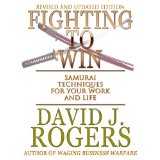
Fighting to win Amazon

Click on book image to order from Amazon.com

or

http://www.barnesandnoble.com/w/fighting-to-win-samurai-techniques-for-your-work-and-life-david-rogers/1119303640?ean=2940149174379


Order Waging Business Warfare: Lessons From the Military Masters in Achieving Competitive Superiority
Waging Business Warfare812sCY9edLL._SL1500_

Click on book image to order from Amazon.com

or

http://www.barnesandnoble.com/w/waging-business-warfare-lessons-from-the-military-masters-in-achieving-competetive-superiority-revised-edition-david-rogers/1119079991?ean=2940149284030



17 Comments

Filed under Artists, Becoming an Artist, Creativity Self-Improvement, Developing Talent, Human Potential and Achievement, Goals and Purposes, Motivation, Writers

Angie

woman-259004_640(Appeared previously under a different title in East on Central)

A few afternoons a week when I was twelve I performed odd jobs for a small neighborhood grocery store with a creaky wood floor and a big bay window called Angie’s.

When I had a delivery to make I brought my red, hand-painted-by-my-father wagon around front and put the load in. Then I would charge, bound straight for glory down the narrow little streets whose every bump my wagon was friends with and had crisscrossed a thousand times, until I had turned a corner or was otherwise out of sight of Angie’s husband Mr. Costello, who spied like a penitentiary guard from the top step of the store to see if I was slacking off.

I treasured my escapes to my happiest world that waited as loyally as a dog outside the store for me. I loved being out on the familiar streets alone, on my own, free, with no adults to burden or restrain me, and there like a person entering a garden after a long illness, relished being reunited with the hallowed fresh air and sunlight, the glorious shades and shapes that festooned this, the tiny patch of the earth that Fortune had so generously allocated to me, and the sights that pleased my eyes, and sounds beyond number that sang in the streets like minstrels.

Delivering groceries was my favorite chore because it liberated me from Mr. Costello, whom I considered diabolical. Otherwise I would have to sweep the floors or shelve cans while Mr. Costello hovered menacingly over me, scowling and cursing, “Don’t do it like that kid, damn it, do it like this,” or, “Boy, turn the friggin cans so the customer can see the nice picture of peas on the front.” I didn’t think Mr. Costello despised me any more than he did anyone else since he treated everyone so miserably, without discriminating, including Angie–especially Angie.

Almost all the people I delivered to were feeble old widows, worn to weariness by a long life and loneliness. They led quiet, solitary lives, having years before given up hope of leaving their apartment for fear of falling and being hospitalized and dying there alone. They had thin, emaciated hands with long fingers and translucent skin that was traversed by long knotted blue veins. They walked with backs bowed and in a slow shuffle—despondent women in perpetual mourning. Their slippers made shy whispering sounds on the carpet, and in the air about their apartments hung the stale and unmistakable odor of a human life approaching its end.

Most every afternoon Mr. Costello, who had committed so many wrongs that it was impossible to remember a fraction of them, would go into the bathroom in the rear by the freezer and come out gussied up in dark silk shirts and two-tone shoes and brilliant yellow or pink ties. Smelling of sweet cologne, he would leave the store, walking in an arrogant strut. Then I would stand behind the shelves and watch Angie—singing softly to herself, swaying, dancing–as she glided, a seraph, through the narrow aisles. She was young and lithe; Mr. Costello was so old.

Beautiful, Angie had such fire in her spirit that I felt it flaming out to me when I approached her. It singed me like molten tongs. She smiled with such sweetness, gentleness, guilessness, and goodness that it broke my heart. She was to me an Egyptian queen, and her hair, her voice, her hands, her presence, brought something into my life which I knew to be love.

Because of her my life was purer and more beautiful, and when I stood close to her I could not breathe. When I dreamed, it was of her. When she was left alone by her husband, those were her hours of splendor, when she was set free and her spirit soared and she became the woman she truly was. But when he returned at sundown the day seemed to die and she surrendered and was transformed into a captive again.

One afternoon after he had chastised me for being a dime short on a customer payment, and I had accepted his wrath wordlessly, terrified to speak, Mr. Costello left the store. Angie came down the stairs to the basement where I was weighing potatoes. In the dim half-light of the single overhead bulb, I looked at her lovely face and her large round breasts confined in a green cotton blouse.

“Don’t let him scare you,” she said.

I longed to ask, “Why don’t you run away?” and to thank her for her kindness. But being a child uncomfortable with both adults and words, I said nothing. She came close and held my face between her soft palms and kissed my lips. Then she touched my shoulder with her finger and turned and went upstairs. Soon I heard the little chime on the front door and Mr. Costello returning early and grousing that Angie had been sloughing off. The bread racks, the cases of produce, and soup cartons hadn’t been touched.

pull-25799_640Out on the street on a delivery one afternoon I met Red Martin. In the air was a hot, summery, sleepy, syrupy feeling. The cicadas were out in great, noisy numbers and the neighborhood panhandler dozed contentedly in the shadows in a doorway. Red was a tough boy with hair of fire. We stopped on the sidewalk for just a few minutes, maybe only seconds, only long enough for Red to say, “Going to the playground. Feel like coming along?” and for me to reply, “Gotta work.”

“See ya,” Red said, and hustled up the street, tossing a baseball in the air that he raced to catch in his mitt.

“See you, Red,” I called after him.

On the way back to the store after the delivery, my wagon rattling noisily without a load, I realized that what meant so much to me–Angie’s kiss–was meaningless to her. She would surely forget it as quickly and completely as she would had she petted a kitten.

I didn’t know then that my memory of that one moment would accompany me through all my life like a medallion that I would take out from time to time to admire, that once in a while something would remind me and I would wonder whatever had become of her, would wonder if we are ever granted a reprieve from our mistakes or must spend the rest of our lives paying for them.

Billy Henson came running down the street and stopped me just about where Red and I had talked ten minutes before.

“Did you hear what happened?” Billy said.

“What?”

“Red Martin died.”

“Red Martin,” I said. “I just talked to him. How could he be dead?”

“All I know is he started running out by the pitcher’s mound and fell down. His head hit a rock or something and he was dead. They say he died when he hit the ground. Anyway, he just died. He’s dead.”

Red Martin, I thought as I walked back to Angie’s, Red Martin. I had never really liked him that much, though I didn’t remember why. But I was remorseful and reproached myself now that he was dead. The realization that life was so uncertain and that for the first time death had come near to me and would again filled me with awe.

Somehow, I thought, approaching the store, a death should be a more momentous event, something should change as a result, something should be different; the world should take note. But everything in my world of those streets, those sounds, those sights, those people, was the way it had been before. Everything the same–except for Red.

Those same familiar streets shaded by the same cool poplars and elms, same cars slowly passing, same neighbors coming and going, same pungent smells of bubbling tar where muscular shirtless sweating workers with colorful bandanas toiled in the torrid sun, same red wagon buffeting noisily behind me; my returning again to Angie’s where cruel cologne-smelling Mr. Costello with his afternoon girlfriends and two-tone shoes and string ties would continue the daily torture of his wife. And where Angie would slowly metamorphose into one of the decrepit dying women I delivered to, and would sing gaily in the aisles of that little store like a bird lovely in its cage until the last end of her days came, as Red’s had come, and mine would come, and everyone’s would come.

© 2014 David J. Rogers

6 Comments

Filed under Growing Up Stories, Personal Stories