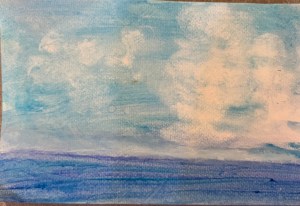
You hear so much yapping about a career in writing and art being a hard life. Shoveling coal for a living is a hard life, but when you are doing what you were put on earth to do with your life–and that is to write or paint–your life is simple, for then you have answered the most crucial questions of all: “What shall I be? “What shall I do? Then you ask, “How do I do it” and that is your craft, that is your art.
My blog is intended for writers and artists. Three million Americans identify themselves as writers. 2.7 million Americans identify themselves as artists. Of course, the blog also reaches millions of people in foreign countries who also identify themselves as artists and writers. To date my blog has been looked at by four hundred thousand writers and artists, the majority Americans, and others from even the least populated mountain and island kingdoms.
An Example of What Happens to Writers as Their Lives Unfold: The Opportunities that Appear
I will use myself as an example of a writer whose career over many years I can describe. It may be of value to writers and artists to compare to their own careers. Fighting to Win: Samurai Techniques for Your Work and Life is my best and my favorite book. It was written to help people. The main beneficiaries of Fighting To Win are discouraged people—broke, out of work, disappointed with their career or life, etc. Fighting to Win lifts them up.
Many people–probably most– struggle to find direction for their lives, but some people know from their earliest years the life, the career, they will pursue. I began writing professionally at eight–$25 for a story published in Jack & Jill. I didn’t know then that eventually in my career as writer I would, as many writers do, evolve into writer/poet/book marketer/public speaker/blogger. I decided on the way home from school on a rainy day that my goal when I grew up would be to be a writer so I could write beautiful words like “lovely,” “sea-faring,” and “proficient.” That goal has never changed through the publications of twelve books that are not self-published.
Ninety percent of a writer’s talent is inborn. That’s why writers needn’t attend the Iowa school of writing, but are generally self-taught. Some writers who write surprisingly well when they are very young are prodigies. There are artist prodigies too that draw and paint beautifully like much older artists. They master perspective when they seem too young to have mastered it .Mozart was a music prodigy, composing at four. Baryshnikov was a prodigy in ballet. He was the greatest dancer of his era because he could leap highest.
An early blooming prodigy can perform something before being taught to do it. For example, a young writing prodigy can write a story that has a plot, characterization, themes, tension, mystery, a strong conclusion though they have not been taught those features. The remaining ten percent of a writer’s expertise is skill and technique that comes from study, a ten percent separating great from good, and a phase that introduces the need for hard work, even among the most naturally-gifted.
As in every field, sweat-and-toil hard workers out-perform lazy or listless workers. You cannot rely on natural talent alone to bring high success. Without drive and intelligence–however naturally talented you are–you will not go as far as you could. Each day writers and artists should hope they have talent and tell themselves. “Today I will be energetic. Today I will be focused.”
A career in the arts is in keeping with my Welsh heritage. The Welsh entertain each other with stories and songs. I completed three degrees in American literature and taught Self Development in a university graduate school. At age twenty I had a short story published in a major literary journal. At twenty-one, a highly-regarded writing teacher said of my paper, “Teachers wait their entire career for a student who can write like this.”
I knew nothing about publishing and sent the entire manuscript of Fighting to Win to a publisher who called me and said they wanted to publish the book. I asked what kind of changes they wanted made and they said, “None. The book is a perfect book.” That statement soured me. Surely no book in first draft form is that good. I wanted a more demanding publisher who would encourage me to write my best. I turned the offer down. Having some doubts about the book I wrote an entirely new draft, starting from scratch, consuming a year.
I made an agreement with an excellent literary agent. I owe him a debt of gratitude. He was energetic and honest, and placed my book Fighting to Win with Doubleday. After the success of Fighting to Win, another publisher said they wanted me to write a book for them. “What do you want me to write about?” I asked. They said, “Whatever you want.” So I wrote Waging Business Warfare for Scribner’s publisher, a book that The Wall Street Journal said would change the way companies do business. Both books climbed the best sealer charts. Fighting to Win was also a best seller in Sweden. Waging Business Warfare in France and Japan.
Writer or artist, you have to distinguish yourself from the crowd. You have to get known. I’ve had many appearances in the national media on publicity tours and on my own. The books and my name became known in North America and foreign countries who purchased rights. I discovered that I am a good interviewee for marketing books, which is really sales. I have trained people in selling technique. The goal of a writer marketing to the broadcast media is to be invited back. Ideal is when the host of the show says “Call whenever you have something you want to talk about. We’ll put you on right away.”
Having written a book that becomes known by the public changes the author’s life forever. If you’re an author you’d better like the book since you and it from the publication date to the end of your life will be inseparable. You will be known as “So and so, the he author of….”
A New York publisher, I didn’t know, head of a major house who “had read everything,” generously called me out of the blue to tell me she had read Fighting to Win and found it “One of the two or three best books of any type–prose, poetry, biography, history, arts etc.–I have ever read.”
Then I took on a new career: public speaking in auditoriums in North America and Europe to audiences of thousands about their self-improvement, based on the content of Fighting to Win. I discovered a talent for public speaking to large audiences that I wasn’t aware of. Long ago I was afraid of public speaking, but now I enjoy it as much as I do writing, and the income is impressive. Many speakers/writers earn more money from speaking than from writing. The writer who can also speak is lucky. It is quite a shock to writers accustomed to working alone to find themselves on a stage addressing three, four, five thousand people who have come to hear an author’s wisdom.
Later I began this blog, designed to stimulate thinking about the important roles of writers and artists, especially those who hope to excel, a goal I share, placing emphasis on research and prescriptive how-to advice. I wanted to think of every aspect of writers’ and artists’ work life and write something practical to aid them. Each blog is an essay pertaining to the life of writers or artists–their necessary knowledge, their moods, their challenges, their discouragements, and so on. My most popular post is “The Characteristics of Creative People.” There are now 141 essays.
A major change in this writer’s life was turning, later in life, from writing prose to writing poetry. Since then there has been a stream of publications of poems and great joy. I wrote a book of poetry about adventures I had at seventeen when for six months I lived the life of a hobo hitching rides on freight trains: The Poetry of Riding Freight Trains Across America.
Philip Roth said eventually people won’t read novels anymore because with such busy lives, growing busier, they don’t have the many hours needed to read a novel. A poem can be read in a few minutes.

In Bliss
When you spend thousands of hours working hard over many years as many writers and artists have, and think of your craft all the time since childhood, writing and painting and other arts are the simplest tasks of your time here on earth. Dancers find a similar joy in dancing, actors in acting. When unhindered, such craftsmen write, paint, act, and dance in bliss.
© 2025 David J. Rogers
For my interview from the international teleconference with Ben Dean about Fighting to Win, click the following link:
Order Fighting to Win: Samurai Techniques for Your Work and Life eBook by David J. Rogers
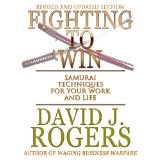
Click on book image to order from Amazon.com
or
Order Waging Business Warfare: Lessons From the Military Masters in Achieving Competitive Superiority
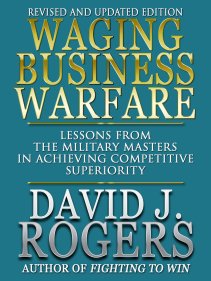
Click on book image to order from Amazon.com
or
 Every writer and painter has in their memory at least one moment and one thought or image that captures their imagination and provides inspiration for their work. Every writer and every painter reading this post remembers such a scene and such a pristine, unforgettable moment that occurred in their youth, middle age, or old age.
 Then there was a sound of a wind thrashing the wheat fields, rippling the fields in great waves like breakers tumbling upon a beach. Looking, listening, alone, no fear, feeling joy, free, that was the loveliest moment in my life. Only I had seen the bird. There was no one near enough to see it, only I–the bird with the flaming red wings coming from out of the field against a background of no other movement but the wind-blown fields, and no one else on earth to witness its flight. I now in a car bound for California saw in the bird the beauty that from childhood a writer is always hoping to convey in their writing, the beauty a painter always hopes to paint.
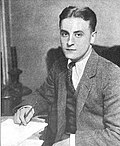 F. Scott Fitzgerald’s (1896-1940) writing was the major interest in his life. From grade school to his death nothing was quite true to him unless he had written about it. He was a fine writer, and his writing was always about himself or people he was intimate with. As a result his life was inextricably bound up with his work and his life with his kooky and attractive wife Zelda was an interest in itself. He lived a colorful life and a disastrous one with Zelda. They lived like fairy-story hero and heroine, filling newspapers with reports of their wild life-style. Much of the disaster of their lives were of their own making. Fitzgerald is called the creator of the Jazz Age which began with his writing best seller This Side of Paradise at the age of twenty-four, making him rich, his goal for writing it. The book became the voice of the younger hedonistic, thrill-loving, post-World War I generation.
 When you grow up in Chicago as I did
 When I was seventeen I
  Then in a second dream
 All writers are equipped with a good memories, but Thomas Wolfe’s memory was astonishing. Because of it he was able with ease to recall events, people, and places in stunning detail. That was his strength. His weakness was an inability to restrain the deluge of words that poured out of him from evening to dawn as he wrote, or when he spoke, and he simply, despite himself, had no ability to stay within the requirements of writing a saleable novel. He had no concept of how to write such a book and needed the help of his editor, the legendary Maxwell Perkins of Scribner’s, who at the same time was the editor of Ernest Hemingway and F. Scott Fitzgerald, two other difficult clients.
 No writer in the nineteen thirties–or even now–could write with the beauty of Thomas Wolfe’s prose. His reputation after his death suffered because of the perceived formlessness and verbiage of his writing in an age when critics preferred tight structure and economy of language–short sentences and short episodes, and highly-focused scenes rather than the volume and torrents of Wolfe’s language. Once considered by Nobel Prize winners William Faulkner and Sinclair Lewis to be America’s finest writer, and in the past extremely popular with readers and critics, Wolfe is now almost never read–unfortunately in my opinion, if one is interested in being inspired by the brilliance of written expression. Hard as you look, you will not find Thomas Wolfe–once thought a towering genius–in current anthologies of American literature.
 My poem describes the first hobo camp of about three hundred men we came upon, a camp looking like “the camps of infantry.” We went down the hill to meet the men, slept there a few days, ate fried beans, and listened to and took notes about the stories the forgotten men enjoyed telling.
 My most popular post is entitled
  sculptures, prints, and ceramics, and established Lynn Fontanne as a great dancer, Laurence Olivier a great actor, George Gershwin (as hard a worker as there ever has been in any field), a great composer, and so on.
 Pitch Black Nights


 davidjrogersftw