I wanted to know why artists and writers are so self-absorbed.
Then I wanted to know why writers, painters, and other artists bloom late.
In popular posts I addressed those questions. Now I want to know why so many writers and artists are intense and have intense personalities.
Waking, Wanting To Get Going
 I was excited waking up at 3:00 A.M. yesterday, and I was not thinking of going back to sleep. I wanted to finish some poems where I had left off the night before. I thought, “Let my wife–a calmer, less excitable person–sleep; I love to work and I have work to do.”
Then I started thinking that it was likely that other creative people I know–good friends in the arts–at that very moment also were waking early and were anxious to get to work on their project, that we are similar–we resemble each other in regard to the emotions we bring to bear as we live and work–that we are all creative and we are all intense and excitable. Certain qualities endear creative people to me. One is their intensity.
It seemed to me then that intensity and excitability were a pattern, a hard and fast characteristic of myself and my artful friends, and come to think of it, of many of the famous writers and artists and other creative people I have been reading about, studying, admiring, and writing about all my life. Their intensity made them different.
The Feeling of Intensity
What does intensity feel like?
 Intense writers and artists do everything intensely–experiencing, feeling, thinking, and imagining. They are significantly different human beings from other writers and artists (and agents and family members and co-workers) who are not intense. They feel their emotions strongly. They soar high with elevated emotions, and they plunge into dark moods, at times their moods changing so fast as to be bewildering. In contrast, people who are not intense the way so many writers and artists are feel their emotions more mildly and without such major fluctuations between the high moods and the low moods. Differences in intensity between people who work closely together or live together may cause conflicts.
Some writers and artists feel that they are being flooded by waves of joy, that their every cell is being excited. Some writers and artists–perhaps you, certainly I–revise their work tirelessly, at times almost maniacally, ten times, twenty times, thirty times, until they are satisfied the work is the best they can do. Only then can they stop themselves.
The intensity of writers’ and artists’ personality is a powerful element of their creativity. The wonderful poet John Keats thought that intensity–not intelligence or any other quality — in and of itself is the most powerful creative element of all.
Intensity and the Arts
 Intensity is a quality found in many creative people that facilitates artistic pursuits. Abbe Dimnet said that the creator’s intensity will be reflected in the quality of the work: “The experience of most artists is that the quality of their production is in keeping with the intensity of their wish.” Henry James wrote: “It is art that makes life, makes intensity, makes importance.” Horace said, “Painters and poets alike have always had license to dare anything.” It is their intensity that gives them strength. Keats said, “The excellency of every art is its intensity “ A problem every writer and artist faces is maintaining in every phase of their story or painting the intensity that keeps it going and energizes the creator’s every gesture and the work’s every detail. They must be able to generate and sustain intensity as they work.
Emotional Intensity and Over-Excitability of Many People in the Arts
“Emotional intensity” of the kind I am describing is a quality that Polish psychologist, psychiatrist, physician, and poet Kazimierz Dabrowski found when he studied intellectually or artistically gifted people. The degree of a person’s emotional intensity is a stable characteristic. Some people are intense; some are not. Just as self-absorbed artists and writers can’t help being self-absorbed any more than they can help having the color eyes they do, intense artists and writers can’t help being intense.
Dabrowski recognized that, as I thought, creative people experience an intensification of experience much beyond what other people experience. Dabrowski considered the intensity of their emotions, their sensitivity and emotional extremes–their “over-excitabilities”–to be part and parcel of their makeup. Every aspect of their personality is intense.
They are “spirited,” and are also more sensitive, perceptive, energetic, and persistent than other people. They possess what I have called “inner” skills such as persistence, confidence, and courage that not everyone has but that lead directly to success in the arts. Dabrowski identified five “overexcitabilites” exhibited by more people in the artistically gifted population than in the general population.
The Five Dimensions of Intense Writers’ and Artists’ Lives
- Sensual
Sensualists, intense writers and artists seek an enhanced sensory and aesthetic pleasure in seeing, smelling, tasting, touching, hearing, and sex. They delight in beautiful objects and in sounds of words, and in form, color, and balance. Negatively, they may overeat and be sexually over-indulgent.
- Psychomotor
Intense people have a surplus of energy, are competitive, enjoy intense physical activity such as fast games and sports, often are compulsive talkers–they may jabber–and act impulsively. They may have nervous habits. They may bite their nails or have nervous twitches.
- Intellectual
They enjoy intensified activity of their mind in their curiosity, concentration, and in their capacity for sustained intellectual effort, avid reading, asking probing questions, and making keen observations. They can vividly recall what they see with their eyes (that fundamental necessity for writers and artists) and may be detailed planners. They are tenacious problem-solvers. They search for truth and understanding. They think about thinking and love theory and analysis. They are logical and independent thinkers.
- Imaginational
In speaking and writing, intense writers and artists often use images and metaphors, are given to poetic and dramatic perceptions, and are skilled at inventing. Some can make up fantasy worlds of their own and imaginary companions and are attracted to magic and fairy tales. Under emotional tension their imagery can mix truth and fiction. They may have elaborate dreams and illusions. They cannot tolerate boredom. They may lack self-judgment and be overly-critical.
- Emotional
The feelings and emotions of over-excitable writers and artists are intensified. They are given to extremes of emotions, complex feelings and a large range of emotions and have an awareness of the feelings of others. They have heights and depths of emotions that others lack. At times their mood soars. And it also may plunge. Their moods change quickly.
They may have strong physical expressions of over-excitability such as tense stomach, sinking heart, pounding heart, sweaty palms. Intense writers and artists experience euphoria, enthusiasm, and ecstasy, but also shyness, timidity, and obsessiveness.
But Dabrowski found that inner forces were at work in them also, forces that generated overstimulation, conflicts, and pain, and often set them out in a search for a way out. One way out may lead to inner growth and transformation, another may lead to results such as addiction.
Examples of Famous Intense Writers and Artists
 Who could be more intense than poet Walt Whitman who expressed a wish to have “one hour of madness and joy,” “to feed the remainder of life with one hour of fullness and freedom,” “To have the feeling today or any day I am sufficient as I am.” Who more intense than novelists Charles Dickens with his phenomenal storehouse of drive that enabled him to work on a multiplicity of books, speeches, plays, travels, and social projects at the same time without ever tiring?
Or Thomas Wolfe whose monumental goal was nothing less than to describe in the millions of published words that poured out of him uncontrollably, as from a spigot, every experience he had ever had? And Gustave Flaubert, a pioneer of a modern writing style, who agonized rewriting his novels and stories to perfection? Or intense painter Vincent van Gogh who produced a masterpiece a day, or Claude Monet, who for his artistic experiments could paint thirty or forty canvasses of exactly the same scene.
There are drawbacks to a writer or artist being over-excitable and intense. But the advantages of being a writer or artist who is intense and has the powerful energies, the drive, and many other qualities that facilitate success in the arts far outweigh the negatives. The creative’s intensity is reflected in the quality of the work they produce–more intensity, better quality work.
If writers and artists are asked to identify the important characteristics they would l really like to have that would positively affect their career, they will be wise to identify intensity.
An intense writer or artist trying to create a vision they perhaps alone perceive is fortunate.
© 2023 David J. Rogers
For my interview from the international teleconference with Ben Dean about Fighting to Win, click the following link:
Order Fighting to Win: Samurai Techniques for Your Work and Life eBook by David J. Rogers
Click on book image to order from Amazon.com
or
Order Waging Business Warfare: Lessons From the Military Masters in Achieving Competitive Superiority
Click on book image to order from Amazon.com
or
 People in every walk of life and in every hemisphere on earth–in cities, on deserts, in towns and villages–long to create something. My nine year old grandson is a talented artist and cellist studying architecture. His six year old sister takes dance and will begin taking piano lessons in the fall. Their forty two year old father was an excellent cellist in his youth and was inspired by the performance of a famous cellist to return to it last year. My wife, is a former cellist, and has taken up water colors and has returned to the piano. I write every day. I have for many years, and when I am not writing I am thinking about it and planning what I will write. We are representative people no different from millions of others with whom we share the globe because the current era is an Age of Heightened Creativity. Little children and women and men of all ages are bent on having creative experiences. They will not let their creative instincts be stifled.
 It became a permanent part of your entire being–an idea, a theme, or an image that became a guiding force in your life. You may not be conscious of it, but it starts you out in a creative direction, and gives you a sense of moving steadily in that direction, of heading straight toward something concrete and specific. Making a living in art is difficult and so most artists must find financial security other than in art. But whatever your occupation if you are to be an artist you will define yourself first as an artist, an accountant, HR manger, or English teacher second.
 Noted composers and performing artists in musical fields–so sensitive to sound and tone—possess what the Germans call Horlust–“hearing passion.” Writers–particularly poets and lyrical writers–have a word passion (they adore words), and painters adore colors and shapes, often from the cradle.
 What is inside the shut door is the artist’s rich inner life from which creative products pour–without stopping if the artists explore themselves more and more deeply. Transformation of what is inside the artist into what is outside is the
  Poet W.H. Auden wrote, “Speaking for myself, the questions which interest me most when reading a poem are two. The first is technical: ‘Here is the verbal contraption. How does it work?’ The second is, in the broadest sense moral. What kind of guy inhabits this poem? What is his notion of the good life or the good place? His notion of the Evil One. What does he conceal from the reader? What does he conceal even from himself?” William James said it is the amount of life in the act of creation which artists feel that makes you value their mind.
 Artists must be people of action because their main goal is production of works over which they think and
  Children and adults may drop out, but those who turn to art may well be playing the cello or dancing or painting, only getting better and enjoying their art perpetually–all their lives– with fond
 ball passing back and forth between you and life. No one ever holds the advantage all the time. The advantage can swing to you or away from you at any time. Sometimes you hold the advantage, and an ideal life and great achievements in your career or personal life seem so near you can touch them with your fingers. Then you suffer a setback, a crisis, or a major problem, and you’re driven down into the dark depths of discouragement. You have lost the advantage, and your need now is to get it back.
 “The Swing of the Advantage” is a concept from my print best seller Fighting to Win: Samurai Techniques for Your Work and Life (now available as an eBook). From the twelfth through the nineteenth centuries Japanese samurai (bushi) were fighting men and women in service of a lord, a “daimyo.” They were the greatest warriors who ever lived, and based their expertise on physical, psychological, and Zen spiritual insights and techniques that they acquired through as demanding training as there has ever been in any discipline. Their skills were legendary. Fighting To Win prescribes their
  dragon’s mask.”
 Is there any area in your personal or professional life right now in which the advantage has swung away from you? What will you do to get the advantage back? Whatever it is, don’t delay. Run straight toward it zan totsu–
 Why what I’m going to say now is true, no one has been able to figure out, but almost all people relax their efforts when they get close to achieving even their most important goals. They struggle and struggle and then seem to get lazy and disinterested. They are like a sprinter who runs fast to the tape and slows down or stops. But good coaches advise runners to “run through the tape.” Whatever you do, don’t relax just when you’re getting close to success, but persist in applying your utmost energy
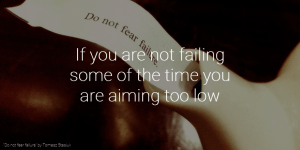 Why are you and I so afraid of failure? Many people live in terror of it and feel they must never fail, but always succeed, trailing clouds of glory. Yet failure can be a blessed life-changing event. If you experience only successes, you come to expect quick and easy results, and your sense of confidence is easily undermined if you suffer a setback. Setbacks and failures serve two useful purposes: Not only do they show us that we need to make changes and adjustments in order to gain the success we are seeking, but also they teach us that success usually requires confident, persistent, skilled, focused effort sustained over time. Once you set failures aside and become convinced that you have what it takes to succeed, you quickly rebound from failures. By having courage and sticking it out through tough times, you come out on the far side of failures with even greater confidence and commitment.
 The effect of
  Confidence is needed if you are to be successful as an artist. Make it a point to never lose confidence. If you find yourself losing it, use affirming statements, such as “I can do this; I believe in myself.’
 The most successful people have high career aspirations, are confident, and generally attribute their success to high effort and failure to lack of effort.
 Creative people who are the most likely to ask for help are those with a high opinion of themselves, while those with a low opinion of themselves are the least likely, although they may be the most in need of it and would profit from it. Asking for help shows that you’re serious about reaching your goals. Useful feedback can help you evolve and reach high levels of satisfaction and achievement.












 davidjrogersftw