 Think of the last time you were discouraged. You were knocked off balance and became weakened and vulnerable. Possibly something you longed to happen did not happen, or something you dreaded happening did happen. Then you were discouraged. Courage is a thing of the heart. The word “courage” derives from couer,” the French for heart. To be “dis” couraged is to lose heart. You were never too young and will never be too old be to be discouraged. You don’t outgrow discouragement.
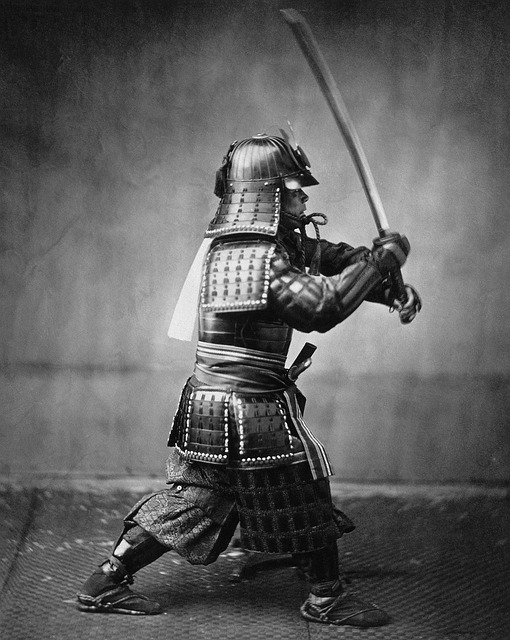
 Action is the most effective antidote to discouragement To rid yourself of being discouraged strive to be a person of action. The happiest and most courageous people in the world have a preference for action. Rarely are they discouraged. They are too busy to be. In high spirits they persist through difficulties, overcoming setbacks, resisting gloomy moods, never losing hope. That is why they are so happy. The samurai of ancient Japan were the most action-obsessed men and women who ever lived.
An Example of What Happens When You Are Discouraged
Good things can come out of bad things. So life taught me.
When you are cheated out of money, it is usually because you were too trusting, and I was to the tune of a sixty thousand dollar loss at a time when sixty thousand dollars might just as we’ll have been six million. I had a wife and four children and I was not rich. I had performed work in good faith, and then did not get paid. My spirit was taken out of me, my once firm faith in peoples’ decency was now shaken, and I couldn’t find  peace. So I began to search for solace and wisdom.
I had to think. I had to decide what to do now. I was so miserable and angry that I decided, being a writer, to put together a research-based book that would help me recover and would also appeal to other people who were battling the pains of discouragement.
The product of what I thought would be a one year creative venture was to be a book about which people would say, “It saved me from despair. It gave me hope. Once I was discouraged, but now I’m not.” In the book there would be no anger, bitterness, or vengefulness toward anyone, even the two evil men who had taken food out of my children’s mouths. Just good sense, good feelings, and good writing.
 I chose as the basis of the book the spiritual insights of samurai warriors of ancient Japan. It may seem that the psychology of people like that who lived four centuries ago in a foreign country would have little to say to you, yet if you are interested in ways to strengthen yourself spiritually, that is the place and era to look for information. Samurai had introduced the teachings of Zen into the Japanese culture. Zen was “the religion of the samurai.” Many samurai were poets.
Were you to acquire the skills of the samurai that the book I wrote is concerned with, the following benefits–the changes in their lives readers told me about–would occur:
Your resilience in recovering from discouragement and other setbacks would be remarkable
Your commitment to your major life’s purposes would be miraculous
Your powers of concentration would be exceptional
You would be afraid less often; old fears would disappear
Committing Yourself to Action
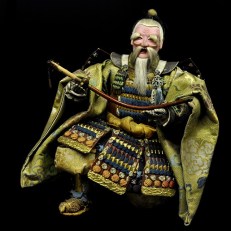 Samurai were models of action-oriented people. The essential feature of the samurai “Way” (way of life) is action. (That a discipline is a Way is indicated by the suffix “do.” The samurai Way is “bushido). All samurai spiritual insights and training were designed for one reason: to equip the person (a samurai or you) to make up their mind quickly and firmly and to go into action confidently.
Samurai were consumed by making a decision and taking steps to achieve their goals, and doing so with little time between the urge to action and the action itself, just as the flame appears immediately when you strike a match. A text that guided samurai says, “The Way of the samurai is immediacy. It is doing things NOW.” Another says, “When things are done slowly seven of ten turn out poorly.”
You will have ideal results if like a samurai you commit your entire being when you take action, putting all of your physical, spiritual, and psychological strength into the acts your life requires you to perform– an author writing a book, a sales person making a pitch, a public speaker addressing an audience, a parent listening to a little child as she speaks to you, etc.
Hold nothing back in reserve. Clear your mind of all distractions. Forget everything else. Forget yourself. Forget the impression you are making. Forget winning or losing. Forget fame and wealth. Forget setbacks. Concentrate solely on performing the action beautifully. Behave as though your every act is the last of your life. Behave as though this is what you will be remembered for.
Are you a person of action or are you waiting for someone to save you?
Writing a Successful Book
 I was fortunate to find a good agent who had faith in the project and in me, and we proposed the book to a publisher who accepted it. There would be an advance in two payments. That was good; I needed the money. I laid everything else aside, not having time to waste, and was excited by the process I loved–studying, reading, writing, revising, using my brain, having insights, then “aha” revelations. I found that the sections that gave me the most trouble and took the most time invariably proved to be the most popular when the book was published. That was a profound learning, I worked twelve to fifteen hours a day for two years to finish Fighting to Win: Samurai Techniques for Your Work and Life.
Fighting to Win’s popularity began slowly. There was a minimum of initial publicity. But then the book found its market–men and women looking for strength, a new beginning, and an escape from discouragement. It caught fire in one city after another, racking up sales in the United States, Japan, and Europe. When my article “Fighting to Win” appeared in Success Magazine it was the most read feature Success ever published.
Being Discouraged Is Contrary to Good Mental Health
 Every day’s goal of healthy people is to be happy, to love and be loved, and not to be discouraged. But there are many impediments–opponents. In the arts among artists and writers I know so well, and in everyday work and personal life, like a samurai in battle, everyone encounters those opponents. Some are outer opponents–an outrageous person who’s hard to get along with (a harsh critic of your writing or painting, for example if you are in the arts), personal crises, setbacks, failures, Etc. People who steal from you.
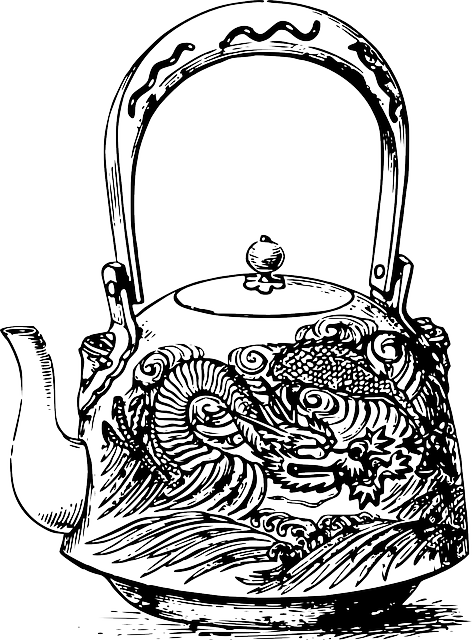
But most opponents are inner psychological “dragons” in the samurai vocabulary, powerful opponents such as obsessions, anxieties, fears, and worries. Usually the inner spiritual opponents are the most dreadful. Every person has talents. If you surrender to dragons it makes full realization of those talents impossible. You won’t become the person you had the potential to be.
 All samurai training was designed to overcome those dragons so that in your everyday life you will progress smoothly from experience to experience, challenge to challenge, achievement to achievement, happiness to happiness.
Be Ready for These Five Dragons
Samurai were trained to overcome five universal spiritual blocks to action, and developed many methods for doing so, as Fighting to Win prescribes. If left alone without dealing with them, these blocks will fester and lead some people to discouragement. Those main inner opponent dragons are described in Chapter Two of Fighting to Win. They are:
- Fear–of any kind (Everyone is afraid of at least one thing every day)
- Being afraid to take risks. (That fear makes people timid and cowardly)
- Thinking too much and not acting at all, or not quickly enough
- Doubting yourself (the main dragon of many people, particularly people in the arts.)
- Hesitating
 Acquiring wisdom from the samurai Way suits people who wish to overcome discouragement and are able to make use of insights and techniques from any era or culture that will help them. What strikes me is the ease with which readers of the book adapt those insights from centuries ago to their current everyday living.
Writing is said to be therapeutic, and that was certainly true of my experience writing Fighting to Win. I overcame my deep discouragement and was happy to find that the book helped many people overcome theirs.
© 2023 David J. Rogers
For my interview from the international teleconference with Ben Dean about Fighting to Win, click the following link:
Order Fighting to Win: Samurai Techniques for Your Work and Life eBook by David J. Rogers
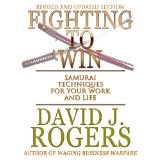
Click on book image to order from Amazon.com
or
Order Waging Business Warfare: Lessons From the Military Masters in Achieving Competitive Superiority

Click on book image to order from Amazon.com
or
 focus on a system to improve your creative performance is to be aware of what you are trying to accomplish–with your life, and in this year, this day, this moment. When you acquire the habit of saying to yourself often in your daily life–morning, noon, and night–“Focus on your purpose,” those words become a hypnotic motto that stirs your muscles and mind to action. Then your life takes on a quality that is now becoming rare even among gifted creators–vital intensity that facilitates the production of works that can be pointed to and admired. That single goal–producing works as a result of talent combined with discipline–is more powerful than all other creative goals.
 that specialty. And you must
 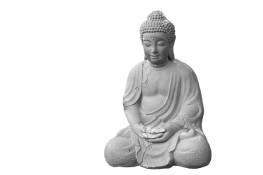 free of suffering are the goal in Buddhism. The Buddhist Eightfold Path consists of eight ideals that when practiced bring an upright and happy life. They are eight prescriptive “rights,” including right association–being careful about associating with good, wholesome, even holy people; right intent–making up your mind as to the one main purpose in life you really want to pursue; right speech–no lying, backbiting, or slander; right thoughts–thinking compassionately, generously, and with goodwill; right conduct–not killing, stealing, or lying; right effort–using your will power and taking action to achieve a good life; right concentration–the use of techniques to enhance concentration and enlightenment. And there is right livelihood–doing what you’re best suited to do in an honest occupation that harms no one.
 Success in a creative field (in fact success in any field) is not attributable to one thing alone such as talent or IQ as many people believe, or three or four things. I believe there are eight components. It’s important to understand what the eight components are and the questions they will answer:
 their creative lives by means of the work they do. If they are unable to work or the work is poor quality or is stopped-up and doesn’t go well, they suffer. Regarding the necessity of a creator to
  There isn’t one universal work/production program that suits all creators. A production program won’t work if it’s imposed. Each creator’s program will have to be idiosyncratic–custom-designed by yourself for yourself. To find the ways and means to improve the quantity and quality of your production, you should experiment and try out different approaches until the best work/production program suited to yourself is found.
 For high quality uninterrupted work to happen, not all, but most creators need isolation and solitude. “The concentration of writing requires silence. For me, large blocks of silence. It’s like hearing a faint Morse code…a faint signal is being given and I need quiet to pick it up” (Philip Roth). Some creators prefer noisy environments. But even the feeling that you might be interrupted interferes with creative thought.
 production goals continuously in mind. Production ebbs and flows. Some days work comes out of you in torrents. You’re in overdrive. But other days–nothing. But one way or another,
  A curious thing would happen. The quantity group would also produce the highest quality work. The quantity group would churn out streams of work and learn from their many mistakes and develop wide assortment of skills. But the quality group would get caught up the elusive concept of perfection and grandiose dreams and would become paralyzed. Some creators produce 10, 15, or 25 times more works than other creators. Those who produce the most works usually rise higher, do better work, and find a greater sense of accomplishment.
 If you neglect an activity for just two days you’ll function much less effectively when you resume work. In writing and painting, as in everything else, inactivity leads to the atrophy of abilities. Your level of motivation affects your willingness to work. The quantity of your production is in direct proportion to the intensity of your
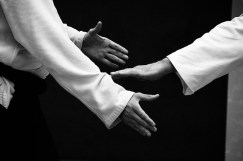 We were sitting about three feet apart, facing each other. I said, “I’ll be happy to.” The host said, “Should we go over there where we have more room?” I said, “This is fine. I won’t have to get up out of this chair. Throw a punch at me as though you are mad at me and want to knock me down. Don’t hold anything back. Really throw a punch.”
 I’ve seen emotional extending used successfully to overcome the fear of an upcoming speech many times. Go into a room by yourself, sit on a chair, and alone, worry and make yourself afraid. Tell yourself things that scare you. Exaggerate. Do this for five or six minutes, or longer, if necessary. After a while you will find the fear disappears. Extending excites emotions that are troubling you, then calms them down. The fear of asking for a promotion or a raise, of having an upcoming job interview or of asking for a date can be dealt with the same way. Whatever the fearful situation is, extending will help.
 If you choose to use the aikido approach to overcome external and emotional adversaries, be aware that the way to “serve” one’s adversary in the aikido style is to understand what they want, and to give them more of it to get what you want. Remember: the extending technique or process can be an antidote to the emotions of fear, worry, anxiety, the blues, and depression.
 ball passing back and forth between you and life. No one ever holds the advantage all the time. The advantage can swing to you or away from you at any time. Sometimes you hold the advantage, and an ideal life and great achievements in your career or personal life seem so near you can touch them with your fingers. Then you suffer a setback, a crisis, or a major problem, and you’re driven down into the dark depths of discouragement. You have lost the advantage, and your need now is to get it back.
 “The Swing of the Advantage” is a concept from my print best seller Fighting to Win: Samurai Techniques for Your Work and Life (now available as an eBook). From the twelfth through the nineteenth centuries Japanese samurai (bushi) were fighting men and women in service of a lord, a “daimyo.” They were the greatest warriors who ever lived, and based their expertise on physical, psychological, and Zen spiritual insights and techniques that they acquired through as demanding training as there has ever been in any discipline. Their skills were legendary. Fighting To Win prescribes their
  dragon’s mask.”
 Is there any area in your personal or professional life right now in which the advantage has swung away from you? What will you do to get the advantage back? Whatever it is, don’t delay. Run straight toward it zan totsu–


























 davidjrogersftw