Reflections on Creative Purposes
In my book Fighting to Win I place emphasis on the Japanese maxim Mokuteki hon’I, which means “Focus on your purpose.” They are a few simple words that can have a major positive effect, changing the whole course of an existence. To focus on your purpose as this post asks you to  focus on a system to improve your creative performance is to be aware of what you are trying to accomplish–with your life, and in this year, this day, this moment. When you acquire the habit of saying to yourself often in your daily life–morning, noon, and night–“Focus on your purpose,” those words become a hypnotic motto that stirs your muscles and mind to action. Then your life takes on a quality that is now becoming rare even among gifted creators–vital intensity that facilitates the production of works that can be pointed to and admired. That single goal–producing works as a result of talent combined with discipline–is more powerful than all other creative goals.
I have looked very seriously into what brings success to people in the arts, the sense that the person is functioning in a creative field at as high a level of performance as is possible for him or her. I have come to the conclusion that to reach excellence and satisfaction as a writer, artist, actor, dancer, musician, director, architect, etc., and to excel in any creative field and have a long and perhaps illustrious career, you must pursue, with all the commitment and intelligence you can muster, a small number of certain types of goals.
To excel, to make your mark in a creative field, I realized that you must find your most suitable creative specialty and develop your skills for  that specialty. And you must increase your knowledge of your chosen niche and put yourself on a specific Life Path with the objective always of producing a steady stream of high quality works that will bring you creative happiness. But it was clear to me that much more was involved.
So I wracked my brain for a way to convey in a clear, interesting, and organized way exactly what over the years I had come to believe about how a “real creator” such as those I admire most came into being. I searched my experiences for a useful model. I’d become interested in Buddhism at seventeen and over the years had done a lot of reading and thinking about it. It was there that I found my model.
As you and I live we encounter suffering. That that suffering is the most basic fact of life is the most important tenet of the religion or philosophy or approach to life known as Buddhism. That is the first of Buddhism’s Four Noble Truths, physical and mental suffering, dukkha.
A Buddhist strives to follow an “Eightfold Path” which is intended to lead to enlightenment and the end of dukkha. Enlightenment and a life  free of suffering are the goal in Buddhism. The Buddhist Eightfold Path consists of eight ideals that when practiced bring an upright and happy life. They are eight prescriptive “rights,” including right association–being careful about associating with good, wholesome, even holy people; right intent–making up your mind as to the one main purpose in life you really want to pursue; right speech–no lying, backbiting, or slander; right thoughts–thinking compassionately, generously, and with goodwill; right conduct–not killing, stealing, or lying; right effort–using your will power and taking action to achieve a good life; right concentration–the use of techniques to enhance concentration and enlightenment. And there is right livelihood–doing what you’re best suited to do in an honest occupation that harms no one.
Then I thought, “That’s it. That’s what I’m looking for: a clear path that will take a creator to what he/she is seeking and needs strong, continuous encouragement, compassion, and votes of confidence to reach—an eightfold path, but without any religious connotation.”
So now I realize that you and I can realistically speak of The Creator’s Eightfold Path consisting of eight specific components—eight “rights”–that must be present–not one missing–if a person pursuing a career of creative endeavors is to reach high performance and become the real thing.
Introduction to the Components of the Creator’s Eightfold Path
 Success in a creative field (in fact success in any field) is not attributable to one thing alone such as talent or IQ as many people believe, or three or four things. I believe there are eight components. It’s important to understand what the eight components are and the questions they will answer:
Right Work/Production Program: How can you produce the quality and quantity of works that you hope for?
Right Craft: How will you know if the creative specialty you have chosen to pursue is the most appropriate for you?
Right Identity: What are the personal qualities that will best equip you for the creative craft you have chosen to pursue?
Right Education, Training, and Development: How can you prepare yourself to reach your highest creative performance?
Right Skills: What are the variety of skills you’ll need, and what is your authentic voice and most expressive style?
Right Knowledge: What knowledge will you need if your goal is to excel?
Right Motivation/Drive: Do you have the drive and doggedness you will need if you are to excel?
Right Life Path—are you following the Way of the Creator?
You can reflect on these components and identify the ones in which you are strong and those in which you are weak and need improvement.
In future posts I will discuss further the components of the Creator’s Eightfold Path.
Here is an introduction to one of the components:
Insights about Right Work/Production Program
The most vital factor of successful production is working with a single-minded preoccupation—the focus on the one thing, the work itself–whether for fifteen minutes or many hours–avoiding and getting rid of distractions, and ignoring as much as you realistically can other responsibilities.
It is not enough to possess talents. Talents must be put to work and result in paintings and poems and such. Creators make the structure of  their creative lives by means of the work they do. If they are unable to work or the work is poor quality or is stopped-up and doesn’t go well, they suffer. Regarding the necessity of a creator to sweat and produce paintings, poems, symphonies or buildings, etc., Saul Bellow said, “For the artist, work is the main thing and always comes first.” Brewster Ghiselin said, “It is only as the work is done that the meaning of the creative effort can appear and that the development of the artist…is attained.” Psychologist Howard Gardner writes about high-excelling creative people. He says, “Individuals whose stock in trade is to do things which are novel, are people who’ve got to have a pretty good command of how they work.”
The Value of Structure
Successful creators almost always structure their work time and environment carefully. One of the first things a creator does is to clear a work space. A perfect work place and good production routines and rituals are to be treasured. By simply being there ready to work repetitively the same time day after day, the power of good habits goes into effect.
 There isn’t one universal work/production program that suits all creators. A production program won’t work if it’s imposed. Each creator’s program will have to be idiosyncratic–custom-designed by yourself for yourself. To find the ways and means to improve the quantity and quality of your production, you should experiment and try out different approaches until the best work/production program suited to yourself is found.
A well thought out Right Work/ Production Program should be designed to enable you to:
- Focus on your work for desired periods of time–minutes or hours, weeks or months
- Abandon what isn’t working, putting aside futile problems that will lead to dead-ends and frustration
- Free yourself from distractions and time-wasters
- Remain efficient and productive in the midst of obstacles and setbacks in either your creative or personal life
- Maintain and not fully deplete your energy and stamina
- Achieve a desirable level of output
Be Ready to Work
 For high quality uninterrupted work to happen, not all, but most creators need isolation and solitude. “The concentration of writing requires silence. For me, large blocks of silence. It’s like hearing a faint Morse code…a faint signal is being given and I need quiet to pick it up” (Philip Roth). Some creators prefer noisy environments. But even the feeling that you might be interrupted interferes with creative thought.
The Value of Volume.
The big names in an art are often the artists who have produced the most works. They have a genius for productivity. It is a good idea to have  production goals continuously in mind. Production ebbs and flows. Some days work comes out of you in torrents. You’re in overdrive. But other days–nothing. But one way or another, good mood or bad mood, you must apply yourself, overcome inertia, and get work out.
In Art & Fear, authors David Bayles and Ted Orland talk about the importance of a creator’s need for production. They write about what happens in a ceramics class that I’ve found also happens in a class of writers. You could take two groups of writers in a class. Those on the left side of the room would be graded solely on the quantity of the work they produced. Those on the right side would be graded only on the work’s quality. On the final day of the class the teacher would measure the amount of work of the quantity group—500 pages an A, 350 pages a B, and so forth. Those the teacher would grade on quality would have to produce only one story, but it would have to be perfect to justify an A.
 A curious thing would happen. The quantity group would also produce the highest quality work. The quantity group would churn out streams of work and learn from their many mistakes and develop wide assortment of skills. But the quality group would get caught up the elusive concept of perfection and grandiose dreams and would become paralyzed. Some creators produce 10, 15, or 25 times more works than other creators. Those who produce the most works usually rise higher, do better work, and find a greater sense of accomplishment.
Working Regularly Is Almost Mandatory
 If you neglect an activity for just two days you’ll function much less effectively when you resume work. In writing and painting, as in everything else, inactivity leads to the atrophy of abilities. Your level of motivation affects your willingness to work. The quantity of your production is in direct proportion to the intensity of your motivation and drive. Creators with drive are able to persist steadily without interruption whereas poorly motivated creators will interrupt their work more often and not engage in it for long periods. Samuel Johnson said, “If you want to be a writer, write all the time.”
© 2022 David J. Rogers
For my interview from the international teleconference with Ben Dean about Fighting to Win, click the following link:
Order Fighting to Win: Samurai Techniques for Your Work and Life eBook by David J. Rogers

Click on book image to order from Amazon.com
or
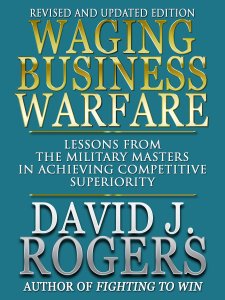
Order Waging Business Warfare: Lessons From the Military Masters in Achieving Competitive Superiority
Click on book image to order from Amazon.com
or
 had, but doesn’t. It is a highly-regarded journal and would enhance any serious writer’s reputation to appear in it. That journal had published other pieces of Kathy’s in the past during her particularly prolific period when work poured out of her and was in demand by editors and readers. Some of her books were being published at the time, and many of her articles appearing in magazines were achieving record readership scores.
 I am talking about the difference between writers whose overriding goal is to see their work in print–a Publication Focus–contrasted with writers whose overriding goal stops short of publication in which they are not interested. They are concerned solely with generating what is in their judgment the highest possible quality text–a Production Focus. The latter are more than contented to produce works they are proud of without seeing them published.
 matters to them is that the works they produce be the best they have the skills to produce. They believe that because they are not interested in publishing but in producing the highest quality work they can, they are more creative and do better work than they would were they competing with others to see their work in print, and there are grounds for that belief.
 produced was then graded by professionals–seasoned painters grading the paintings, experienced writers the writing, etc. The results were significant in that no matter what the reward was or when it was given, if the subjects thought they were working for external rewards, even a little trinket, and not for fun and pleasure, they became less creative. But when they were light-hearted and fooling around and no external reward was involved, they were more creative and their work was better.
 a clear, informative, and entertaining way concepts that were unfamiliar to western thinking. It was a challenge because the concept of the book was totally new and original. Every day’s work of many hours was fulfilling, I didn’t spend a second thinking about how my book would do in the stores, only about the book’s clarity and how useful I could make it and how inviting it would be for readers. It was a highly successful and profitable book and my ambitions for the next book I began were high. But I found my thoughts losing focus. They often wandered away from the book’s content and style and how to satisfy the reader to where I would build the new house the new book’s royalties would bring me and the kind of cars I would buy. Both books received many accolades and made best seller lists. But whereas I wouldn’t change a single word of the first book, I live with the knowledge that the second book could have been better.
 “One day I seemed to shut a door between me and all publishers. I said to myself, ‘Now I can write.” He started working on The Sound and the Fury, “thinking of books, publication, only in the sense in saying to myself, I wont (sic) have to worry about publishers liking or not liking this at all.”
 writing every day. Most of them quit because of the heavy, depressing weight of too many failures and too few–if any–successes and the toll of failures on one’s
  bored. Just as children do that, writers can do something remarkable. As fully absorbed as children, they can work on perfecting a single paragraph forty or fifty times without experiencing a moment of boredom while people who are not writers and think that one draft is sufficient are astonished that such a feat is possible. The conclusion of Amabile’s experiments was that a playful approach like that of children increases the likelihood of producing creative results, and that pursuing external rewards diminishes the person’s creativity.
 themselves) which Production Writers experience has been shown to improve the quality of the work that is produced. That is why so many famous writers think that they, and no one else, are the best judge of their work and why so many of them ignore or don’t ask for the advice of editors. Who enjoys being evaluated? Writers often dread evaluations, and evaluations negatively affect the writer’s mood and thus the quality of work that is produced. A Production Writer may ask for editorial assistance–to be helped–but not to be evaluated.
 and he suddenly was rich. On the other hand, when Ernest Hemingway was young and poor in Paris and unable to support his family with his stories he would catch pigeons in the Luxembourg Gardens when the gendarme on duty went into a café during his break, and then take them home and cook them. Some writers, like painters such as Pablo Picasso, love being rich. Picasso said he wanted to work without material worries “like a pauper,” “but with a lot of money.”
 What do geniuses talk about?
  One of the problems superb writers face is that they–and no one else–are the best judge of their work and yet they must endure sometimes ignorant, amateurish editors and critics. Henry Miller found himself being abused by editor after editor he submitted work to. He snarled, “Who are these shits? Where do they get off saying such things to me?”
 Sherwood Anderson died after swallowing a toothpick with a hors d’ oeuvre at a cocktail party. Katherine Mansfield married a singing teacher eleven years older than herself and abandoned him the morning after their wedding night. George Bernard Shaw said, “Experience is the name everyone gives to his mistakes.”
 ready to start writing. Ernest Hemingway had to first sharpen all the pencils he anticipated using that day. Edgar Alan Poe petted his cat before he started.
  Jonathan Swift, author of Gulliver’s Travels, went a year without talking to anyone. Truman Capote’s advice to young writers was to socialize and not “go up to a pine cabin all alone,” because “You reach that stage soon enough.” Voltaire preferred the company of his mistress. He wrote in bed using her back as a desk.
 Maurice Valency thought that failure is very difficult for a writer to bear, “but very few can manage the shock of early success.” P.G. Wodehouse said that success comes to a writer rather gradually, and that it is something of a shock to him or her to realize the heights to which they have risen.
 Playwright Lillian Hellman said writers are “fancy talkers about themselves.” She said that if she had to give advice to young writers she would say, “Don’t listen to writers talk about writing or themselves.”


























 davidjrogersftw