A serious writer has the identity of a writer, emphasizes the production of works, and is a skilled craftsman.
Serious Writers Have a Writer’s Identity
 Sometimes a person who one day will become a serious writer doesn’t know herself what she might do with her life. But she feels instinctively that she’s good for something and has some reason for existing. She has a hunch that there is something important in her that’s worth pursuing further. She finds that something in words. She makes herself into a writer–an expert in expressing herself via written language. At times, with some people, writing becomes the center of their identity, and they become another Saul Bellow who said that when he wrote he felt like an artist, but when he was not writing he didn’t feel like anything.
As a writer you’re specially endowed with (and may have been born with) not only “creative stuff” but with an assortment of personality qualities that equip you specifically for the writer’s role. And it’s that identity that gives you the sense that you’re a person with a definite life task—to write, to create. Whether you find writers in big cities or in remote jungles or rain forests and deserts you will also find them generally to be quite similar. Writers who succeed have a combination of such inner qualities as curiosity, obsessiveness, doggedness, and endurance. They’re playful, sensitive to life, open to experience, and have an abundance of physical strength, energy, and stamina. Often it’s the end of the writer’s endurance that stops her work day. They have a much higher tolerance for ambiguity than the great majority of people—one reason they’re usually such good problem-solvers.
Your everyday identity isn’t the same as your writer identity. The “you” that shines through a novel you’ve written isn’t the same person your neighbors know. It’s a version of you, but yet it’s different. As a writer you’ve a sensitivity to language which a person either possesses or does not possess.
Language—for a writer shaping it into phrases, sentences, and paragraphs–is delightful. Amy Tan wrote, “I am a writer. And by definition, I am someone who has always loved language. I am fascinated by language in daily life. I spend a great deal of my time thinking about the power of language.”
You know the basics of grammar (know a noun, a verb, and a preposition when you see them), and have the biggest vocabulary and highest appreciation of words, the greatest skill in using them, and the best ear for them. Most writers are able to produce large volumes of work. But that’s just the tip of the characteristics writers have in common and which make up the identity of serious writer.
Serious Writers Emphasize Production of Works
 A main goal of writers and all other creative people is to produce works. Writers make the structure of their creative lives by means of their work. If they are unable to work or the work doesn’t go well, they suffer. The writer–the artist, whatever the art–uses the art to express emotion and when they are denied that expression they feel tension and conflict.
Always have your production goals in mind: “The only certainty about writing and trying to be a writer is that it has to be done, not dreamed of or planned and never written, or talked about…but simply written” (Janet Frame). Saul Bellow said, “For the artist work is the main thing and always comes first.” Psychologist Howard Gardner writes about high-excelling creative people. He says, “Individuals whose stock in trade is to do things which are novel, are people who’ve got to have a pretty good command of how they work.” Psychologist Abraham Maslow said, “The fact that people who create are good workers tends to be lost.” The inventor, whether artist or thinker, creates the structure of his psychic life by means of his work…It is only as the work is done that the meaning of the creative effort can appear and that the development of the artist…is attained” (Brewster Ghiselin.)
In Art & Fear, authors David Bayles and Ted Orland write about what happens in a ceramics class that I’ve found also happens in a class of writers. You could take two imaginary groups of writers in a class—those on the left side of the room would be graded solely on the quantity of the work they produced. Those on the right side would be graded only on the work’s quality. On the final day of the class the teacher would measure the amount of work of the quantity group—500 pages an A, 350 pages a B, and so forth. Those the teacher graded on quality would have to produce only one story, but it would have to be perfect to justify an A.
A curious thing would happen. The quantity group would also produce the highest quality work. The quantity group would churn out streams of work and learn from their many mistakes and develop a wide variety of skills. But the quality group would get caught in the elusive concept of perfection and grandiose dreams and would become paralyzed. Some writers produce 10, 15, or 25 times more writing than others and those most productive usually rise higher, do better work, and find a greater sense of accomplishment.
Experienced writers almost always structure their work time and environment carefully. A perfect work place and good production routines and rituals are to be treasured. Simply by being there, ready to work repetitively the same time day after day, the power of good habits goes into effect. Some writer’s production habits will strike you as strange. The poet H.D. (Hilda Doolittle) splashed ink on her clothes to give her a feeling of freedom when she wrote. Hard-boiled detective writer Raymond Chandler could only write when he was drunk, and poet A.E. Housman rarely wrote unless he was sick. Voltaire wrote love poems in bed using his mistress’ back as a desk. I’m sure you have your own peccadillos too, and if we ever meet you can tell me about them. I’ll tell you about mine.
Writers’ production ebbs and flows. Some periods the words come out of you in torrents. You’re in overdrive–700 words a day, a thousand, 1,500, and every word is perfect. Other days they wouldn’t come out were you to use blasting powder. Some writers—most—find it easy to be distracted. Beth Henley, Pulitzer Prize winning playwright at 28, said, “I love to work, although sometimes I spend whole days doing nothing more than picking the lint off the carpet and talking to my mother on the phone.” Joyce Carol Oates says she squanders as much as 90% of her time writing letters—e-mails—to authors, her writer friends. “The problem is that they write back, and so do I. And suddenly the morning has vanished irretrievably.”
There isn’t one universal work/production program that suits all writers. A production program won’t work if it’s imposed on you. Your program will have to be custom-designed by yourself for yourself. To find the ways and means to improve your production should be a major aim.
If as a writer you’re productive, you’re happy. If you’re not, you’re unhappy. Ernest Hemingway, as hard a working and production-minded writer as there’s ever been, said that for him, “Work could cure almost anything.” But many writers aren’t successful because they haven’t figured out the best work/production program that equips them to:
- Focus on the work for desired periods of time
- Abandon what isn’t working, putting aside futile problems that will lead to dead-ends
- Free themselves from distractions and time-wasters
- Persist in the midst of obstacles and setbacks
- Maintain their energy
- Achieve a desirable level of output
Serious Writers Are Craftsmen
 The sciences and anything involving a machine are mysteries to me. I have no aptitude for them. Once I got hold of an old used paperback on how to become handy around the house and did some wiring and put in a light switch in the children’s bedroom without burning the house down. My children watched me and marveled. I swelled with pride. I felt I’d really accomplished something. I’d say to guests, “come upstairs for a second” and show them the light switch and brag, “I put that in.” A very unusual accomplishment for me. But writing I understand and am good at. I’m confident about it. It’s my best craft.
Writers are talented people who have open to them many routes that could enable them to express themselves. But they focus on writing. Everyone has one dominant ability, and writing may well be yours. Ernest Hemingway could have been a professional big-game hunter or deep-sea fisherman—he was that versatile. He said, “I like to do and can do many things better than I can write, but when I don’t write I feel like shit.” William Faulkner could have made it as a painter.
The craft you choose to try to excel in has to be appropriate and can’t be simply wishful thinking. A moment comes—an experience occurs—and you become aware that writing, not something else, is the direction that suits you best and will lead to a fulfillment you might not reach if you follow another route to another craft—the craft of the engineer, the attorney, the athlete, etc., for example.
Your aptitudes, personality, abilities, capabilities, temperaments, tastes, strengths, weaknesses, and interests are matched up first of all with a writing career and then with the kind of writing you wish to do. Will you specialize in fiction or non-fiction, drama, or poetry, novels or short stories, comedies or tragedies, or will you be a jack of all trades and write more than one? What you choose becomes the craft that’s your own.
Awakening to the realization that the writing craft is appropriate to you and you to it can strike at any time in a person’s life. Harriet Doerr finished her degree at 67 and won the National Book Award at 73. Englishman Thomas Chatterton was a mature poet by the age of sixteen. Poets, like mathematicians, mature very young. Dylan Thomas was at his most talented at nineteen.
A serious writer’s identity, production, and craftsmanship are three pillars of a structure of writing excellence.
© 2024 David J. Rogers
For my interview from the international teleconference with Ben Dean about Fighting to Win, click the following link:
Order Fighting to Win: Samurai Techniques for Your Work and Life eBook by David J. Rogers
Click on book image to order from Amazon.com
or
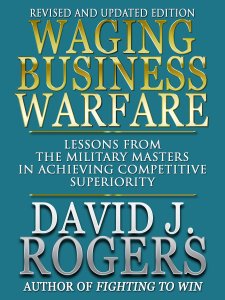
Order Waging Business Warfare: Lessons From the Military Masters in Achieving Competitive Superiority
Click on book image to order from Amazon.com
or
 If you are to be a writer who will be recognized, you must have faith that you have been created to be a writer, that writing is a destiny toward which your life has been aimed. Virginia Wolf and Toni Morison felt that way, and James Joyce, Dylan Thomas, and Ernest Hemingway. Many writers we haven’t heard of yet, but will, also feel that way. The faith that you are fated to be a writer is a writer’s first requirement. You must believe that it is when you are writing that you’re doing what you were brought into the world to do.
 History shows that writers who will amount to anything also all have an attitude of “seriousness” about their work and their lives: “This is my only life; I am not playing games. I try to write every day. I strive to get better and better still and will do that all my life.”
 As a writer you must be true to your awesome potential–must be in fact what you are potentially. If you are not doing enough with your gifts, your conscience lets you know. The conscience of a writer asks, “Who am I? Why am I here? Where am I going? Have I become what I should have become? If I have not become what I should have become, what will I do now?” Your writer’s conscience is the voice that calls you to be the person you are fully prepared to be, the uniquely talented writer you have been created to be.
 A writer begins with a talent. Talent is the raw material from which a writer’s career is shaped. Doing well what others find difficult is talent. It is not possible to describe the complete, complex structure of knowledge and skills the talented writer has acquired. The best predictor of future success isn’t just time spent writing, but the amount of time devoted to improving not just this skill or that skill, but the specific skills which are the most essential if a person is to become excellent--those ten or so necessary abilities they must possess if they hope to excel. Developing those skills is the first focus of a person on the Writer’s Way. Skills are taught–by a teacher, or a mentor, or they are
  contentment. “There is a blessed peace in a retreat that happens to suit my fraught nature…I arrive in a heaven…and I sink immediately in a sort of peace from life that I don’t seem to be able to find anywhere else” (Lynn Freed).
 Then, possibly without being aware of how it happened, out of the act of writing more frequently, acquiring knowledge of effective writing, involving yourself in the writing world, enduring at times frustration, suffering, and pain you wouldn’t have had were you not a writer, and growing in
  Writing as a Way opens up new facets of your being that you might not be aware of. You write regularly over an extended period of time–one year, five, ten, thirty, or fifty. It’s writing that you think most about and talk with other writers about and possibly bore your loved ones speaking about. Writing as a Way becomes an indispensable part of your daily and weekly life.
 When you’re writing, you’re focused. Your mind is sharp, crisp. Your thoughts don’t wander. You’re not thinking of anything else. A headache disappears. Worry about the rent dissolves. You forget about yourself, almost as though you’ve stopped existing except in the words you’re putting so carefully on the screen before you. You may be working on four, five, or six projects simultaneously, moving from one to another as the mood strikes, each project requiring different talents. When people don’t recognize the value and quality of your writing, your faith in yourself helps you persist. Poet Stephen Spender said, “It is evident that faith in their work, mystical in intensity, sustains poets.”
 The most distinguishing quality of creative people is a persistent and enthusiastic absorption in their work, in spite of any frustration and suffering they may endure. Creative talent is indistinguishable from passion and intensity. You can hardly call yourself creative without them. One reason writers who are experts are more accomplished than writers who are very good but not great is that experts are more passionate about writing and spend more hours at it, working six hours while less capable writers work two hours. The only way you could keep some people from writing would be to break their fingers.
 It is not unusual for writers and other artists fully absorbed in their work to be for that time in a
  In the arts,
  Through writing you’re drawing out of yourself all that is in you–all the knowledge you’ve acquired, all the experiences you’ve lived through, what your emotions are, what skills you bring, and what you aspire to become. You gain meaning in life and a better understanding of who you are through performing writing. You have the sense that you are a person who is able to reveal important things. Delving deeply, expressing to the world what treasures you have found, you are now an artist, a remarkable status you have achieved by following the Way of the Writer.
 Although talent in the arts most often shows itself early, because it takes so many years to develop their talent and become highly proficient in the arts, people who will become expert musicians, painters, performers, and writers can expect to be late bloomers. Artists who perform at a high level do not demonstrate remarkable talent in short order. They are not usually in their twenties or thirties, but in their forties, fifties, and sixties. All spend many years developing the knowledge, attitudes, and skills that will eventually enable them to be recognized for their mastery. All arts involve learning form and the art’s devices, and the need for control, craft, revisions, and structure–time consuming efforts. All begin by imitating existing techniques they have studied.
 A survey of 47 outstanding instrumentalists found that their ability was first noticed on average at the age of four years and nine months. Then they began a very long and arduous period of development of their talent. Pianists work for about seventeen years from their first formal lessons to their first international recognition, involving many thousands of hours of intense practice. The fastest in one study was twelve years, and the slowest took twenty-five years. In other fields you may even be an early bloomer, but in the arts if your expertise is to be at a high level of mastery, unless you are a Dylan Thomas, a rarity who was at his peak at nineteen, you had best avoid discouragement and expect to bloom late.
 Novelist
  When the majority of their friends and associates are settled in a career and life style, late bloomers are not. Late bloomers may eventually reach the height of their achievements and fulfillment which I call “their true
  If you’re a late bloomer, you’ve made false starts. You haven’t peaked yet, haven’t reached your destiny yet, but you may be determined to bloom one day. Late bloomers are more willing than most to persevere and if need be to fail but try again and again until they reach a life they desire. If you are a late bloomer, more than most people you have the sense that you’re constructing yourself as you go along, even rejecting what other people may call golden opportunities if those opportunities don’t appear to lead you in the direction you desire most.
 with the goal in mind for me to have a national television talk show. It was an excellent opportunity and would have paid extremely well. But my wife and I talked it over and I decided that what I wanted to do with my life above all else was simply to sit at a computer in my upstairs work room while my four children played noisily downstairs and my wife came up once in a while to say hello, and produce artful paragraphs that reflected my years of hard work and training. To me that was blooming. I turned the opportunity down. Late bloomers often make similar very difficult decisions while they are constructing themselves.
 Most people–possibly all–who find fulfillment later in life find it in a mission, calling, or vocation. You cannot be dissatisfied when you’re doing the work for which you feel you were brought into the world, a thought that consoled
  Going back to school as a transition to another field is a strategy late bloomers find appealing, in essence ending one career and starting another.
 Have you bloomed? If you haven’t what are you going to do about that? People who aren’t leading satisfactory lives haven’t bloomed at all, and many are trying to, but many have never started trying, and just as many have given up. Better to start if you haven’t already, whatever your age or condition in life. You can always forget the past and start out again, making no excuses for starting out late. Experiment, follow your instincts, and assess yourself and your feelings about your life. Are you going right or are you going wrong?
 Buddhism sets up qualities a life must have if the person is to find fulfillment. One quality is “Right Livelihood:” To be most fulfilled the person must be in the occupation that most suits them and is most beneficial to them. My wife and I have four children. Each is very different than the others but is perfect for their occupation. The analytical one who loves mathematics is the director of revenue for a city. The organized one manages a number of people. The one who wants to help people is a therapist. The most sociable one is a real estate agent helping people find the home they will be most happy in.
 All necessary components have to be present if you are to excel at the writer’s craft. If just one component is missing, you no longer have an ideal writer. If you are to succeed in an art there must be a fit between the talent you possess and the talent necessary to participate with distinction in the art.
 Writers and other artists should be able to recall many thousands of detailed memories that form a basis of their writings–a gift to recall sensations and experiences from many years earlier and to reconstruct them in their original freshness and vividness.
 Good writers can do that, but not all writers can, even some writers who work very hard trying to learn how to. Think of any writer’s skill–some people will master it easily, some only with great difficulty, and some will never master it. Whatever they do, some writers’ scenes are not effective.
 A writer should have an insatiable passion to write and the skill of persistence. Joyce Carol Oates is a prolific author of fifty-eight novels for a reason. She has good writing practices, and finds no reason why one who professes to be a writer shouldn’t be writing all the time. She says, “When writing goes painfully, when it’s hideously difficult, and one feels real despair (ah, the despair, silly as it is, is real!)–then naturally one ought to continue with the work; it would be cowardly to retreat. But when writing goes smoothly–why then one certainly should keep on working, since it would be stupid to stop. Consequently one is always writing or should be writing.”
 Andrea, a friend—“Andy”–seemed to reach her peak when she had two short stories published in prestigious literary journals at twenty-four and a novel that sold moderately well at twenty-eight. She didn’t think then it would be her peak, but assumed it was a preview of other successes soon to come. But they haven’t come and she’s been wondering what’s wrong with her.
 path to solving the problem by admitting she’s found herself on a performance plateau—in a performance rut.
 decides they are different. The earlier work was simpler and more heart-felt and sincere. She realizes that she has fallen into a trap of “showing off”–of trying to impress readers with what a good writer she is and how brilliant she is rather than in telling a story in a simple, direct, “Here’s my work, take it or leave it” style.
 She also plans to read biographies and autobiographies of writers living and dead who will inspire her.















 davidjrogersftw