In my book Fighting to Win I describe in detail Budo, the Way of the samurai warrior that proved to be of interest to many people internationally. Just as the Way of the samurai has fascinated me for decades, there is a Way of the Writer which I have long been actively involved in that I would like to describe here as I conceive of it.
A Way is more than a discipline. It is a style of practicing a skill or art that embraces the heart, spirit, and mind of the practitioners of the Way–the beginners who devote themselves to the Way and become masters.
Developing into a Writer Following a Way
 A writer begins with a talent. Talent is the raw material from which a writer’s career is shaped. Doing well what others find difficult is talent. It is not possible to describe the complete, complex structure of knowledge and skills the talented writer has acquired. The best predictor of future success isn’t just time spent writing, but the amount of time devoted to improving not just this skill or that skill, but the specific skills which are the most essential if a person is to become excellent--those ten or so necessary abilities they must possess if they hope to excel. Developing those skills is the first focus of a person on the Writer’s Way. Skills are taught–by a teacher, or a mentor, or they are self-taught. Many of the most successful and distinguished writers taught themselves.
You read about writing and famous writers and may take classes and may belong to writers’ groups. You may go to writers’ retreats and find  contentment. “There is a blessed peace in a retreat that happens to suit my fraught nature…I arrive in a heaven…and I sink immediately in a sort of peace from life that I don’t seem to be able to find anywhere else” (Lynn Freed).
Someone mentors you or singles you out and offers help. You apply yourself and develop a solid foundation in the mechanics of writing, and branch out into in your specialty and learn its mechanics and then range far beyond the mechanics, becoming a proficient writer, then excellent, then superb, masterful.
You may be a natural-born novelist, or essayist, playwright, poet, or screen writer, or you may begin writing no more promising than anyone else. But at some point—it could be at the age of seven or forty or sixty five or at a bleak crisis or turning point or epiphany in your life–if you are on the first steps of the Writer’s Way, you begin to write more purposefully, mindfully, self-consciously, and ambitiously. Your goals grow higher, your future path a little less faint.
 Then, possibly without being aware of how it happened, out of the act of writing more frequently, acquiring knowledge of effective writing, involving yourself in the writing world, enduring at times frustration, suffering, and pain you wouldn’t have had were you not a writer, and growing in confidence, your writer’s style and voice growing clearer, you are “taken” by the craft of writing fully and completely–unequivocally.
You find yourself a practitioner of the Way of the Writer. As a writer involved in a Way you are willing to give up other rewards for the sole experience of writing because for you writing is satisfying in a way few if any other things are. It is not so much the content of the writing you do that accounts for your pleasure, but the process of writing that brings joy in and of itself. The biographies of great artists make it clear that the creative urge often “yokes everything to the service of the work” (Carl Gustave Jung). For most serious writers, to write itself is more rewarding than the acclaim they receive.
What It Feels Like If You Are On the Way of the Writer
 Writing as a Way opens up new facets of your being that you might not be aware of. You write regularly over an extended period of time–one year, five, ten, thirty, or fifty. It’s writing that you think most about and talk with other writers about and possibly bore your loved ones speaking about. Writing as a Way becomes an indispensable part of your daily and weekly life.
At times writers on a Way write night and day, revision upon revision, embellishing, reworking, cutting, shaping and reshaping, and finally deciding if the work is done and ready “to go out.” Although writing is often grueling, tedious, and not easy but difficult to master, few other things matter as much to practitioners of any of the arts as sweat and work. When you’re away from writing, you crave it. If you’re away too long, you become edgy, nervous, and irritable. The only relief is to get back to the writer’s work you adore. You try to write at least one hour every twenty-four. Gertrude Stein said that even though she had never been able to write more than a half hour a day, all day and every day she had been waiting for that half hour.
Something you find essential in the act of writing keeps you going and makes you return to it again and again in spite of the setbacks and deep disappointments every writer knows well. There is “just something about” putting words together, of experimenting with ideas, of holding them in your mind as you would analogously hold a ball in your hand, and of the emotional release of “losing” yourself in the work, of having a penchant for detail because writing is an art of detail.
 When you’re writing, you’re focused. Your mind is sharp, crisp. Your thoughts don’t wander. You’re not thinking of anything else. A headache disappears. Worry about the rent dissolves. You forget about yourself, almost as though you’ve stopped existing except in the words you’re putting so carefully on the screen before you. You may be working on four, five, or six projects simultaneously, moving from one to another as the mood strikes, each project requiring different talents. When people don’t recognize the value and quality of your writing, your faith in yourself helps you persist. Poet Stephen Spender said, “It is evident that faith in their work, mystical in intensity, sustains poets.”
The joy and exhilaration you receive on the Writer’s Way even from the physical act of sitting at the computer, taking a first breath of your work day, getting ready to write, and touching the keyboard with your fingertips, or the thrill at the design of the text on the computer screen is beyond the experience and comprehension of non-writers. Those aspects of the writer’s life add up to an experience which is often as necessary to the writer’s wellbeing as loving and being loved.
 The most distinguishing quality of creative people is a persistent and enthusiastic absorption in their work, in spite of any frustration and suffering they may endure. Creative talent is indistinguishable from passion and intensity. You can hardly call yourself creative without them. One reason writers who are experts are more accomplished than writers who are very good but not great is that experts are more passionate about writing and spend more hours at it, working six hours while less capable writers work two hours. The only way you could keep some people from writing would be to break their fingers.
When you are a writer on a Way, when you’re writing you are in your element and are maximally effective. You have high aspirations. You’re willing to sacrifice other pleasures and have a need to do your work without being interfered with, to be free of conflicts that impede your writing goals.
At times you live with uncertainties, doubts, and tension. But over the months or years you develop strength, confidence, and faith in your abilities and judgment. If asked, you’d define yourself as creative, inventive, determined, and enthusiastic. You’ve found that you have good insights into your capabilities and are aware of those you lack. The hardships, worries, disappointments, and stresses you encounter—if they don’t drive you away from a Writer’s Way–play a necessary part in making you stronger. There are many things you can’t do well that other people are far better at. But one thing you can do is write better than most other people.
 Whatever your mood, even if grim, writing make you feel beater. Pleasure increases the more you write, partially because you work independently, isolated and self-sufficient. Since creative achievers typically engaged in solitary activities as children, you’re no stranger to working alone. “Aloneness…is not merely the effect of the circumstances in the life of creators: it is often also part of their personality–for the creator is frequently apart and withdrawn even in the presence of others, and makes a deliberate attempt to seek solitude” (R. Ochse).
The more you write, the more automatic your writing becomes. Then it is done without the interference of thought, like a bead of dew dropping simply and directly from a leaf: “My work is done at a subterranean level and as fragments come to the surface, I record them as they come up” (Katherine Anne Porter.)
Writing Is Blissful, but Painful
Virginia Woolf referred to a writer’s “rapture.” She said, “Perhaps this is the strongest pleasure known to me. It is the rapture I get when in writing I seem to be discovering what belongs to what, making a scene coming right, making a character come together.” That rapture is what writers often experience while writing, engaged in the Way of the Writer.
 It is not unusual for writers and other artists fully absorbed in their work to be for that time in a state of ecstasy while they think, “What I am working on is essential to my fulfillment. I will be tenacious; I will persist for long periods without being diverted and try to make my work exceptional and appealing to an audience, applying all the skills of the craft I’ve labored so diligently to develop.”
But a person on a Writer’s Way is not spared emotional and physical suffering. George Orwell thought that writing a book was “a horrible, exhausting struggle, like a long bout of some painful illness” that writers are driven to by a demon they don’t understand but can’t resist. French novelist Gustave Flaubert wrote a friend, “You have no notion what it is to sit out an entire day with your head between your hands beating your unfortunate brains for a word.” Julian Green wrote, “if only people knew what lies at the heart of my novels. What a tumult of desires these carefully written pages conceal! I sometimes have a loathing for the furious cravings that give me no peace except when I am writing.”
Following a Writers Way, You’re a Seeker and Teller of Truth.
 In the arts, Anton Chekhov said, one must not lie, but must always be truthful. You’re trying to find what your truth really is and how best to express it and not deviate from it so that readers will understand it and find value in it and trust you. It is only through your writing that the truths you’ve discovered, and now believe in and strongly feel, will be expressed. How hard and how long you’ll have to work to express your truth is unimportant because every time you write it’s a coming into your own, a renewal of the best you have to offer the world.
The logical end of the Writer’s Way is to become a capital W writer, a Real Writer–to become known by your family, friends, teachers, editors, agents, and readers, and to define yourself as “someone who is very serious about writing.” Juvenal expressed the truth that “The incurable itch of writing possesses many.” Why across the world in every hemisphere and country is that true?
 Through writing you’re drawing out of yourself all that is in you–all the knowledge you’ve acquired, all the experiences you’ve lived through, what your emotions are, what skills you bring, and what you aspire to become. You gain meaning in life and a better understanding of who you are through performing writing. You have the sense that you are a person who is able to reveal important things. Delving deeply, expressing to the world what treasures you have found, you are now an artist, a remarkable status you have achieved by following the Way of the Writer.
© 2021 David J. Rogers
For my interview from the international teleconference with Ben Dean about Fighting to Win, click the following link:
Order Fighting to Win: Samurai Techniques for Your Work and Life eBook by David J. Rogers
Click on book image to order from Amazon.com
or
Order Waging Business Warfare: Lessons From the Military Masters in Achieving Competitive Superiority
Click on book image to order from Amazon.com
or
 If you want to be successful in the arts, be older rather than younger. Older is better because most outstanding contributions to the arts are not made by people in their teens, 20s, 30s, or 40s, but in their 50s, 60s, and 70s. Why is that so? The main reason why, artistically, older is better than younger is that to have the ability to do artistic work expertly and do increasingly superior work, the main factor is the artist’s KNOWLEDGE and its PRACTICAL APPLICATION over a period of time that is often long.
 No artist has ever lived –Shakespeare, Michelangelo, Proust, Picasso, Mozart–who had so much talent that they didn’t need considerable knowledge to excel at a high level. Talent is a blessing, but talent alone isn’t enough.
 In any field in which you are intensely engaged, such as serious writing or painting, the brain you feed with knowledge just goes on learning and learning and learning and your abilities grow and grow. The more knowledge you have, the faster you’ll recognize related information that’s relevant to solving problems you are facing. You’ll be able to say, quite quickly, “So-and-so handled the problem I’m now facing by…” Acquiring knowledge is what you are doing all the time you’re working at your craft, talking with others about your craft, studying it, taking classes, reading, and practicing to develop your skills.
 The more knowledge that is needed to excel in a field, the more
  Following in the footsteps of the greats is a vital route to writing knowledge, and knowledge leads to skills, and skills coupled with confidence lead to success. What helps is an aptitude for learning and learning fast, which I can hardly imagine a person in the arts not possessing.
 Let’s hope that your mind is a sponge sopping up knowledge because people in the arts who can acquire knowledge quickly and remember large amounts of it have an advantage when trying to create something original.
 fix. I was writing what should be an easy section on planning what you are about to write or paint. Now planning is something I know a lot about. For years I was a trainer for a consulting company I founded. I trained thousands of people to use the best techniques of planning so they might effectively plan whatever business or career project they had in mind.
 Even as children girls and boys who will become writers and painters when they grow up have been told and taught by teachers to plan the work before they begin to execute it. They are taught that in grade school, and in graduate school professors or experienced visiting artists and writers stipulate that every work should have a plan. Planning becomes a habit that isn’t questioned because “everyone knows you have to have a plan before you begin. How else will you know how to proceed?”
 Some creatives meticulously plan and think the work to be produced through to the last detail. But some non-planner creatives begin to paint or write without a subject in mind, preferring to permit the work to grow organically and emerge. Some writers, like me, begin without any conscious concept of how to proceed other than, at best, a notion not at all well-developed of what the work should probably be about.
 Non-planning Virginia Woolf said that her idea for Mrs. Dalloway started without any conscious direction. She thought of making a plan but soon abandoned the idea. She said, “The Book grew day by day, by week, without any plan at all, except that which was dictated each morning in the act of writing.” Had someone asked her what exactly she was trying to accomplish other than to follow a woman throughout a day she would have replied, “I’m not sure.” The planner- writers are sure of where they are going. Their plan tells them.
 The more spontaneous process which non-planning creatives like greats Woolf and Mark Twain (possibly America’s greatest writer) and Michelangelo and Leonardo da Vinci use to complete a work is contrary to the rational goal-setting, plan-making processes. Following a plan inhibits certain creatives for whom a more spontaneous approach results in better work.
 Galenson describes two significantly different types of artists. The “everything must be planned” artists are called Conceptualizers: they must have a full-blown concept of the work they wish to create in all its detail before they begin writing or painting the work. Ernest Hemingway, William Faulkner, James Joyce, Herman Melville, and F. Scott Fitzgerald were Conceptual writers. Pablo Picasso was a Conceptual painter. Conceptualizers state their carefully- wrought goals for a particular work precisely
  Once Conceptualizers find the crucial problem they advance slowly with a plan, but Experimentalists move fast without a plan. Experimentalist’s goals are imprecise. They have ideas about what the work will be like when it is finished, but are unclear about everything else until the piece is written, the painting mounted on a wall. That imprecision is how Experimentalists like to work, but it creates problems. Not clear as to what they want the final work to look like, they have trouble finishing works.
 Conceptualizers tend to bloom early, often with a striking new style or innovation or great success at the start of their career. They mature quickly, starting very early, not gradually through years of trial and error as Experimentalist painters like Jackson Pollock and Claude Monet did, but rapidly. A young Ernest
  People in every walk of life and in every hemisphere on earth–in cities, on deserts, in towns and villages–long to create something. My nine year old grandson is a talented artist and cellist studying architecture. His six year old sister takes dance and will begin taking piano lessons in the fall. Their forty two year old father was an excellent cellist in his youth and was inspired by the performance of a famous cellist to return to it last year. My wife, is a former cellist, and has taken up water colors and has returned to the piano. I write every day. I have for many years, and when I am not writing I am thinking about it and planning what I will write. We are representative people no different from millions of others with whom we share the globe because the current era is an Age of Heightened Creativity. Little children and women and men of all ages are bent on having creative experiences. They will not let their creative instincts be stifled.
 It became a permanent part of your entire being–an idea, a theme, or an image that became a guiding force in your life. You may not be conscious of it, but it starts you out in a creative direction, and gives you a sense of moving steadily in that direction, of heading straight toward something concrete and specific. Making a living in art is difficult and so most artists must find financial security other than in art. But whatever your occupation if you are to be an artist you will define yourself first as an artist, an accountant, HR manger, or English teacher second.
 Noted composers and performing artists in musical fields–so sensitive to sound and tone—possess what the Germans call Horlust–“hearing passion.” Writers–particularly poets and lyrical writers–have a word passion (they adore words), and painters adore colors and shapes, often from the cradle.
 What is inside the shut door is the artist’s rich inner life from which creative products pour–without stopping if the artists explore themselves more and more deeply. Transformation of what is inside the artist into what is outside is the
  Poet W.H. Auden wrote, “Speaking for myself, the questions which interest me most when reading a poem are two. The first is technical: ‘Here is the verbal contraption. How does it work?’ The second is, in the broadest sense moral. What kind of guy inhabits this poem? What is his notion of the good life or the good place? His notion of the Evil One. What does he conceal from the reader? What does he conceal even from himself?” William James said it is the amount of life in the act of creation which artists feel that makes you value their mind.
 Artists must be people of action because their main goal is production of works over which they think and
  Children and adults may drop out, but those who turn to art may well be playing the cello or dancing or painting, only getting better and enjoying their art perpetually–all their lives– with fond
  Andrea, a friend—“Andy”–seemed to reach her peak when she had two short stories published in prestigious literary journals at twenty-four and a novel that sold moderately well at twenty-eight. She didn’t think then it would be her peak, but assumed it was a preview of other successes soon to come. But they haven’t come and she’s been wondering what’s wrong with her.
 path to solving the problem by admitting she’s found herself on a performance plateau—in a performance rut.
 decides they are different. The earlier work was simpler and more heart-felt and sincere. She realizes that she has fallen into a trap of “showing off”–of trying to impress readers with what a good writer she is and how brilliant she is rather than in telling a story in a simple, direct, “Here’s my work, take it or leave it” style.
 She also plans to read biographies and autobiographies of writers living and dead who will inspire her.


 From childhood on, there have been moments in my life–and I think you have experienced this in your life too—when I’ve had to perform and no one could help me—not my mother, not my wife, not a friend.
 It’s very lonely knowing that whether or not you will succeed depends solely on your own skills, your own personality and character, your own preparation, and your own strengths. Then no one can help you, no one can write the novel for you, no one can paint the portrait for you today, or dance in your place, or perform your role in tonight’s play. You’re on your own, my friend. Will you be at the height of your talent today or won’t you? Will you have it? Will your work be good? Will you be satisfied?
 When you write, you’re asking yourself, “Does it sound right?” “Does it flow?” “Is it a good quality?” You’re also “self-instructing.” Self-instruction is talking to yourself to guide actions and telling yourself what strategies you should use. A writer may self-instruct to use more imagery in the story, and self-monitor to count the number of images or tell herself, “My mind is starting to wander. I should focus my attention better.”
 Boil your whole performance down to a few statements, words, phrases, or images:
 finishing, you’ve developed a bad habit and you’d better do something about it.
 start another contrary, more fruitful habit. To break the habit of consistently not writing, you develop the habit of writing regularly. To combat the habit of quitting too soon, you make yourself not quit.
 You’re not a child or hedonist, a worshipper of permissiveness and pleasure who doesn’t have any will power. There are many writers who write not the traditional four or fewer hours daily, but put in eight hours a day, much longer than the majority, considering themselves no different than their parents who worked eight hours a day and the majority of the work force who work eight hours daily.
 It takes longer to completely absorb yourself in an ambitious project than in an easier, less complicated one. And during that period, distractions seem to come up out of the ground. Any intrusion on the delicate world of a creative mind can make that world disappear. Every intrusion not only robs you of time, but also of the time it takes you to recover. If you set a goal of working a three-hour session and have three interruptions you may be busy for three hours but only do fifteen minutes of actual work. If you try to do four things simultaneously, you’ll probably only finish one, at most two.
 Don’t let a
  work that leads to the fulfillment of your gifts over the avoidance of work.
 Why what I’m going to say now is true, no one has been able to figure out, but almost all people relax their efforts when they get close to achieving even their most important goals. They struggle and struggle and then seem to get lazy and disinterested. They are like a sprinter who runs fast to the tape and slows down or stops. But good coaches advise runners to “run through the tape.” Whatever you do, don’t relax just when you’re getting close to success, but persist in applying your utmost energy
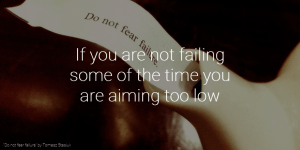 Why are you and I so afraid of failure? Many people live in terror of it and feel they must never fail, but always succeed, trailing clouds of glory. Yet failure can be a blessed life-changing event. If you experience only successes, you come to expect quick and easy results, and your sense of confidence is easily undermined if you suffer a setback. Setbacks and failures serve two useful purposes: Not only do they show us that we need to make changes and adjustments in order to gain the success we are seeking, but also they teach us that success usually requires confident, persistent, skilled, focused effort sustained over time. Once you set failures aside and become convinced that you have what it takes to succeed, you quickly rebound from failures. By having courage and sticking it out through tough times, you come out on the far side of failures with even greater confidence and commitment.
 The effect of
  Confidence is needed if you are to be successful as an artist. Make it a point to never lose confidence. If you find yourself losing it, use affirming statements, such as “I can do this; I believe in myself.’
 The most successful people have high career aspirations, are confident, and generally attribute their success to high effort and failure to lack of effort.
 Creative people who are the most likely to ask for help are those with a high opinion of themselves, while those with a low opinion of themselves are the least likely, although they may be the most in need of it and would profit from it. Asking for help shows that you’re serious about reaching your goals. Useful feedback can help you evolve and reach high levels of satisfaction and achievement.





 davidjrogersftw