When a new and different style in the arts first appears, it is not welcomed. Innovation clashes with the artists, critics, teachers, and the public whose tastes currently dominate the art and is greeted with ridicule and contempt. Such was the case with painting’s Impressionism. It was distained, laughed at, and belittled by the establishment.

Monet: The Garden
The central members of the group of artists we call Impressionists met each other in cafes, studios, and galleries in the early and middle 1860s, and by the end of that decade had worked together long enough to identify themselves as a group. Among them were Claude Monet, Gustave Courbet, Edouard Manet, Camille Pissarro (the oldest and most steadfast of them), Edgar Degas, Auguste Renoir, Alfred Sisley (the least well known), Mary Cassatt (an American), Berthe Morisot( the most misunderstood) and Gustave Caillebotte. The paintings they created are arguably the most beautiful and accessible in the history of art.
In time, Impressionism established itself as a major force, then became the most popular style of panting in the West. Its appeal passed on quickly to painters in other countries and to all other arts, including the music of Frenchman Claude Debussy whose Impressionist compositions such as Prelude a L’après-midi d’un faune changed forever the very sound of music, and the Impressionistic literature of popular American writer Stephen Crane.
Just as no two Impressionists were exactly alike–Degas the son of a wealthy Parisian banker, Renoir the son of an impoverished tailor, Cassatt a Philadelphia socialite, Pissarro a Danish citizen educated in Central America–so no two Impressionists were trying to accomplish exactly the same thingsin their art.

One of the most flexible aspects of the Impressionist movement was its refusal to be highly defined. There was no doctrine of Impressionism and there were never rules. There were no clear standards on which to judge a work. The early Impressionists painters shared with the novelists, playwrights, and composers of their generation a fascination with “the here and now,” the wish to represent their own time. Impressionist paintings, prints, and drawings of the streets and locations in Paris and its surroundings reflect their world so accurately that they can be dated.
As a school of painting, Impressionism culminated the art of the nineteenth century. It fused together the contributions of conflicting schools in a way that led painting to the art of the twentieth century, partially as a continuation of Impressionism and partially as a reaction against it.
However different their concerns, all Impressionists shared an interest in the effects of light on objects, none of them more than Claude Monet (1840-1926), to whom light became a long obsession.
An Impressionist wants to reproduce the effects of light rather than the form of the object that is reflected in the light–a painting of a yellow flower only as the impression of light made on the artist.
Claude Monet
 Monet was the most renowned and most influential pioneer of Impressionism–the giant of Impressionism. Painting out of doors, Monet devoted his life to creating new ways of capturing light’s changeable qualities on canvas. A 12:00 p.m. sunlight is not the same as a 4:00 p.m. sunlight, or even a 12:05 sunlight or 12:10 sunlight. Early evening sunlight is similar to but, different from morning sunlight. The suns of one month are different from the suns of every other month. Such facts filled Monet’s thoughts.
Monet was only twenty-seven when he painted The Beach of Sainte-Adresse, and shortly after painted On the Seine at Bannecourt, which though painted in brilliant hues, lacked a clear subject or a focus on any part of the landscape. These were thoroughly unconventional landscapes that were in every respect ahead of their time.
The lack of a central focus made On the Seine at Bennecourt more appealing. Monet realized that The Beach of Sainte-Adresse was so unusual, and in a way shocking, that he didn’t publically display it for ten years, until the public was more ready to “understand” it. The Seine at Bannecourt has been called the first truly Impressionist landscape.
Monet was a high-energy, insatiable worker. He strove continually to develop and refine his own art, and through his art, advanced the development of the art of Western painting. Many years passed before the full scope of his talents were recognized. Yet, working alone without a powerful patron, the importance of his vision of art was recognized during his lifetime. Unlike many pioneers who pass away uncelebrated and in poverty, Monet would end his life prosperous and acclaimed.
The Mind of a Scientist
The scientific method involving theories, observations, and experiments appealed to Monet. He had a scientist’s mind, testing his theories and carefully recording the effects of his experiments that focused on sunlight. The emphasis on the subject at “a particular moment of time” that he sought to capture in his paintings–which he termed “instantaneity”– is akin to what the French call un coup d’oeil. It means “something perceived in the blink of an eye.”

Monet: Waterloo Bridge in sunlight
“The quality of instant vision, the subject revealed in a momentary aspect, takes on more importance in Impressionism than it ever had before…The pure Impressionists will paint as if they had caught the subject unaware in a chance gesture, “(John Canaday.) In painting colored light Impressionists break the surface of the canvas into thousands of fragmented tints.
Monet became so focused on light–to reducing all visual experiences to pure light–that when his young wife died, he was horrified to find himself analyzing the nacreous tints of her skin in the early light.

Monet: Waterloo Bridge in Fog
As his fascination with light grew, he expressed the wish that he had been born blind in order to paint objects without knowing what they were. He began more and more to develop the ability to look at a scene or an object and see light and nothing but light.
His Aims Change
His aims in his art changed as he more and more deeply immersed himself in theoretical thinking about his art. In his early painting, like any artist he is absorbed in the pleasure of the subject–what is being shown in the painting. Apparent too is his joy in the act of painting, of the inventiveness and energy involved in the painter’s craft and a participation in a real-life world of sunlight, air, and flowers.
He then experienced the change from being a painter whose role was to respond to nature into a painter who became fascinated and preoccupied by an abstract problem.
Saint-Lazare Train Station and the Field of Poppies
The 1877 Impressionist exhibition included in one room seven paintings of the surviving twelve painted by Monet of the Parisian depot Saint-

Monet: Saint Lazare Train Station
Lazare. They were the first series of Monet’s long career to explore a single subject at different times and under different conditions of light and dark.
It has been said that Monet convinced the station master that he was a famous artist in order to persuade him to run the engines while the trains stood still so they would make billowing clouds of steam. It was from the Saint-Lazare station that artists took trains to virtually all the landscape sites that the Impressionists preferred.

Monet: Field of poppies
Thirteen and fourteen years later Monet chose to paint in three paintings the difficult subject of poppy fields. They were challenging because the intense greens, reds, and oranges of the fields were affected very little by atmospheric conditions. To compensate he looked tor variety in the skies and the shadows in the trees. The poppy group was followed by another series of five paintings of ripening wheat, and that series was followed by The Haystacks.
The Haystacks Paintings, the Rouen Cathedral, the Pool at Giverny
In his later paintings Monet’s fascination with the scene became a devotion to the technical process of painting works that illustrate a style he was seeking to create. Monet was analyzing the relationship between color and sunlight in a variety of stages between early morning light, the bright light of midday and evening half-light exhibited a series of fifteen paintings of haystacks he painted in 1891 in different lights at different times of day.
 Monet became obsessed with the sculptured shape of haystacks and with the dramatic contrasts of light and shade inherent in their form. The haystack paintings were a great success and led Monet to a more elaborate analysis of the effects of light on objects.
Monet painted forty pictures of Rouen Cathedral on gray days, bright days, in early light, late light, full light, and light at different seasons of the year. The Rouen pictures were followed by another series of a perfect subject.
For the subject that would absorb him most Monet need go no further than his garden. He preferred to reside with his family in spacious suburban houses with elaborate flower gardens and immense day-lit studios. In the garden of his house in Giverny was a pool of water lilies that took his attention in the 1890’s. He discovered in the pool and its surfaces, leaves, and blossoms that floated on it his subject for the rest of his life–the translucent petals of the blossoms, the leaves half-submerged in the water the same color with light glancing off surfaces, the whites and rainbow tints.
From the Effects of Light to an Art of Abstract Surfaces: The Water Lilies Period
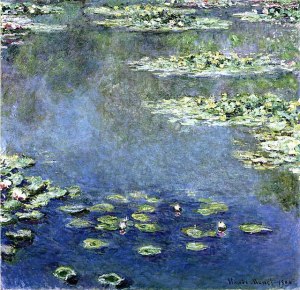 Monet gradually transformed his art from painting spontaneous approximations of the effects of light and atmosphere to an art of abstract surfaces existing for themselves. The focus of his art became the surface of pools and areas where the balance of water, light, air and the delicate substance of blossoms co-mingled, echoed each other, crossed on another’s boundaries, and blended together so that there was no difference between them. His last works were a series of large decorative panels in which the forms of nature are difficult to distinguish.
 If the water lilies are thought of as real-life water lilies they become a great disorderly mass of arbitrary color. But if the water lilies are considered abstract arrangements of color applied in careful strokes they coalesce meaningfully.
Through his obsession with light, his energy, work ethic, scientist’s mind, craft, and controlled experiments, Claude Monet took Impressionism to its limits–and beyond.
© 2023 David J. Rogers
For my interview from the international teleconference with Ben Dean about Fighting to Win, click the following link:
Order Fighting to Win: Samurai Techniques for Your Work and Life eBook by David J. Rogers

Click on book image to order from Amazon.com
or
Order Waging Business Warfare: Lessons From the Military Masters in Achieving Competitive Superiority

Click on book image to order from Amazon.com
or
 Whether you find creative people in remote little mountain kingdoms accessible only by mule or in big, modern, cosmopolitan cities, you will discover that they are surprisingly alike. The many traits they share are not all favorable; some are obstacles. Yet those traits–the worst and the best together–prepare creative people for fascinating lives other people look at with admiration and envy.
 May be “overlooked” as school children. Their talents unrecognized, they may have undistinguished elementary and high school careers, only to be recognized for their significant achievements later in life to the surprise of everyone.
 Sadly, at times may be too emotionally ill to work, particularly poets and writers who may be victims of the high and inexplicable incidence of debilitating
  Have an insatiable need to
  “Know who they are.” Are marked by a clear, unambiguous sense of identity, as “I am an historical novelist specializing in women’s roles in England during the Victorian era.”
 Can be playful, child-like, humorous, silly, fun to be with, and seem younger than their age.
 Benefit from a rare a
 For survival must become skilled at overcoming obstacles, of which there are many in the arts.
 People in every walk of life and in every hemisphere on earth–in cities, on deserts, in towns and villages–long to create something. My nine year old grandson is a talented artist and cellist studying architecture. His six year old sister takes dance and will begin taking piano lessons in the fall. Their forty two year old father was an excellent cellist in his youth and was inspired by the performance of a famous cellist to return to it last year. My wife, is a former cellist, and has taken up water colors and has returned to the piano. I write every day. I have for many years, and when I am not writing I am thinking about it and planning what I will write. We are representative people no different from millions of others with whom we share the globe because the current era is an Age of Heightened Creativity. Little children and women and men of all ages are bent on having creative experiences. They will not let their creative instincts be stifled.
 It became a permanent part of your entire being–an idea, a theme, or an image that became a guiding force in your life. You may not be conscious of it, but it starts you out in a creative direction, and gives you a sense of moving steadily in that direction, of heading straight toward something concrete and specific. Making a living in art is difficult and so most artists must find financial security other than in art. But whatever your occupation if you are to be an artist you will define yourself first as an artist, an accountant, HR manger, or English teacher second.
 Noted composers and performing artists in musical fields–so sensitive to sound and tone—possess what the Germans call Horlust–“hearing passion.” Writers–particularly poets and lyrical writers–have a word passion (they adore words), and painters adore colors and shapes, often from the cradle.
 What is inside the shut door is the artist’s rich inner life from which creative products pour–without stopping if the artists explore themselves more and more deeply. Transformation of what is inside the artist into what is outside is the
  Poet W.H. Auden wrote, “Speaking for myself, the questions which interest me most when reading a poem are two. The first is technical: ‘Here is the verbal contraption. How does it work?’ The second is, in the broadest sense moral. What kind of guy inhabits this poem? What is his notion of the good life or the good place? His notion of the Evil One. What does he conceal from the reader? What does he conceal even from himself?” William James said it is the amount of life in the act of creation which artists feel that makes you value their mind.
 Artists must be people of action because their main goal is production of works over which they think and
  Children and adults may drop out, but those who turn to art may well be playing the cello or dancing or painting, only getting better and enjoying their art perpetually–all their lives– with fond


























 davidjrogersftw