Components of a Certain Kind Make a Writer a Writer
A Monte Python skit tells the story of an accountant who was dissatisfied with accounting because he felt it was so boring. He went to a service that analyzed an individual’s personality and capabilities and advised the person on the occupation that would best suit them. The tests revealed that he was a very boring person, which made him perfect for the accountant’s job. The skit gets a laugh, but also illustrates the fact that certain personal characteristics do equip people to perform well in a pursuit.
A number of components come into alignment to result in the direction of a person’s life and career. The components making a social worker are different from the components that work together to make a diplomat or a baker. Why do you happen to be a writer and not an acrobat or botanist? You didn’t become the writer you are willy-nilly. There are reasons. Why were Picasso and Monet painters and not novelists?
 Buddhism sets up qualities a life must have if the person is to find fulfillment. One quality is “Right Livelihood:” To be most fulfilled the person must be in the occupation that most suits them and is most beneficial to them. My wife and I have four children. Each is very different than the others but is perfect for their occupation. The analytical one who loves mathematics is the director of revenue for a city. The organized one manages a number of people. The one who wants to help people is a therapist. The most sociable one is a real estate agent helping people find the home they will be most happy in.
You’re a writer because you have components of a certain type—an unusual type—of many personal qualities, interests, motivations, values, attitudes, abilities, experiences, and other elements equipping you specifically for the writer’s life, which I needn’t tell you is anything but an ordinary, typical, or easy life.
 All necessary components have to be present if you are to excel at the writer’s craft. If just one component is missing, you no longer have an ideal writer. If you are to succeed in an art there must be a fit between the talent you possess and the talent necessary to participate with distinction in the art.
The existence of serious writers is atypical. Most people do not live a serious writer’s life. They do not keep artist’s work hours. They are not absorbed in words, paragraphs, style, and sentences. They are not concerned with publishers’ deadlines. They do not worry about the rhythms of sentences, their music. Their training is different. Their friends are different, as are their ambitions and dreams. They are not so self absorbed as writers are. Writers’ lives are like other writers’ lives.
Ernest Hemingway—quite probably the most innovative stylist of all–had all the components. William Faulkner had them all. Shakespeare had them all, and Marcel Proust, Eugene O’Neill, Virginia Woolf, and Joseph Conrad and James Joyce and centuries before them Sophocles and Euripides. No component was missing. Stephen King, Joan Didion, and John Grisham have them. People who win Nobel Prizes have them. Do you have them?
Louise Nevelson said: “My theory is that when we come on this earth, many of us are ready-made…Some of us–most of us–have genes that are ready for certain performances. Nature gives you these gifts.”
Needed Writers’ Skills
 Writers and other artists should be able to recall many thousands of detailed memories that form a basis of their writings–a gift to recall sensations and experiences from many years earlier and to reconstruct them in their original freshness and vividness.
A seventy-five year old writer may describe the expression on her mother’s face at her fourth birthday party. And if a photograph of that face that day were held up it would be identical to the skilled writer’s written description.
If you don’t have the writer’s components and wish to excel as a writer you’ll have to acquire them–if you can. For example, having a rich imagination, being comfortable working in solitude, and being inquisitive are qualities that writers should possess. (If writers cannot be productive working alone for long periods they will have problems.)
But not everyone who wishes to be a writer is able to easily acquire all the components. For example, to be considered a good writer, a writer must possess a range of identifiable technical capabilities such as the ability to create an effective dramatic scene.
 Good writers can do that, but not all writers can, even some writers who work very hard trying to learn how to. Think of any writer’s skill–some people will master it easily, some only with great difficulty, and some will never master it. Whatever they do, some writers’ scenes are not effective.
They become known as novelists or short story writers who though perhaps superlative in other respects, write scenes that are flat. Some writers are masters of the sentence. Their sentences seem to pop out of the text and startle you with their beauty. Thomas Wolfe could not handle the plots of his novels but wrote wonderful episodes.
Or the writer’s descriptions of characters and landscapes are always poor because they have no facility for creating images, metaphors, and similes although a good writer should have an “eye” and know how to write vivid descriptions that enliven the text and appeal to readers’ senses. Some writers must struggle to create a single image while others–painters in words–are able to pull five good ones out of the air at will. They are asked, “How are you able to do so easily what is so difficult for me?” It is a gift.
 A writer should have an insatiable passion to write and the skill of persistence. Joyce Carol Oates is a prolific author of fifty-eight novels for a reason. She has good writing practices, and finds no reason why one who professes to be a writer shouldn’t be writing all the time. She says, “When writing goes painfully, when it’s hideously difficult, and one feels real despair (ah, the despair, silly as it is, is real!)–then naturally one ought to continue with the work; it would be cowardly to retreat. But when writing goes smoothly–why then one certainly should keep on working, since it would be stupid to stop. Consequently one is always writing or should be writing.”
© 2021 David J. Rogers
For my interview from the international teleconference with Ben Dean about Fighting to Win, click the following link:
Order Fighting to Win: Samurai Techniques for Your Work and Life eBook by David J. Rogers

Click on book image to order from Amazon.com
or
Order Waging Business Warfare: Lessons From the Military Masters in Achieving Competitive Superiority
Click on book image to order from Amazon.com
or
 thousands of hours developing yours (so that I’d recognize anywhere that it is yours), I have consciously spent many hours developing mine.
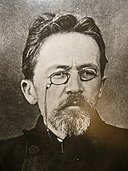

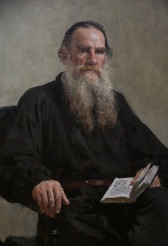

 changing or ineffable in a single sentence, you face both the limitations of the sentence itself and the extent of your own talent” (Pat Conroy).
 That’s 3 or 400 thousand words a year.” Novelist
  years. They worry and doubt themselves. They are discouraged and anxious. The act of writing does not excite or enchant them as it usually does. They have suffered agonies and are growing hopeless because of the dreadful misery called writers block that has taken hold of their mind, imagination, and spirit and will not let go.
 subjects just need time, as I’ve learned over and over again” (Joyce Carol Oates). This opinion says that there are “half hour” writing problems— problems that need a half hour to be solved—and “six month” writing problems that won’t be solved in less than half a year. These writers believe that you can’t solve the problem until it has reached its allotted time.
 One is to simply persist. Sit down at the computer every day and hack away without any self-judgment. Don’t worry or get anxious or depressed. Do this until your block cures itself. Another way is to completely cut off your involvement with writing. Don’t allow yourself to think about it. Forbid yourself from sitting down and writing at the computer or by hand. Don’t talk about writing. Do that for a specified period of time you set for yourself–ten days or two weeks. At the end of that period you may feel so deprived that you will develop a new enthusiasm and energy that may help you get on track again.
 and he suddenly was rich. On the other hand, when Ernest Hemingway was young and poor in Paris and unable to support his family with his stories he would catch pigeons in the Luxembourg Gardens when the gendarme on duty went into a café during his break, and then take them home and cook them. Some writers, like painters such as Pablo Picasso, love being rich. Picasso said he wanted to work without material worries “like a pauper,” “but with a lot of money.”
 What do geniuses talk about?
  One of the problems superb writers face is that they–and no one else–are the best judge of their work and yet they must endure sometimes ignorant, amateurish editors and critics. Henry Miller found himself being abused by editor after editor he submitted work to. He snarled, “Who are these shits? Where do they get off saying such things to me?”
 Sherwood Anderson died after swallowing a toothpick with a hors d’ oeuvre at a cocktail party. Katherine Mansfield married a singing teacher eleven years older than herself and abandoned him the morning after their wedding night. George Bernard Shaw said, “Experience is the name everyone gives to his mistakes.”
 ready to start writing. Ernest Hemingway had to first sharpen all the pencils he anticipated using that day. Edgar Alan Poe petted his cat before he started.
  Jonathan Swift, author of Gulliver’s Travels, went a year without talking to anyone. Truman Capote’s advice to young writers was to socialize and not “go up to a pine cabin all alone,” because “You reach that stage soon enough.” Voltaire preferred the company of his mistress. He wrote in bed using her back as a desk.
 Maurice Valency thought that failure is very difficult for a writer to bear, “but very few can manage the shock of early success.” P.G. Wodehouse said that success comes to a writer rather gradually, and that it is something of a shock to him or her to realize the heights to which they have risen.
 Playwright Lillian Hellman said writers are “fancy talkers about themselves.” She said that if she had to give advice to young writers she would say, “Don’t listen to writers talk about writing or themselves.”
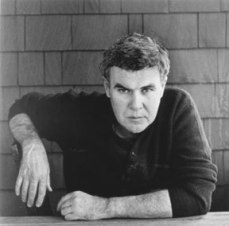 American Chekhov.” Another critic considered Carver “one of the greatest modern short story writers.” Poet Hayden Carruth wrote, “Among the great American writers of the 20th century, no question, Carver is the most endearing. He carries our humanity into the 21st.”
 college class at Chico State University by John Gardner (1933-1982). In years to come Gardner, then twenty-six, would become an important and influential person in American literature. Carver said that a good writing teacher is something like a literary conscience, a friendly critical voice in your ear, and that after being taught by Gardner, all his writing career he sensed him looking over his shoulder when he wrote, showing approval or disapproval over words, phrases, and strategies.
 Gardner thought that a novelist needed “an almost daemonic compulsiveness.” He was energetic and charismatic and his students responded. One student said “he was born with a quicker ratio to the passage of time than the rest of us.” Carver said that Gardner’s teaching “went right into my blood stream and changed the way I looked at things…He took my stories more seriously…I was completely unprepared for the kind of criticism I received from him.” He considered Gardner the teacher who first inspired him and intimidated him, teaching him to be tough on himself.
 finishing, you’ve developed a bad habit and you’d better do something about it.
 start another contrary, more fruitful habit. To break the habit of consistently not writing, you develop the habit of writing regularly. To combat the habit of quitting too soon, you make yourself not quit.
 You’re not a child or hedonist, a worshipper of permissiveness and pleasure who doesn’t have any will power. There are many writers who write not the traditional four or fewer hours daily, but put in eight hours a day, much longer than the majority, considering themselves no different than their parents who worked eight hours a day and the majority of the work force who work eight hours daily.
 It takes longer to completely absorb yourself in an ambitious project than in an easier, less complicated one. And during that period, distractions seem to come up out of the ground. Any intrusion on the delicate world of a creative mind can make that world disappear. Every intrusion not only robs you of time, but also of the time it takes you to recover. If you set a goal of working a three-hour session and have three interruptions you may be busy for three hours but only do fifteen minutes of actual work. If you try to do four things simultaneously, you’ll probably only finish one, at most two.
 Don’t let a
  work that leads to the fulfillment of your gifts over the avoidance of work.
 Actor Lord Laurence Olivier aimed at perfect performances, as did Peter O’Toole, Olivier’s successor as the world’s greatest actor–the perfect performances in the perfect tragedies as the perfect characters–as Hamlet, King Lear, Othello, or Iago. One night Olivier felt that he had achieved perfection in a performance. Others in the cast also told him he had. He said, “What I’m thinking is I’ve done it, but will I be able to do it again?” Perfection is difficult and rare. It is hard to repeat. It is a concept that grows in importance to artists as their skills and accomplishments ascend to high levels.
 It is true that serious dancers currently and throughout history have aimed at perfection, but other artists–usually the best in the art, those that are aware that they have a significant talent–also aim for perfection in their work, I believe. Those who do aim for perfection in their novels, musical composition, and paintings and other art works let it be known through their
  When they are watching the performance of a play what the audience hopes to see more than anything else is a virtuoso performance they will not be able to forget however long they live and how many plays they see. The virtuoso performance is the single most exciting and popular feature not only of drama but of any art, and the most thrilling feature of a virtuoso performance is not the possibility that the artist may fail. Rather, it is the spectacle of succeeding in an extraordinary way–a performance that is perfect because it has no errors. All the time I am listening to music as I do all day long or reading a narrative I think is great such as James Joyce’s short story “Araby,” and Frank Sinatra’s rendition of “In the Wee Small Hours of the Morning” I am thinking, “Keep it up James and Frank. Don’t fail. Continue being great until the story or the song is finished and perfect from the beginning to the end”
 The days and nights of everyday living of the artist seeking perfection must be filled to the brim with their art. More than likely, the artist has grown up with it, seen it mature, and watched it take over a good part of his or her being. Short story master Raymond Carver reflecting on his career put it this way: “conversation was fine, camaraderie was fine, making love was fine, raising a family was okay, but interfered with writing.”
 Why what I’m going to say now is true, no one has been able to figure out, but almost all people relax their efforts when they get close to achieving even their most important goals. They struggle and struggle and then seem to get lazy and disinterested. They are like a sprinter who runs fast to the tape and slows down or stops. But good coaches advise runners to “run through the tape.” Whatever you do, don’t relax just when you’re getting close to success, but persist in applying your utmost energy
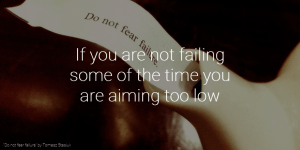 Why are you and I so afraid of failure? Many people live in terror of it and feel they must never fail, but always succeed, trailing clouds of glory. Yet failure can be a blessed life-changing event. If you experience only successes, you come to expect quick and easy results, and your sense of confidence is easily undermined if you suffer a setback. Setbacks and failures serve two useful purposes: Not only do they show us that we need to make changes and adjustments in order to gain the success we are seeking, but also they teach us that success usually requires confident, persistent, skilled, focused effort sustained over time. Once you set failures aside and become convinced that you have what it takes to succeed, you quickly rebound from failures. By having courage and sticking it out through tough times, you come out on the far side of failures with even greater confidence and commitment.
 The effect of
  Confidence is needed if you are to be successful as an artist. Make it a point to never lose confidence. If you find yourself losing it, use affirming statements, such as “I can do this; I believe in myself.’
 The most successful people have high career aspirations, are confident, and generally attribute their success to high effort and failure to lack of effort.
 Creative people who are the most likely to ask for help are those with a high opinion of themselves, while those with a low opinion of themselves are the least likely, although they may be the most in need of it and would profit from it. Asking for help shows that you’re serious about reaching your goals. Useful feedback can help you evolve and reach high levels of satisfaction and achievement.











 davidjrogersftw