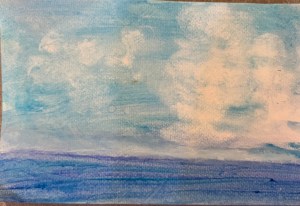
You hear so much yapping about a career in writing and art being a hard life. Shoveling coal for a living is a hard life, but when you are doing what you were put on earth to do with your life–and that is to write or paint–your life is simple, for then you have answered the most crucial questions of all: “What shall I be? “What shall I do? Then you ask, “How do I do it” and that is your craft, that is your art.
My blog is intended for writers and artists. Three million Americans identify themselves as writers. 2.7 million Americans identify themselves as artists. Of course, the blog also reaches millions of people in foreign countries who also identify themselves as artists and writers. To date my blog has been looked at by four hundred thousand writers and artists, the majority Americans, and others from even the least populated mountain and island kingdoms.
An Example of What Happens to Writers as Their Lives Unfold: The Opportunities that Appear
I will use myself as an example of a writer whose career over many years I can describe. It may be of value to writers and artists to compare to their own careers. Fighting to Win: Samurai Techniques for Your Work and Life is my best and my favorite book. It was written to help people. The main beneficiaries of Fighting To Win are discouraged people—broke, out of work, disappointed with their career or life, etc. Fighting to Win lifts them up.
Many people–probably most– struggle to find direction for their lives, but some people know from their earliest years the life, the career, they will pursue. I began writing professionally at eight–$25 for a story published in Jack & Jill. I didn’t know then that eventually in my career as writer I would, as many writers do, evolve into writer/poet/book marketer/public speaker/blogger. I decided on the way home from school on a rainy day that my goal when I grew up would be to be a writer so I could write beautiful words like “lovely,” “sea-faring,” and “proficient.” That goal has never changed through the publications of twelve books that are not self-published.
Ninety percent of a writer’s talent is inborn. That’s why writers needn’t attend the Iowa school of writing, but are generally self-taught. Some writers who write surprisingly well when they are very young are prodigies. There are artist prodigies too that draw and paint beautifully like much older artists. They master perspective when they seem too young to have mastered it .Mozart was a music prodigy, composing at four. Baryshnikov was a prodigy in ballet. He was the greatest dancer of his era because he could leap highest.
An early blooming prodigy can perform something before being taught to do it. For example, a young writing prodigy can write a story that has a plot, characterization, themes, tension, mystery, a strong conclusion though they have not been taught those features. The remaining ten percent of a writer’s expertise is skill and technique that comes from study, a ten percent separating great from good, and a phase that introduces the need for hard work, even among the most naturally-gifted.
As in every field, sweat-and-toil hard workers out-perform lazy or listless workers. You cannot rely on natural talent alone to bring high success. Without drive and intelligence–however naturally talented you are–you will not go as far as you could. Each day writers and artists should hope they have talent and tell themselves. “Today I will be energetic. Today I will be focused.”
A career in the arts is in keeping with my Welsh heritage. The Welsh entertain each other with stories and songs. I completed three degrees in American literature and taught Self Development in a university graduate school. At age twenty I had a short story published in a major literary journal. At twenty-one, a highly-regarded writing teacher said of my paper, “Teachers wait their entire career for a student who can write like this.”
I knew nothing about publishing and sent the entire manuscript of Fighting to Win to a publisher who called me and said they wanted to publish the book. I asked what kind of changes they wanted made and they said, “None. The book is a perfect book.” That statement soured me. Surely no book in first draft form is that good. I wanted a more demanding publisher who would encourage me to write my best. I turned the offer down. Having some doubts about the book I wrote an entirely new draft, starting from scratch, consuming a year.
I made an agreement with an excellent literary agent. I owe him a debt of gratitude. He was energetic and honest, and placed my book Fighting to Win with Doubleday. After the success of Fighting to Win, another publisher said they wanted me to write a book for them. “What do you want me to write about?” I asked. They said, “Whatever you want.” So I wrote Waging Business Warfare for Scribner’s publisher, a book that The Wall Street Journal said would change the way companies do business. Both books climbed the best sealer charts. Fighting to Win was also a best seller in Sweden. Waging Business Warfare in France and Japan.
Writer or artist, you have to distinguish yourself from the crowd. You have to get known. I’ve had many appearances in the national media on publicity tours and on my own. The books and my name became known in North America and foreign countries who purchased rights. I discovered that I am a good interviewee for marketing books, which is really sales. I have trained people in selling technique. The goal of a writer marketing to the broadcast media is to be invited back. Ideal is when the host of the show says “Call whenever you have something you want to talk about. We’ll put you on right away.”
Having written a book that becomes known by the public changes the author’s life forever. If you’re an author you’d better like the book since you and it from the publication date to the end of your life will be inseparable. You will be known as “So and so, the he author of….”
A New York publisher, I didn’t know, head of a major house who “had read everything,” generously called me out of the blue to tell me she had read Fighting to Win and found it “One of the two or three best books of any type–prose, poetry, biography, history, arts etc.–I have ever read.”
Then I took on a new career: public speaking in auditoriums in North America and Europe to audiences of thousands about their self-improvement, based on the content of Fighting to Win. I discovered a talent for public speaking to large audiences that I wasn’t aware of. Long ago I was afraid of public speaking, but now I enjoy it as much as I do writing, and the income is impressive. Many speakers/writers earn more money from speaking than from writing. The writer who can also speak is lucky. It is quite a shock to writers accustomed to working alone to find themselves on a stage addressing three, four, five thousand people who have come to hear an author’s wisdom.
Later I began this blog, designed to stimulate thinking about the important roles of writers and artists, especially those who hope to excel, a goal I share, placing emphasis on research and prescriptive how-to advice. I wanted to think of every aspect of writers’ and artists’ work life and write something practical to aid them. Each blog is an essay pertaining to the life of writers or artists–their necessary knowledge, their moods, their challenges, their discouragements, and so on. My most popular post is “The Characteristics of Creative People.” There are now 141 essays.
A major change in this writer’s life was turning, later in life, from writing prose to writing poetry. Since then there has been a stream of publications of poems and great joy. I wrote a book of poetry about adventures I had at seventeen when for six months I lived the life of a hobo hitching rides on freight trains: The Poetry of Riding Freight Trains Across America.
Philip Roth said eventually people won’t read novels anymore because with such busy lives, growing busier, they don’t have the many hours needed to read a novel. A poem can be read in a few minutes.

In Bliss
When you spend thousands of hours working hard over many years as many writers and artists have, and think of your craft all the time since childhood, writing and painting and other arts are the simplest tasks of your time here on earth. Dancers find a similar joy in dancing, actors in acting. When unhindered, such craftsmen write, paint, act, and dance in bliss.
© 2025 David J. Rogers
For my interview from the international teleconference with Ben Dean about Fighting to Win, click the following link:
Order Fighting to Win: Samurai Techniques for Your Work and Life eBook by David J. Rogers
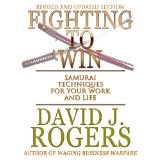
Click on book image to order from Amazon.com
or
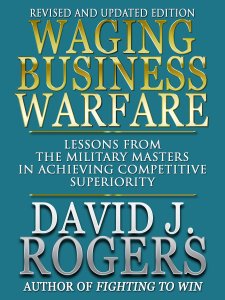
Order Waging Business Warfare: Lessons From the Military Masters in Achieving Competitive Superiority
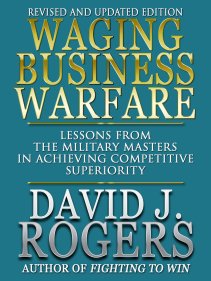
Click on book image to order from Amazon.com
or
 Every memoirist, (as well as every writer of fiction and personal essays and every poet and playwright) should strive to make that attainable talent to evoke the past a part of their repertoire of skills. They can then call on that talent every day as they compose, and it will bring their writing vividly to life.
 There were not enough living room chairs to go around when the full family came over, but there were the dining room chairs to carry in and also for an overflow crowd there were gray metal fold-up chairs stenciled on the back in white “Property of Ebenezer Baptist Church.” Aunt Sarah stored them in the hall closet hidden behind her prized full-length fur coat, and was embarrassed for strangers to see them, for fear they believe the impossible, but conceivable–that she had pilfered the chairs from that house of God.
 On a kitchen wall, above the old serviceable stove, was fastened an Elgin clock that ran fast, forcing everyone to subtract twenty-two minutes a day if they wished for some reason to be accurate, and in the corner of the living room, close to the large drafty window fronting Austin Avenue, was an impressive century- old grandfather clock whose big bronze pendulum, to the entire family’s collective memory, had never moved.
 People in every walk of life and in every hemisphere on earth–in cities, on deserts, in towns and villages–long to create something. My nine year old grandson is a talented artist and cellist studying architecture. His six year old sister takes dance and will begin taking piano lessons in the fall. Their forty two year old father was an excellent cellist in his youth and was inspired by the performance of a famous cellist to return to it last year. My wife, is a former cellist, and has taken up water colors and has returned to the piano. I write every day. I have for many years, and when I am not writing I am thinking about it and planning what I will write. We are representative people no different from millions of others with whom we share the globe because the current era is an Age of Heightened Creativity. Little children and women and men of all ages are bent on having creative experiences. They will not let their creative instincts be stifled.
 It became a permanent part of your entire being–an idea, a theme, or an image that became a guiding force in your life. You may not be conscious of it, but it starts you out in a creative direction, and gives you a sense of moving steadily in that direction, of heading straight toward something concrete and specific. Making a living in art is difficult and so most artists must find financial security other than in art. But whatever your occupation if you are to be an artist you will define yourself first as an artist, an accountant, HR manger, or English teacher second.
 Noted composers and performing artists in musical fields–so sensitive to sound and tone—possess what the Germans call Horlust–“hearing passion.” Writers–particularly poets and lyrical writers–have a word passion (they adore words), and painters adore colors and shapes, often from the cradle.
 What is inside the shut door is the artist’s rich inner life from which creative products pour–without stopping if the artists explore themselves more and more deeply. Transformation of what is inside the artist into what is outside is the
  Poet W.H. Auden wrote, “Speaking for myself, the questions which interest me most when reading a poem are two. The first is technical: ‘Here is the verbal contraption. How does it work?’ The second is, in the broadest sense moral. What kind of guy inhabits this poem? What is his notion of the good life or the good place? His notion of the Evil One. What does he conceal from the reader? What does he conceal even from himself?” William James said it is the amount of life in the act of creation which artists feel that makes you value their mind.
 Artists must be people of action because their main goal is production of works over which they think and
  Children and adults may drop out, but those who turn to art may well be playing the cello or dancing or painting, only getting better and enjoying their art perpetually–all their lives– with fond






 davidjrogersftw