Reflections on Creative Purposes
In my book Fighting to Win I place emphasis on the Japanese maxim Mokuteki hon’I, which means “Focus on your purpose.” They are a few simple words that can have a major positive effect, changing the whole course of an existence. To focus on your purpose as this post asks you to  focus on a system to improve your creative performance is to be aware of what you are trying to accomplish–with your life, and in this year, this day, this moment. When you acquire the habit of saying to yourself often in your daily life–morning, noon, and night–“Focus on your purpose,” those words become a hypnotic motto that stirs your muscles and mind to action. Then your life takes on a quality that is now becoming rare even among gifted creators–vital intensity that facilitates the production of works that can be pointed to and admired. That single goal–producing works as a result of talent combined with discipline–is more powerful than all other creative goals.
I have looked very seriously into what brings success to people in the arts, the sense that the person is functioning in a creative field at as high a level of performance as is possible for him or her. I have come to the conclusion that to reach excellence and satisfaction as a writer, artist, actor, dancer, musician, director, architect, etc., and to excel in any creative field and have a long and perhaps illustrious career, you must pursue, with all the commitment and intelligence you can muster, a small number of certain types of goals.
To excel, to make your mark in a creative field, I realized that you must find your most suitable creative specialty and develop your skills for  that specialty. And you must increase your knowledge of your chosen niche and put yourself on a specific Life Path with the objective always of producing a steady stream of high quality works that will bring you creative happiness. But it was clear to me that much more was involved.
So I wracked my brain for a way to convey in a clear, interesting, and organized way exactly what over the years I had come to believe about how a “real creator” such as those I admire most came into being. I searched my experiences for a useful model. I’d become interested in Buddhism at seventeen and over the years had done a lot of reading and thinking about it. It was there that I found my model.
As you and I live we encounter suffering. That that suffering is the most basic fact of life is the most important tenet of the religion or philosophy or approach to life known as Buddhism. That is the first of Buddhism’s Four Noble Truths, physical and mental suffering, dukkha.
A Buddhist strives to follow an “Eightfold Path” which is intended to lead to enlightenment and the end of dukkha. Enlightenment and a life 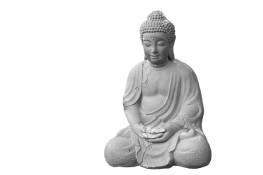 free of suffering are the goal in Buddhism. The Buddhist Eightfold Path consists of eight ideals that when practiced bring an upright and happy life. They are eight prescriptive “rights,” including right association–being careful about associating with good, wholesome, even holy people; right intent–making up your mind as to the one main purpose in life you really want to pursue; right speech–no lying, backbiting, or slander; right thoughts–thinking compassionately, generously, and with goodwill; right conduct–not killing, stealing, or lying; right effort–using your will power and taking action to achieve a good life; right concentration–the use of techniques to enhance concentration and enlightenment. And there is right livelihood–doing what you’re best suited to do in an honest occupation that harms no one.
Then I thought, “That’s it. That’s what I’m looking for: a clear path that will take a creator to what he/she is seeking and needs strong, continuous encouragement, compassion, and votes of confidence to reach—an eightfold path, but without any religious connotation.”
So now I realize that you and I can realistically speak of The Creator’s Eightfold Path consisting of eight specific components—eight “rights”–that must be present–not one missing–if a person pursuing a career of creative endeavors is to reach high performance and become the real thing.
Introduction to the Components of the Creator’s Eightfold Path
 Success in a creative field (in fact success in any field) is not attributable to one thing alone such as talent or IQ as many people believe, or three or four things. I believe there are eight components. It’s important to understand what the eight components are and the questions they will answer:
Right Work/Production Program: How can you produce the quality and quantity of works that you hope for?
Right Craft: How will you know if the creative specialty you have chosen to pursue is the most appropriate for you?
Right Identity: What are the personal qualities that will best equip you for the creative craft you have chosen to pursue?
Right Education, Training, and Development: How can you prepare yourself to reach your highest creative performance?
Right Skills: What are the variety of skills you’ll need, and what is your authentic voice and most expressive style?
Right Knowledge: What knowledge will you need if your goal is to excel?
Right Motivation/Drive: Do you have the drive and doggedness you will need if you are to excel?
Right Life Path—are you following the Way of the Creator?
You can reflect on these components and identify the ones in which you are strong and those in which you are weak and need improvement.
In future posts I will discuss further the components of the Creator’s Eightfold Path.
Here is an introduction to one of the components:
Insights about Right Work/Production Program
The most vital factor of successful production is working with a single-minded preoccupation—the focus on the one thing, the work itself–whether for fifteen minutes or many hours–avoiding and getting rid of distractions, and ignoring as much as you realistically can other responsibilities.
It is not enough to possess talents. Talents must be put to work and result in paintings and poems and such. Creators make the structure of  their creative lives by means of the work they do. If they are unable to work or the work is poor quality or is stopped-up and doesn’t go well, they suffer. Regarding the necessity of a creator to sweat and produce paintings, poems, symphonies or buildings, etc., Saul Bellow said, “For the artist, work is the main thing and always comes first.” Brewster Ghiselin said, “It is only as the work is done that the meaning of the creative effort can appear and that the development of the artist…is attained.” Psychologist Howard Gardner writes about high-excelling creative people. He says, “Individuals whose stock in trade is to do things which are novel, are people who’ve got to have a pretty good command of how they work.”
The Value of Structure
Successful creators almost always structure their work time and environment carefully. One of the first things a creator does is to clear a work space. A perfect work place and good production routines and rituals are to be treasured. By simply being there ready to work repetitively the same time day after day, the power of good habits goes into effect.
 There isn’t one universal work/production program that suits all creators. A production program won’t work if it’s imposed. Each creator’s program will have to be idiosyncratic–custom-designed by yourself for yourself. To find the ways and means to improve the quantity and quality of your production, you should experiment and try out different approaches until the best work/production program suited to yourself is found.
A well thought out Right Work/ Production Program should be designed to enable you to:
- Focus on your work for desired periods of time–minutes or hours, weeks or months
- Abandon what isn’t working, putting aside futile problems that will lead to dead-ends and frustration
- Free yourself from distractions and time-wasters
- Remain efficient and productive in the midst of obstacles and setbacks in either your creative or personal life
- Maintain and not fully deplete your energy and stamina
- Achieve a desirable level of output
Be Ready to Work
 For high quality uninterrupted work to happen, not all, but most creators need isolation and solitude. “The concentration of writing requires silence. For me, large blocks of silence. It’s like hearing a faint Morse code…a faint signal is being given and I need quiet to pick it up” (Philip Roth). Some creators prefer noisy environments. But even the feeling that you might be interrupted interferes with creative thought.
The Value of Volume.
The big names in an art are often the artists who have produced the most works. They have a genius for productivity. It is a good idea to have  production goals continuously in mind. Production ebbs and flows. Some days work comes out of you in torrents. You’re in overdrive. But other days–nothing. But one way or another, good mood or bad mood, you must apply yourself, overcome inertia, and get work out.
In Art & Fear, authors David Bayles and Ted Orland talk about the importance of a creator’s need for production. They write about what happens in a ceramics class that I’ve found also happens in a class of writers. You could take two groups of writers in a class. Those on the left side of the room would be graded solely on the quantity of the work they produced. Those on the right side would be graded only on the work’s quality. On the final day of the class the teacher would measure the amount of work of the quantity group—500 pages an A, 350 pages a B, and so forth. Those the teacher would grade on quality would have to produce only one story, but it would have to be perfect to justify an A.
 A curious thing would happen. The quantity group would also produce the highest quality work. The quantity group would churn out streams of work and learn from their many mistakes and develop wide assortment of skills. But the quality group would get caught up the elusive concept of perfection and grandiose dreams and would become paralyzed. Some creators produce 10, 15, or 25 times more works than other creators. Those who produce the most works usually rise higher, do better work, and find a greater sense of accomplishment.
Working Regularly Is Almost Mandatory
 If you neglect an activity for just two days you’ll function much less effectively when you resume work. In writing and painting, as in everything else, inactivity leads to the atrophy of abilities. Your level of motivation affects your willingness to work. The quantity of your production is in direct proportion to the intensity of your motivation and drive. Creators with drive are able to persist steadily without interruption whereas poorly motivated creators will interrupt their work more often and not engage in it for long periods. Samuel Johnson said, “If you want to be a writer, write all the time.”
© 2022 David J. Rogers
For my interview from the international teleconference with Ben Dean about Fighting to Win, click the following link:
Order Fighting to Win: Samurai Techniques for Your Work and Life eBook by David J. Rogers

Click on book image to order from Amazon.com
or
Order Waging Business Warfare: Lessons From the Military Masters in Achieving Competitive Superiority

Click on book image to order from Amazon.com
or
 Although talent in the arts most often shows itself early, because it takes so many years to develop their talent and become highly proficient in the arts, people who will become expert musicians, painters, performers, and writers can expect to be late bloomers. Artists who perform at a high level do not demonstrate remarkable talent in short order. They are not usually in their twenties or thirties, but in their forties, fifties, and sixties. All spend many years developing the knowledge, attitudes, and skills that will eventually enable them to be recognized for their mastery. All arts involve learning form and the art’s devices, and the need for control, craft, revisions, and structure–time consuming efforts. All begin by imitating existing techniques they have studied.
 A survey of 47 outstanding instrumentalists found that their ability was first noticed on average at the age of four years and nine months. Then they began a very long and arduous period of development of their talent. Pianists work for about seventeen years from their first formal lessons to their first international recognition, involving many thousands of hours of intense practice. The fastest in one study was twelve years, and the slowest took twenty-five years. In other fields you may even be an early bloomer, but in the arts if your expertise is to be at a high level of mastery, unless you are a Dylan Thomas, a rarity who was at his peak at nineteen, you had best avoid discouragement and expect to bloom late.
 Novelist
  When the majority of their friends and associates are settled in a career and life style, late bloomers are not. Late bloomers may eventually reach the height of their achievements and fulfillment which I call “their true
  If you’re a late bloomer, you’ve made false starts. You haven’t peaked yet, haven’t reached your destiny yet, but you may be determined to bloom one day. Late bloomers are more willing than most to persevere and if need be to fail but try again and again until they reach a life they desire. If you are a late bloomer, more than most people you have the sense that you’re constructing yourself as you go along, even rejecting what other people may call golden opportunities if those opportunities don’t appear to lead you in the direction you desire most.
 with the goal in mind for me to have a national television talk show. It was an excellent opportunity and would have paid extremely well. But my wife and I talked it over and I decided that what I wanted to do with my life above all else was simply to sit at a computer in my upstairs work room while my four children played noisily downstairs and my wife came up once in a while to say hello, and produce artful paragraphs that reflected my years of hard work and training. To me that was blooming. I turned the opportunity down. Late bloomers often make similar very difficult decisions while they are constructing themselves.
 Most people–possibly all–who find fulfillment later in life find it in a mission, calling, or vocation. You cannot be dissatisfied when you’re doing the work for which you feel you were brought into the world, a thought that consoled
  Going back to school as a transition to another field is a strategy late bloomers find appealing, in essence ending one career and starting another.
 Have you bloomed? If you haven’t what are you going to do about that? People who aren’t leading satisfactory lives haven’t bloomed at all, and many are trying to, but many have never started trying, and just as many have given up. Better to start if you haven’t already, whatever your age or condition in life. You can always forget the past and start out again, making no excuses for starting out late. Experiment, follow your instincts, and assess yourself and your feelings about your life. Are you going right or are you going wrong?
 Why what I’m going to say now is true, no one has been able to figure out, but almost all people relax their efforts when they get close to achieving even their most important goals. They struggle and struggle and then seem to get lazy and disinterested. They are like a sprinter who runs fast to the tape and slows down or stops. But good coaches advise runners to “run through the tape.” Whatever you do, don’t relax just when you’re getting close to success, but persist in applying your utmost energy
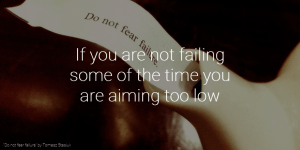 Why are you and I so afraid of failure? Many people live in terror of it and feel they must never fail, but always succeed, trailing clouds of glory. Yet failure can be a blessed life-changing event. If you experience only successes, you come to expect quick and easy results, and your sense of confidence is easily undermined if you suffer a setback. Setbacks and failures serve two useful purposes: Not only do they show us that we need to make changes and adjustments in order to gain the success we are seeking, but also they teach us that success usually requires confident, persistent, skilled, focused effort sustained over time. Once you set failures aside and become convinced that you have what it takes to succeed, you quickly rebound from failures. By having courage and sticking it out through tough times, you come out on the far side of failures with even greater confidence and commitment.
 The effect of
  Confidence is needed if you are to be successful as an artist. Make it a point to never lose confidence. If you find yourself losing it, use affirming statements, such as “I can do this; I believe in myself.’
 The most successful people have high career aspirations, are confident, and generally attribute their success to high effort and failure to lack of effort.
 Creative people who are the most likely to ask for help are those with a high opinion of themselves, while those with a low opinion of themselves are the least likely, although they may be the most in need of it and would profit from it. Asking for help shows that you’re serious about reaching your goals. Useful feedback can help you evolve and reach high levels of satisfaction and achievement.

























 davidjrogersftw