You hear so much yapping about a career in writing and art being a hard life. Shoveling coal for a living is a hard life, but when you are doing what you were put on earth to do with your life–and that is to write or paint–your life is simple, for then you have answered the most crucial questions of all: “What shall I be? “What shall I do? Then you ask, “How do I do it” and that is your craft, that is your art.
My blog is intended for writers and artists. Three million Americans identify themselves as writers. 2.7 million Americans identify themselves as artists. Of course, the blog also reaches millions of people in foreign countries who also identify themselves as artists and writers. To date my blog has been looked at by four hundred thousand writers and artists, the majority Americans, and others from even the least populated mountain and island kingdoms.
An Example of What Happens to Writers as Their Lives Unfold: The Opportunities that Appear
I will use myself as an example of a writer whose career over many years I can describe. It may be of value to writers and artists to compare to their own careers. Fighting to Win: Samurai Techniques for Your Work and Life is my best and my favorite book. It was written to help people. The main beneficiaries of Fighting To Win are discouraged people—broke, out of work, disappointed with their career or life, etc. Fighting to Win lifts them up.
Many people–probably most– struggle to find direction for their lives, but some people know from their earliest years the life, the career, they will pursue. I began writing professionally at eight–$25 for a story published in Jack & Jill. I didn’t know then that eventually in my career as writer I would, as many writers do, evolve into writer/poet/book marketer/public speaker/blogger. I decided on the way home from school on a rainy day that my goal when I grew up would be to be a writer so I could write beautiful words like “lovely,” “sea-faring,” and “proficient.” That goal has never changed through the publications of twelve books that are not self-published.
Ninety percent of a writer’s talent is inborn. That’s why writers needn’t attend the Iowa school of writing, but are generally self-taught. Some writers who write surprisingly well when they are very young are prodigies. There are artist prodigies too that draw and paint beautifully like much older artists. They master perspective when they seem too young to have mastered it .Mozart was a music prodigy, composing at four. Baryshnikov was a prodigy in ballet. He was the greatest dancer of his era because he could leap highest.
An early blooming prodigy can perform something before being taught to do it. For example, a young writing prodigy can write a story that has a plot, characterization, themes, tension, mystery, a strong conclusion though they have not been taught those features. The remaining ten percent of a writer’s expertise is skill and technique that comes from study, a ten percent separating great from good, and a phase that introduces the need for hard work, even among the most naturally-gifted.
As in every field, sweat-and-toil hard workers out-perform lazy or listless workers. You cannot rely on natural talent alone to bring high success. Without drive and intelligence–however naturally talented you are–you will not go as far as you could. Each day writers and artists should hope they have talent and tell themselves. “Today I will be energetic. Today I will be focused.”
A career in the arts is in keeping with my Welsh heritage. The Welsh entertain each other with stories and songs. I completed three degrees in American literature and taught Self Development in a university graduate school. At age twenty I had a short story published in a major literary journal. At twenty-one, a highly-regarded writing teacher said of my paper, “Teachers wait their entire career for a student who can write like this.”
I knew nothing about publishing and sent the entire manuscript of Fighting to Win to a publisher who called me and said they wanted to publish the book. I asked what kind of changes they wanted made and they said, “None. The book is a perfect book.” That statement soured me. Surely no book in first draft form is that good. I wanted a more demanding publisher who would encourage me to write my best. I turned the offer down. Having some doubts about the book I wrote an entirely new draft, starting from scratch, consuming a year.
I made an agreement with an excellent literary agent. I owe him a debt of gratitude. He was energetic and honest, and placed my book Fighting to Win with Doubleday. After the success of Fighting to Win, another publisher said they wanted me to write a book for them. “What do you want me to write about?” I asked. They said, “Whatever you want.” So I wrote Waging Business Warfare for Scribner’s publisher, a book that The Wall Street Journal said would change the way companies do business. Both books climbed the best sealer charts. Fighting to Win was also a best seller in Sweden. Waging Business Warfare in France and Japan.
Writer or artist, you have to distinguish yourself from the crowd. You have to get known. I’ve had many appearances in the national media on publicity tours and on my own. The books and my name became known in North America and foreign countries who purchased rights. I discovered that I am a good interviewee for marketing books, which is really sales. I have trained people in selling technique. The goal of a writer marketing to the broadcast media is to be invited back. Ideal is when the host of the show says “Call whenever you have something you want to talk about. We’ll put you on right away.”
Having written a book that becomes known by the public changes the author’s life forever. If you’re an author you’d better like the book since you and it from the publication date to the end of your life will be inseparable. You will be known as “So and so, the he author of….”
A New York publisher, I didn’t know, head of a major house who “had read everything,” generously called me out of the blue to tell me she had read Fighting to Win and found it “One of the two or three best books of any type–prose, poetry, biography, history, arts etc.–I have ever read.”
Then I took on a new career: public speaking in auditoriums in North America and Europe to audiences of thousands about their self-improvement, based on the content of Fighting to Win. I discovered a talent for public speaking to large audiences that I wasn’t aware of. Long ago I was afraid of public speaking, but now I enjoy it as much as I do writing, and the income is impressive. Many speakers/writers earn more money from speaking than from writing. The writer who can also speak is lucky. It is quite a shock to writers accustomed to working alone to find themselves on a stage addressing three, four, five thousand people who have come to hear an author’s wisdom.
Later I began this blog, designed to stimulate thinking about the important roles of writers and artists, especially those who hope to excel, a goal I share, placing emphasis on research and prescriptive how-to advice. I wanted to think of every aspect of writers’ and artists’ work life and write something practical to aid them. Each blog is an essay pertaining to the life of writers or artists–their necessary knowledge, their moods, their challenges, their discouragements, and so on. My most popular post is “The Characteristics of Creative People.” There are now 141 essays.
A major change in this writer’s life was turning, later in life, from writing prose to writing poetry. Since then there has been a stream of publications of poems and great joy. I wrote a book of poetry about adventures I had at seventeen when for six months I lived the life of a hobo hitching rides on freight trains: The Poetry of Riding Freight Trains Across America.
Philip Roth said eventually people won’t read novels anymore because with such busy lives, growing busier, they don’t have the many hours needed to read a novel. A poem can be read in a few minutes.

In Bliss
When you spend thousands of hours working hard over many years as many writers and artists have, and think of your craft all the time since childhood, writing and painting and other arts are the simplest tasks of your time here on earth. Dancers find a similar joy in dancing, actors in acting. When unhindered, such craftsmen write, paint, act, and dance in bliss.
© 2025 David J. Rogers
For my interview from the international teleconference with Ben Dean about Fighting to Win, click the following link:
Order Fighting to Win: Samurai Techniques for Your Work and Life eBook by David J. Rogers
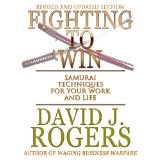
Click on book image to order from Amazon.com
or
Order Waging Business Warfare: Lessons From the Military Masters in Achieving Competitive Superiority
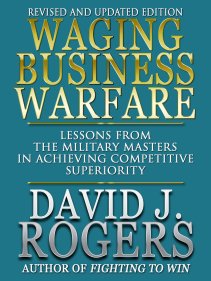
Click on book image to order from Amazon.com
or
 focus on a system to improve your creative performance is to be aware of what you are trying to accomplish–with your life, and in this year, this day, this moment. When you acquire the habit of saying to yourself often in your daily life–morning, noon, and night–“Focus on your purpose,” those words become a hypnotic motto that stirs your muscles and mind to action. Then your life takes on a quality that is now becoming rare even among gifted creators–vital intensity that facilitates the production of works that can be pointed to and admired. That single goal–producing works as a result of talent combined with discipline–is more powerful than all other creative goals.
 that specialty. And you must
  free of suffering are the goal in Buddhism. The Buddhist Eightfold Path consists of eight ideals that when practiced bring an upright and happy life. They are eight prescriptive “rights,” including right association–being careful about associating with good, wholesome, even holy people; right intent–making up your mind as to the one main purpose in life you really want to pursue; right speech–no lying, backbiting, or slander; right thoughts–thinking compassionately, generously, and with goodwill; right conduct–not killing, stealing, or lying; right effort–using your will power and taking action to achieve a good life; right concentration–the use of techniques to enhance concentration and enlightenment. And there is right livelihood–doing what you’re best suited to do in an honest occupation that harms no one.
 Success in a creative field (in fact success in any field) is not attributable to one thing alone such as talent or IQ as many people believe, or three or four things. I believe there are eight components. It’s important to understand what the eight components are and the questions they will answer:
 their creative lives by means of the work they do. If they are unable to work or the work is poor quality or is stopped-up and doesn’t go well, they suffer. Regarding the necessity of a creator to
  There isn’t one universal work/production program that suits all creators. A production program won’t work if it’s imposed. Each creator’s program will have to be idiosyncratic–custom-designed by yourself for yourself. To find the ways and means to improve the quantity and quality of your production, you should experiment and try out different approaches until the best work/production program suited to yourself is found.
 For high quality uninterrupted work to happen, not all, but most creators need isolation and solitude. “The concentration of writing requires silence. For me, large blocks of silence. It’s like hearing a faint Morse code…a faint signal is being given and I need quiet to pick it up” (Philip Roth). Some creators prefer noisy environments. But even the feeling that you might be interrupted interferes with creative thought.
 production goals continuously in mind. Production ebbs and flows. Some days work comes out of you in torrents. You’re in overdrive. But other days–nothing. But one way or another,
  A curious thing would happen. The quantity group would also produce the highest quality work. The quantity group would churn out streams of work and learn from their many mistakes and develop wide assortment of skills. But the quality group would get caught up the elusive concept of perfection and grandiose dreams and would become paralyzed. Some creators produce 10, 15, or 25 times more works than other creators. Those who produce the most works usually rise higher, do better work, and find a greater sense of accomplishment.
 If you neglect an activity for just two days you’ll function much less effectively when you resume work. In writing and painting, as in everything else, inactivity leads to the atrophy of abilities. Your level of motivation affects your willingness to work. The quantity of your production is in direct proportion to the intensity of your
 Buddhism sets up qualities a life must have if the person is to find fulfillment. One quality is “Right Livelihood:” To be most fulfilled the person must be in the occupation that most suits them and is most beneficial to them. My wife and I have four children. Each is very different than the others but is perfect for their occupation. The analytical one who loves mathematics is the director of revenue for a city. The organized one manages a number of people. The one who wants to help people is a therapist. The most sociable one is a real estate agent helping people find the home they will be most happy in.
 All necessary components have to be present if you are to excel at the writer’s craft. If just one component is missing, you no longer have an ideal writer. If you are to succeed in an art there must be a fit between the talent you possess and the talent necessary to participate with distinction in the art.
 Writers and other artists should be able to recall many thousands of detailed memories that form a basis of their writings–a gift to recall sensations and experiences from many years earlier and to reconstruct them in their original freshness and vividness.
 Good writers can do that, but not all writers can, even some writers who work very hard trying to learn how to. Think of any writer’s skill–some people will master it easily, some only with great difficulty, and some will never master it. Whatever they do, some writers’ scenes are not effective.
 A writer should have an insatiable passion to write and the skill of persistence. Joyce Carol Oates is a prolific author of fifty-eight novels for a reason. She has good writing practices, and finds no reason why one who professes to be a writer shouldn’t be writing all the time. She says, “When writing goes painfully, when it’s hideously difficult, and one feels real despair (ah, the despair, silly as it is, is real!)–then naturally one ought to continue with the work; it would be cowardly to retreat. But when writing goes smoothly–why then one certainly should keep on working, since it would be stupid to stop. Consequently one is always writing or should be writing.”


 davidjrogersftw