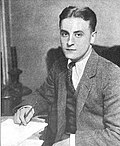
 F. Scott Fitzgerald’s (1896-1940) writing was the major interest in his life. From grade school to his death nothing was quite true to him unless he had written about it. He was a fine writer, and his writing was always about himself or people he was intimate with. As a result his life was inextricably bound up with his work and his life with his kooky and attractive wife Zelda was an interest in itself. He lived a colorful life and a disastrous one with Zelda. They lived like fairy-story hero and heroine, filling newspapers with reports of their wild life-style. Much of the disaster of their lives were of their own making. Fitzgerald is called the creator of the Jazz Age which began with his writing best seller This Side of Paradise at the age of twenty-four, making him rich, his goal for writing it. The book became the voice of the younger hedonistic, thrill-loving, post-World War I generation.
Fitzgerald felt that a person such as himself was happiest if they were rich and had acquired the trappings of wealth and were living “the good life.” In his earlier adult life Fitzgerald saw the “improbable, often the impossible come true. Life was something you dominated if you were any good. Life yielded easily to intelligence and effort. It seemed a romantic business to be a successful literary man.” (Arthur Mizener.)
Fitzgerald felt he could not have chosen any other profession although in the writing trade “you were forever unsatisfied.” In the nineteen twenties the big problems of his life seemed to solve themselves, and if the problems were too tough he ignored them. He strove to make a lot of money from his writing novels and dozens of short stories that were immensely popular, as he did in the early and middle parts of his career. Fitzgerald always lived well beyond his income, troubling his editor Maxwell Perkins for many advances on earnings. He was often confused between writing just for the money and writing high quality literary work. He had a keen understanding of public literary tastes and could profitably write both.
The Crack-Up
Fitzgerald wrote three magazine articles frankly describing his crack-up. His friend Ernest Hemingway advised him against writing them because, he said, they would make Fitzgerald appear weak. The fear of appearing weak was a concern of macho Hemingway, but not of Fitzgerald. Rare is writing so honest about one’s psychological and spiritual problems as Fitzgerald’s revelations in those articles.
For seventeen years things went on marvelously well, and then at thirty-nine Fitzgerald suddenly realized that he had cracked up. He said you can crack up in the mind and can crack up in the body and the nerves. His crack-up was in the nerves where he said there was “too much anger and too many tears.” He said that he had been living a long time “not caring much, not thinking about what was left undone, or of his responsibilities.” He had a sudden instinct that he must go somewhere and be alone for a while. He wrote, “I didn’t want to see people at all. I had seen so many people all my life.” He was seeking “a certain insulation from ordinary cares. I went away and there were fewer people…I felt tired and slept dozens of hours or twenty -four hours at a day.” Sick, he made lists, “hundreds of lists of happy times, baseball plays, popular songs, of pairs of shoes, of women he liked, “and then suddenly, surprising, he said, “I got better.”
In reflection he began to realize “that for two years of my life I had been drawing on resources that I did not possess, that I had been mortgaging myself physically and spiritually up to the hilt. I realized that in those two years…I had weaned myself from all the things I used to love.” He saw that for a long time he had not liked people. He felt that even his love for those closest to him was only an attempt to love them, but was not love. He became bitter about everything he encountered or thought about day and night.
In the article “Putting it Together” Fitzgerald said, “In a real dark night of the soul it is always three ‘o clock in the morning day after day. At that hour the tendency is to refuse to face things as long as possible by retiring to an infantile dream– but one is continually startled out of this by various contacts with the world. One meets these occasions as quickly and carelessly as possible and retires once more back into the dream, hoping that things would adjust themselves by some great material or spiritual bonanza…But as the withdrawal persists one witnesses the disintegration of one’s own personality.”
Fitzgerald said “It was strange to have no self–to be like a little boy left alone in a big house who found he could do anything he wanted, “but found there was nothing he wanted to do.” In a final reflection on his ordeal, his crack-up, Fitzgerald wrote, “A man does not recover from such a jolt–he becomes a different person and eventually the new person finds new things to care about.”
Fitzgerald’s Death
In 1937 Fitzgerald was sick and unable to write and no longer earning royalties. He turned to Hollywood’s film industry. He died at forty-four a modestly paid Hollywood screen writer of mediocre movies. Many critics consider his The Great Gatsby the great American novel many writers have striven to write. The Great Gatsby surprised the literary world by being more substantial than anything Fitzgerald had written before.
© 2025 David J. Rogers
For my interview from the international teleconference with Ben Dean about Fighting to Win, click the following link:
Order Fighting to Win: Samurai Techniques for Your Work and Life eBook by David J. Rogers
Click on book image to order from Amazon.com
or
Order Waging Business Warfare: Lessons From the Military Masters in Achieving Competitive Superiority
Click on book image to order from Amazon.com
or
 or accurate. They are not interesting. Because of an inadequate handling of places, a work that may be superb in every other respect is without convincingly-described locations, scenes, and settings. Descriptions of places are not window dressing that a writer need pay little attention to, but a feature of writing fiction, nonfiction, and drama that is indispensable. Poorly written descriptions of places detract from the quality of the written piece.
 Award-winning short story specialist Eudora Welty did more than anyone else to point out how central to effective fiction place is. She said that the story’s place affects “all currents” of the work, all of its emotions, beliefs, and moral convictions that “charge out from the story” as the author unfolds it. She said the places should always be identified, and adds that they should be described in a particular way that requires significant writing skills.
 Place has been particularly important to some noted authors. You cannot imagine the story’s characters without the place where the author has put them: Dublin to James Joyce, small town and rural Mississippi to Eudora Welty and William Faulkner, Paris, Spain, and Africa to Ernest Hemingway, Camden, Ohio to Sherwood Anderson, southern United States to Truman Capote, James Agee, Reynolds Price, Pat Conroy, and many other “Southern writers,“ the plains of Nebraska to Willa Cather, Chicago to Saul Bellow, the Mississippi River to Mark Twain, the English moors to Charlotte Bronte and sister Emily, eighteenth century London to Charles Dickens, Mexico and the state of Texas to Katherine Anne Porter, Los Angeles to mystery writer Raymond Chandler, and so on.
 (My father was an air raid warden during World War II, and once he took me with him during an air raid practice when the lights of the city were turned off and the skies were filled with search lights) “My father and I turned and came up behind the church where a delivery truck was parked. We walked down the alley, keeping our eyes trained on the apartment buildings’ windows, past the empty lot overgrown with weeds and covered with tin cans and newspapers, and past the bent-in-half, arthritic and reclusive witch’s bleak house. Her ferociously unfriendly German shepherds were oddly quiet. We passed the drowsy homes and apartment buildings of neighbors, only some of whose names we knew. Behind the walls of those buildings were people not unlike us, simple people, all with the stories of their lives never to be written. All shades were drawn, and so the night was perfect, with no more reminders necessary.
 and a full moon dangled in the sky. On the back porches in neat array, like miniature glass sentinels, stood the empty bottles left out for the milk man. Branches of trees laden with rain bent low over back fences like old women on canes. When the wind blew, the leaves showered the two of us with water, and we laughed. On the ground lay deep puddles that we had no choice but to step through, which was fine with me because I was wearing boots. My father’s shoes made squishing sounds and he said,” Another pair down the drain” and we laughed at that, and I splashed through, heavy-footed.”
 swings. The night had taken on an indefinable splendor and given me a feeling of exquisite peace that I hadn’t felt since childhood. I saw a white yacht that was illuminated by deck lights out on the lake. Small waves rocked a rowboat that was not very far from me. With a whoosh, waves tumbled over themselves onto a beach. A bell chimed somewhere on the water. There was a splash and then another. The vivacious woman I was with took off her shirt and bra and swung them over her head like a lasso. She said, “Guess what I do for a living.” I said, “I’ll bet you four million dollars that you are an actress.”
 Old cars with dented fenders and gaudy garters dangling on their rear-view mirrors and pick-up trucks with rifle racks cradling ominous shotguns and carbines were parked four deep in the lot. When the door of the Inn swung open, muscular men, their shirt sleeves rolled up above the bicep, sauntered out arrogantly, their arms tight around the waists of conspicuously made-up women, their heads thrown back in exaltation and abandon, and the chime of laughter spilled into the night like flowing wine.”
 Excellent writers should be able to describe places that they have experienced or have heard or read about and can clearly envision as they compose. They should be able to create vivid descriptions that enliven the text and appeal to the reader’s senses.
 I think of the famous Michael Jordan “flu game” when he had to be carried off the floor after the game with the flu by a teammate, yet scored 38 points and led the Bulls to victory. “Probably the most difficult thing I have ever done,” said Jordan.
 would prefer to be cheerful and happy, but as far as creative work is concerned, how you feel is secondary. What matters most are the requirements of the craft you have committed yourself to, and one requirement is day after day to put out effort to achieve your creative goals. It seems to me that one constant goal that is shared by most people in the arts is to develop your in-born talents to the fullest and that another requirement is to
  corresponded about. Nurturing depression in and out of psychiatric hospitals, some of them committed suicide including John Berryman and Randall Jarrell. Poets Sylvia Plath and Ann Sexton were friends and felt the same. They talked to each other often, and also committed suicide.
 Whatever has been said about the relationship between creatives’ state of mind and their performance, writers and painters I know or have read or heard about have found writing or painting the most fulfilling and blissful thing they do.
 had the same view of the function of writers and artists. Ruskin: “The whole function of the artist in the world is to be a seeing and feeling creature.”
 Painter Edouard Manet thought the urge to create is a simple reflex that doesn’t require thought: “There is only one true thing: instantly paint what you see. When you’ve got it, you’ve got it. When you haven’t, you begin again.”
 Creatives have complex memories from which their art derives: “The essential factor of development of expertise is the accumulation of increasingly complex patterns in memory” (Andreas Lehmann).
 Since the earliest civilizations people have been theorizing about creatives among them and the creative process. The first question was: is creative ability a gift from the gods?
 The best writing resists critical explanation: “In truly good writing no matter how many times you read it you do not know how it is done. That is because there is a mystery in all great writing and the mystery does not dissect out” (Ernest Hemingway).
 Actor Lord Laurence Olivier aimed at perfect performances, as did Peter O’Toole, Olivier’s successor as the world’s greatest actor–the perfect performances in the perfect tragedies as the perfect characters–as Hamlet, King Lear, Othello, or Iago. One night Olivier felt that he had achieved perfection in a performance. Others in the cast also told him he had. He said, “What I’m thinking is I’ve done it, but will I be able to do it again?” Perfection is difficult and rare. It is hard to repeat. It is a concept that grows in importance to artists as their skills and accomplishments ascend to high levels.
 It is true that serious dancers currently and throughout history have aimed at perfection, but other artists–usually the best in the art, those that are aware that they have a significant talent–also aim for perfection in their work, I believe. Those who do aim for perfection in their novels, musical composition, and paintings and other art works let it be known through their
  When they are watching the performance of a play what the audience hopes to see more than anything else is a virtuoso performance they will not be able to forget however long they live and how many plays they see. The virtuoso performance is the single most exciting and popular feature not only of drama but of any art, and the most thrilling feature of a virtuoso performance is not the possibility that the artist may fail. Rather, it is the spectacle of succeeding in an extraordinary way–a performance that is perfect because it has no errors. All the time I am listening to music as I do all day long or reading a narrative I think is great such as James Joyce’s short story “Araby,” and Frank Sinatra’s rendition of “In the Wee Small Hours of the Morning” I am thinking, “Keep it up James and Frank. Don’t fail. Continue being great until the story or the song is finished and perfect from the beginning to the end”
 The days and nights of everyday living of the artist seeking perfection must be filled to the brim with their art. More than likely, the artist has grown up with it, seen it mature, and watched it take over a good part of his or her being. Short story master Raymond Carver reflecting on his career put it this way: “conversation was fine, camaraderie was fine, making love was fine, raising a family was okay, but interfered with writing.”







 davidjrogersftw