Mining Material in One Segment of Your Experience Is A Key to Success in Writing and Art.
Scott Fitzgerald felt that successful writers have a few events in their lives that steal their mind and  heart and they write about in one form or another time and again. What had occurred in the writer’s life before age twenty-one is the period of their life where most good writers find their richest material. Writer after writer reports that. Exceptional writers have exceptional memories. Their talent to evoke from their memories in exact detail written images of the places, people, and events they recall is remarkable. Artists too may have extraordinary memories and paint visual images of them.
When we were seventeen for adventure and to acquire material for hopefully future careers in creative writing my friend Nick and I crisscrossed the country on freight trains illegally for six months, living the life of wandering hobos before we started college. We were shot at with bullets buzzing past our heads, and chased by police with growling German shepherds snapping at our heels, four dollars to my name. Few people have that experience. It meets the writer’s critical need for originality. You can’t forget the details of an adventure like that. They provided me with material to write a unique book of poetry I titled The Poetry of Riding Freight Trains Across America. and since then other poems and blogs about freight train travel by the two of us. An editor said: “I was hooked from the first poem about that extraordinary world of lost men.”
Hobos in a Clearing
We reach the crest of the hill at dusk.
Below us, like the camps of infantry,
Burn the scattered fires of forgotten men,
Each a separate picture.
They live in the open or in
The opulence of tarpaper lean-tos against a tree,
And migrate as punctually as geese.
They wear black–perhaps it is the soot of freight trains–
And squat on their haunches like crickets
Beside the snapping flames.
Streams of smoke trail off high into the trees
And embers flicker and fade, flicker and fade
In the harsh bite and sparkle of the wind,
And glow bronze on the men’s untroubled faces
Late into the night.
Painter Julian Levi said, “It seems to me that almost every artist finds some subdivision of nature or experience more congenial to his temperament than any other. To me, it had been the sea…In painting the sea coast I have tried to acquire as much objective knowledge of the subject as I possibly could.” Levi studied the fishermen, fishing gear, their boats and assorted paraphernalia. T.S Eliot said, “We all have to choose whatever subject matter allows us the most powerful and most secret release; and that is a personal affair.”
Literary critic Gilbert Murray wrote, “It seems to me that the writers who have the power of revelation are just those who, in some particular part of life, have seen or felt considerably more than the average run of intelligent beings. I think that the great difference intellectually between one painter or writer or one actor or director and another is simply the number of things they can see in a square yard of their specific world of creation.”
Most–not all–artists and writers strive to have an original voice. Writers ask themselves, “What do I have to say or paint that people will find interesting enough to pay X dollars to put in their bookcase or on their wall?”I always ask myself, “Did the book buyer get their money’s worth?”
To find your best creative niche you must ask yourself: “What area of my life do I know better than other artists and writers do, am fascinated by, and wish to write about or paint frequently during my life?” Claude Monet painted his beautiful garden innumerable times. Paul Cezanne painted the rolling hill he could see from his window many times. Edgar Degas painted ballerinas.
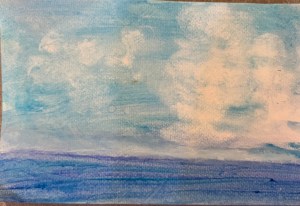
Artists I know specialize in painting clouds and others paint skies exclusively. Many artists paint landscapes and birds and flowers. They then work with that specific material, possibly for their entire lives. It is their most creative world, their signature, what we know them by.
It is not a random choice, but a discriminating, highly selective instinct, a particular order of things that has an outstanding appeal to the person. American writers Ernest Hemingway and before him Stephen Crane were drawn to men under extreme pressure where the best way out of danger was through having courage.
Strive For Freedom As Though Only You Exist
William Faulkner became great as soon as he decided that the only person whose opinion he cared about was his own.
Unless they please themselves, artists and writers will please nobody. They function best when while at work they are thinking of nobody’s liking but their own: “I alone here, on my inch of earth, paint this thing for my own sole joy, and according to my own sole mind. So I should paint it, if no other human being existed but myself…Thus I must do it, for thus I see it, and thus I like it.” (John Ruskin.)
© 2026 David J. Rogers
For my interview from the international teleconference with Ben Dean about Fighting to Win, click the following link:
Order Fighting to Win: Samurai Techniques for Your Work and Life eBook by David J. Rogers
Click on book image to order from Amazon.com
or
Order Waging Business Warfare: Lessons From the Military Masters in Achieving Competitive Superiority
Click on book image to order from Amazon.com
or

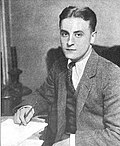 F. Scott Fitzgerald’s (1896-1940) writing was the major interest in his life. From grade school to his death nothing was quite true to him unless he had written about it. He was a fine writer, and his writing was always about himself or people he was intimate with. As a result his life was inextricably bound up with his work and his life with his kooky and attractive wife Zelda was an interest in itself. He lived a colorful life and a disastrous one with Zelda. They lived like fairy-story hero and heroine, filling newspapers with reports of their wild life-style. Much of the disaster of their lives were of their own making. Fitzgerald is called the creator of the Jazz Age which began with his writing best seller This Side of Paradise at the age of twenty-four, making him rich, his goal for writing it. The book became the voice of the younger hedonistic, thrill-loving, post-World War I generation.
 All writers are equipped with a good memories, but Thomas Wolfe’s memory was astonishing. Because of it he was able with ease to recall events, people, and places in stunning detail. That was his strength. His weakness was an inability to restrain the deluge of words that poured out of him from evening to dawn as he wrote, or when he spoke, and he simply, despite himself, had no ability to stay within the requirements of writing a saleable novel. He had no concept of how to write such a book and needed the help of his editor, the legendary Maxwell Perkins of Scribner’s, who at the same time was the editor of Ernest Hemingway and F. Scott Fitzgerald, two other difficult clients.
 No writer in the nineteen thirties–or even now–could write with the beauty of Thomas Wolfe’s prose. His reputation after his death suffered because of the perceived formlessness and verbiage of his writing in an age when critics preferred tight structure and economy of language–short sentences and short episodes, and highly-focused scenes rather than the volume and torrents of Wolfe’s language. Once considered by Nobel Prize winners William Faulkner and Sinclair Lewis to be America’s finest writer, and in the past extremely popular with readers and critics, Wolfe is now almost never read–unfortunately in my opinion, if one is interested in being inspired by the brilliance of written expression. Hard as you look, you will not find Thomas Wolfe–once thought a towering genius–in current anthologies of American literature.
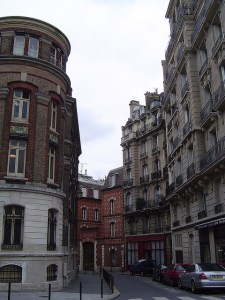 He arrived in Paris in 1930 with no money, no prospects, and no place to stay, in his words, “ a writer at the beginning of his career, naïve, enthusiastic, absorbent as a sponge, interested in everything and seemingly rudderless.”
 Psychologists classify people in categories according to their personality traits. Yet they cannot measure
  Sometimes a person who one day will become a serious writer doesn’t know herself what she might do with her life. But she feels instinctively that she’s good for something and has some reason for existing. She has a hunch that there is something important in her that’s worth pursuing further. She finds that something in words. She makes herself into a writer–an expert in expressing herself via written language. At times, with some people, writing becomes the center of their identity, and they become another Saul Bellow who said that when he wrote he felt like an artist, but when he was not writing he didn’t feel like anything.
 A main goal of writers and all other creative people is to produce works. Writers make the structure of their creative lives by means of their work. If they are unable to work or the work doesn’t go well, they suffer. The writer–the artist, whatever the art–uses the art to express emotion and when they are denied that expression they feel tension and conflict.
 The sciences and anything involving a machine are mysteries to me. I have no aptitude for them. Once I got hold of an old used paperback on how to become handy around the house and did some wiring and put in a light switch in the children’s bedroom without burning the house down. My children watched me and marveled. I swelled with pride. I felt I’d really accomplished something. I’d say to guests, “come upstairs for a second” and show them the light switch and brag, “I put that in.” A very unusual accomplishment for me. But writing I understand and am good at. I’m confident about it. It’s my best craft.
 Writing is a time-consuming process of self-discovery, self-awareness, and self-expression that may satisfy a writer’s deepest needs. Some writers find that nothing can compete with, nothing can replace, the writer’s joy of creating. Many writers so saturate themselves with their work that it becomes a need as strong as sleep, sometimes stronger. Many writers think, “This writing that I am doing is essential to my fulfillment and well-being. At times I may be so involved I will forget to eat. I will forget to make love. I will block out distractions. I will arrange a life-style and personal habits and routines to accommodate my writing.”
 Some writers do consider writing the most important role in their life and give other roles short shrift. Many writers would agree with Katherine Anne Porter who said that the “thing” between her and writing was the strongest bond she had ever had—stronger than any bond she had ever had with any person or activity.
  Here it seems appropriate to talk about my Law of Give Up to Get. The Law of Give Up to Get means simply that to get something important in life, you must give up something else. Gripe all you want, rail at the gods, and wish it weren’t so, but you have no choice. In the long run, perhaps you can have everything you desire. But at any one time, to get A you’ll have to give up B. To get X you must give up Y, and maybe you might have to give up Z too. To write, you have no choice but to give up something else—maybe more than one thing. That’s a law, the way life works: to achieve this, you’ll have to give up that—time, energy and other resources spent doing other things, attaining other satisfactions.
 Are there any roles in your life that can be supported with a smaller investment of time, energy, and other resources so that you can devote more time to writing? Are there any roles currently in your life you might dispense with?


 davidjrogersftw
Why Are So Many Talented Writers Unsuccessful?
I’m assuming that you have a writing talent, and that you may even have been the most talented in your class, in your school, and now are the most talented in your writers’ group, most talented in your home town. That’s something to be proud of. But talent alone isn’t enough to make you a highly successful writer in the competitive field of creative writing in which almost everyone is talented, everyone gifted, and everyone exceptional.
But there are qualities other than talent that will determine how successful, fulfilling, and happy your writing career will be in that competitive world of very talented people. That hard-to-define stuff called talent is just one of the many requirements of the writer who excels. If you are relying solely on the talent you were born with to bring you writing success and happiness you are making a mistake.
Poet John Berryman thought that talent was no more than 20% of a successful poet’s personality, and why shouldn’t the same may be true of novelists, dramatists, screen writers, and essayists? What I’m asking is, “What comprises the eighty percent of a writer’s personality that blended with natural talent brings about success?”
To that question there are innumerable possible answers. According to writers, teachers, critics, and researchers other factors that are important are:
Endurance/ Persistence
Novelist Kurt Vonnegut said that talent was extremely common, but what is rare is endurance, the willingness to endure the sometimes difficult and trying life of the writer. Many writers have come to the conclusion that sheer old-fashioned day-by-day doggedness is the key to writers’ success. In the book The Courage to Write, Ralph Keyes says, “Success as a writer is within the grasp of whoever can tell a story on paper that people want to hear and is willing to persevere, to put up with boredom, frustration, and anxiety. Determined writers will find ways to get published regardless of whether they are brilliant or have a degree from the Iowa Writer’s Workshop.”
Passion, Intensity, Obsessiveness, Willpower, and Patience
Among the personal qualities that cause motivation strong enough to sustain a writer through the inevitable trials, disappointments, setbacks, and self-doubts are those that are not luxuries but necessities for any writer who is in any way serious about writing: passion, intensity, obsessiveness, willpower, and patience. Gertrude Stein said that all of a writer’s work comes out of a passion as a powerful force, and added that if you really have that passion you aren’t able to recognize it because you don’t know what it is to feel any differently. Many people with obsessive compulsiveness–including writers I’ve known–are especially productive not despite that affliction but because of it.
Hard Work, Commitment, and the Hunger for Success
Writing teachers are generally in agreement that it’s not the best, most talented students whose names they see in print in later years, but the hardest workers and the hungriest for success. The students with the most talent but the weakest work ethic who dazzled the class disappear into oblivion, while the hard workers often go on to great achievements. Many prodigiously gifted but poorly motivated people do not end up where gifted people belong: in the upper echelons of their field. Without pursuing all your goals with clear-mindedness, confidence, and commitment over years, you’ll probably quit after repeated failure.
Every writer, as every artist and every actor, who experiences minimal success eventually asks “Should I quit?” or lowers their ambitions. Writers who have achieved a high level of excellence and success are not satisfied to reach merely an acceptable level of performance, but are motivated to pursue increasingly higher goals.
Example of Pursing Increasingly Higher Creative Goals: Frank Loesser
Self-Confidence and The Need to do Your Best
Those who are sure of themselves intensify their efforts when they don’t reach their goal. Studies of high-performers in all the arts show that they are all universally alike: over and over again they are people who believe in trying to excel, in doing one’s best, in working very hard and spending time constructively. They are intensely attracted to their field from their first exposure to it and all through their efforts to develop their skills and their “reach.” In fact, if you have an intense interest in a creative field, that in itself is almost always a sign that you have a natural talent in it.
The Effect of Passing Comments
Talent can be ignited at any time. The cause of motivation to write a 300 page book or continue on the writer’s life path may be nothing more than a passing comment. Simply being told by someone else or telling yourself that you can achieve much more through trying harder will get most people to try harder. Just being told that they are talented is often enough to start people off to develop that talent.
An Analogy
Talent in writing will not bring success unless it is supplemented by other human qualities. Without endurance, determination, intensity, passion for writing, obsessiveness, will power, hard work, commitment, hunger for success, and self-confidence a writer would be analogous to an automobile–beautiful, streamlined, expertly designed–but lacking an engine.
© 2023 David J. Rogers
For my interview from the international teleconference with Ben Dean about Fighting to Win, click the following link:
Order Fighting to Win: Samurai Techniques for Your Work and Life eBook by David J. Rogers
Click on book image to order from Amazon.com
or
http://www.barnesandnoble.com/w/fighting-to-win-samurai-techniques-for-your-work-and-life-david-rogers/1119303640?ean=2940149174379
Order Waging Business Warfare: Lessons From the Military Masters in Achieving Competitive Superiority
Click on book image to order from Amazon.com
or
http://www.barnesandnoble.com/w/waging-business-warfare-lessons-from-the-military-masters-in-achieving-competetive-superiority-revised-edition-david-rogers/1119079991?ean=2940149284030
Follow my blog with Bloglovin
Share this:
7 Comments
Filed under Confidence, Developing Talent, Human Potential and Achievement, High Achievement, Intensity, Persistence, Success, Willpower, Writers, Writers' Characteristics
Tagged as Frank Loesser, Gertrude Stein, John Berryman, Kurt Vonnegut, passing comments, Ralph Keyes