Once you are a really good writer or artist, you enjoy many advantages. But beware because now you will also have new weaknesses.
 As a really good writer, painter, actor, architect, or composer you have the ability to generate the best solutions to creative problems. The solutions are much better than the solutions less capable creatives settle on. Your aesthetic judgment is better than theirs. You perceive features of the problems facing you and the solutions to them that lesser creatives don’t notice and can’t think of.
One reason why you are so capable is that if you are really good at your craft, you are able to keep huge amounts of useful information in your working memory, far more than less excellent writers, painters, etc. can keep in their minds. You can easily draw on that wealth of knowledge you’ve acquired about your art–its history, its techniques and artists, its methods leading to success and those that lead to failure or exasperation. Even genius, left alone with no help from extensive knowledge, is not strong.
As an example of the wealth of knowledge possessed by excellent creatives, let me cite multiple Academy Award-winning and Pulitzer Prize winning composer and song-writer Marvin Hamlisch.  He had a staggering knowledge of American songs. I knew Marvin and would do exhaustive research trying to stump him with the least known and most esoteric songs my research could find, asking him “Who wrote…?” and “Who wrote…?” However obscure the song and no matter how confidently I thought, “He will never know this one,” he always knew.
But you must guard against a common weakness of really good creatives: over-confidence in their artistic judgement. Capable as you may be, your judgment is not infallible, and sometimes it is wrong. For example, even a supremely talented writer, painter, or architect can waste months or years on an ill-advised project that looked promising but turned sour. Thomas Wolfe studied playwriting at Harvard and wrote bad plays for nine years before realizing, at the suggestion of his lover, that he had no future in playwriting, but was “meant” to write novels.
In another instance it took George Bernard Shaw five years of submitting to publishers one novel each year to realize the opposite: that he had no future writing novels, but could write plays masterfully. An editor who had turned down Shaw’s novels had said, “Unfortunately we must reject this novel too, but the dialogue was wonderful. Did you ever think of writing plays?’ That was all that was necessary for Shaw to turn the direction of his career.
Really good artists and writers are generally (though not always as in the cases of Wolfe and Shaw) good judges of their own abilities. They are self-critical and self-demanding to a very high degree. They are self-absorbed in a positive way and closely study themselves and their work, which they are obsessed with. They are motivated by a so-called “urge to improve,” and monitor themselves so that they are able to detect errors in their knowledge, technique, style, and skill, and do something to correct those errors.
 Unlike ordinary writers who might not be aware that their plots are not believable, a really good writer would be aware if theirs were not. Yet, in spite of being vividly aware and quite objective and accurate about their own work, expert artists and writers have the weakness of often being wrong in their predictions about the performance of novices they have been asked to evaluate. It is as though they are unable to recognize talent while it is still in a formative state. In fact, the greater their expertise, the more likely they are to be wrong in predicting the performance of novices.
Something very similar may happen in the field of professional editing–highly experienced editors not recognizing the promise of young writers. For example, when young English schoolteacher William Golding’s submission of his first book, Lord of the Flies, was being considered by Faber and Faber Publishers, the editors,  including the senior editor whose judgment was “always right” rejected it as impossible to understand. Only Charles Monteith, who had never edited a book before, argued angrily on behalf of the book he had fallen in love with despite its obvious flaws. Unlike the experts, he saw that good editing could remedy its weaknesses. Lord of the Flies, edited by Monteith, became an international best seller.
Golding went on to write many books, essays, and plays. Golding and Monteith became an example of a superb writer-editor-friends team working together in harmony for many years of productivity culminating In Golding’s Nobel Prize. So if you are a novice and are looking for objective and accurate appraisal of your ability, it may be a good idea not to ask an expert, but to go to a teacher and to hope the publisher’s editor assigned to you is as enthusiastic as Charles Monteith was and as willing to fight for your book.
To improve their artistic performance, really good artists and writers will be more opportunistic, making use of whatever sources of information they need to solve their creative problems. Just as stand-up comedians steal jokes from each other, artists and writers “borrow” insights and techniques from other artists in their own art and from other arts as well, and from any other field they are familiar with.
 Really good creatives are able to pull out of their minds–with ease–the insights they need. They are so able and accustomed to using the substantial skills they have developed, that they do so automatically, “without thought” as a Zen master would say. To them writing or painting is easy. Yet, at the same time, they may be victims of inflexibility in the face of new circumstances. At times they have trouble adjusting to situations confronting them.
For example, marvelous actor Charles Laughton was offered the starring role in the movie The Bridge on the River Kwai, but hard as he tried, he could not form a concept of the role sufficient for him to play it. He turned the role down. He said that he finally realized how it should be played when he saw Alec Guinness play in the movie the role he might have had. Was it an Academy Award winning role, whoever would have played it? Would Laughton have won the Oscar for best actor as Guinness did?
 Really good creatives spend considerable time analyzing the problems facing them while less accomplished creatives spend less time and are not as patient as the exceptional creatives. A study discovered that students in art school who would become the best and most financially successful after graduation took much longer to meditate on and plan their paintings, lithographs, and sculptures.
A weakness of many really good artists and writers is overlooking details that don’t seem to them to pertain to the problem, but do pertain to it. Highly talented people are notoriously blasé about details, don’t worry about them, and don’t like to bother with them. (For example, when F. Scott Fitzgerald submitted the manuscript for The Great Gatsby, it had more than 100 misspellings.) That can also be seen in areas other than the arts. People with extensive knowledge about a sport recall fewer details of a text about that sport than people with little knowledge of the sport.
 Genius in the arts or in any other pursuit is almost always specific to one art, one domain. Often it is assumed without too much thought that a person with a high level of skill in one area will almost automatically be skilled in another area or many other areas. That’s called “the halo effect.” Yet while there are exceptions, the halo effect is generally invalid. High-performing creators do not excel in areas where they have no expertise. But in a single domain they are on their home turf, and their work is really good.
© 2022 David J. Rogers
For my interview from the international teleconference with Ben Dean about Fighting to Win, click the following link:
Order Fighting to Win: Samurai Techniques for Your Work and Life eBook by David J. Rogers

Click on book image to order from Amazon.com
or
Order Waging Business Warfare: Lessons From the Military Masters in Achieving Competitive Superiority

Click on book image to order from Amazon.com
or
 focus on a system to improve your creative performance is to be aware of what you are trying to accomplish–with your life, and in this year, this day, this moment. When you acquire the habit of saying to yourself often in your daily life–morning, noon, and night–“Focus on your purpose,” those words become a hypnotic motto that stirs your muscles and mind to action. Then your life takes on a quality that is now becoming rare even among gifted creators–vital intensity that facilitates the production of works that can be pointed to and admired. That single goal–producing works as a result of talent combined with discipline–is more powerful than all other creative goals.
 that specialty. And you must
  free of suffering are the goal in Buddhism. The Buddhist Eightfold Path consists of eight ideals that when practiced bring an upright and happy life. They are eight prescriptive “rights,” including right association–being careful about associating with good, wholesome, even holy people; right intent–making up your mind as to the one main purpose in life you really want to pursue; right speech–no lying, backbiting, or slander; right thoughts–thinking compassionately, generously, and with goodwill; right conduct–not killing, stealing, or lying; right effort–using your will power and taking action to achieve a good life; right concentration–the use of techniques to enhance concentration and enlightenment. And there is right livelihood–doing what you’re best suited to do in an honest occupation that harms no one.
 Success in a creative field (in fact success in any field) is not attributable to one thing alone such as talent or IQ as many people believe, or three or four things. I believe there are eight components. It’s important to understand what the eight components are and the questions they will answer:
 their creative lives by means of the work they do. If they are unable to work or the work is poor quality or is stopped-up and doesn’t go well, they suffer. Regarding the necessity of a creator to
  There isn’t one universal work/production program that suits all creators. A production program won’t work if it’s imposed. Each creator’s program will have to be idiosyncratic–custom-designed by yourself for yourself. To find the ways and means to improve the quantity and quality of your production, you should experiment and try out different approaches until the best work/production program suited to yourself is found.
 For high quality uninterrupted work to happen, not all, but most creators need isolation and solitude. “The concentration of writing requires silence. For me, large blocks of silence. It’s like hearing a faint Morse code…a faint signal is being given and I need quiet to pick it up” (Philip Roth). Some creators prefer noisy environments. But even the feeling that you might be interrupted interferes with creative thought.
 production goals continuously in mind. Production ebbs and flows. Some days work comes out of you in torrents. You’re in overdrive. But other days–nothing. But one way or another,
  A curious thing would happen. The quantity group would also produce the highest quality work. The quantity group would churn out streams of work and learn from their many mistakes and develop wide assortment of skills. But the quality group would get caught up the elusive concept of perfection and grandiose dreams and would become paralyzed. Some creators produce 10, 15, or 25 times more works than other creators. Those who produce the most works usually rise higher, do better work, and find a greater sense of accomplishment.
 If you neglect an activity for just two days you’ll function much less effectively when you resume work. In writing and painting, as in everything else, inactivity leads to the atrophy of abilities. Your level of motivation affects your willingness to work. The quantity of your production is in direct proportion to the intensity of your
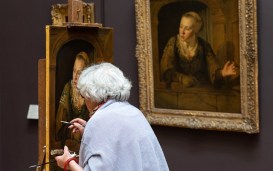 If you want to be successful in the arts, be older rather than younger. Older is better because most outstanding contributions to the arts are not made by people in their teens, 20s, 30s, or 40s, but in their 50s, 60s, and 70s. Why is that so? The main reason why, artistically, older is better than younger is that to have the ability to do artistic work expertly and do increasingly superior work, the main factor is the artist’s KNOWLEDGE and its PRACTICAL APPLICATION over a period of time that is often long.
 No artist has ever lived –Shakespeare, Michelangelo, Proust, Picasso, Mozart–who had so much talent that they didn’t need considerable knowledge to excel at a high level. Talent is a blessing, but talent alone isn’t enough.
 In any field in which you are intensely engaged, such as serious writing or painting, the brain you feed with knowledge just goes on learning and learning and learning and your abilities grow and grow. The more knowledge you have, the faster you’ll recognize related information that’s relevant to solving problems you are facing. You’ll be able to say, quite quickly, “So-and-so handled the problem I’m now facing by…” Acquiring knowledge is what you are doing all the time you’re working at your craft, talking with others about your craft, studying it, taking classes, reading, and practicing to develop your skills.
 The more knowledge that is needed to excel in a field, the more
  Following in the footsteps of the greats is a vital route to writing knowledge, and knowledge leads to skills, and skills coupled with confidence lead to success. What helps is an aptitude for learning and learning fast, which I can hardly imagine a person in the arts not possessing.
 Let’s hope that your mind is a sponge sopping up knowledge because people in the arts who can acquire knowledge quickly and remember large amounts of it have an advantage when trying to create something original.



 davidjrogersftw