“And if I were standing in the middle of my people
Age would go from me and I would be young again.”
(Translated from the Irish by Lady Gregory)
 Chicago’s Sheridan Road ran parallel to Lake Michigan, as it does today, and when you walked down it in those days you heard the sounds of the traffic mingling with the lapping of the waves on the beaches. From the beaches on clear days you could see on the horizon’s edge the western shore of Michigan to the east, and out on the lake low in the water turgidly-moving barges carrying loads of ore down from Minnesota to the steel mills of northern Indiana.
On certain afternoons in July and August the sun bore down on the sand so intensely that it was painful to walk on it, so men dashed to and from the tumbling waves carrying their squealing little children in their arms. One by one all the great industrialists’ mansions that lined the street were torn down and the beaches were filled in and replaced by closely-packed massive and towering apartment buildings with hundreds of verandas which were far more impressive architecturally, but far less beautiful.
Few people remember the mansions or the beaches, but most believe that the high-rises have stood there forever. Now when you walk down Sheridan Road, the traffic is so heavy and the water so far away behind the buildings that you can no longer hear the waves.
Three blocks to the west was Edgewater, a miniscule street slung like a hammock between a quiet street to the east and a busy street to the west. There I lived quite happily in a moderately dilapidated apartment which I shared with my parents, two sisters, one brother, two blue parakeets, and a dog.
Along the street stood nearly identical sturdy brown brick two and three-flats with large, clean lace-curtained windows in the front and small open porticos decorated with terra cotta flower pots of various sizes. Inside the apartments the ceilings were high and the rooms were laid out more or less the same as ours. Those buildings were interspersed with squat, frail but fearless homes of families of two, five, or eight children and were concealed from the late morning or afternoon sun by tall trees. In the back yards and on the front lawns stood shady poplars and towering American elms whose profusion of leaves, singed and curled by the blistering summer sun, hung parched and brittle, and shook like tinsel when the leaves fluttered in the wind.
The morning sun revealed rectangular lawns that, except when snow obscured them, were always closely cropped and tidily trimmed as though meticulous angels appeared every night to care for them. The hedges that hid modestly in the shadows were as neatly shorn as boys’ fresh haircuts, and the flowers in the beds were tall and brightly-colored. In late autumn the brilliant orange, crimson, and yellow leaves that had been liberated from the trees by westerly winds scampered wildly, crisply, and noisily along the pavement and adorned the lawns like jewels.
On no particular schedule—or none we were aware of—from down the alley emerged the gray rag man sitting high atop a complaining horse-drawn, creaking wagon, his voice preceding him as he called “Rags, old iron.” As the wagon neared, you heard, faintly at first, and then more purely, the rhythmic, hollow clomp, clomp, clomp, clomp of the shod hooves of the old gray horse whose head hung low and swayed slowly to the rhythm of its gait. Then you heard it snort as it struggled futilely with its bit, and saw its huge protruding brown eyes glazed with an expression of weariness and sorrow, and the sunlight shimmering off the sweat that coated its flanks.
In the early evenings as though all in unison, the regiments of gray, strong, working men, pensive, plain, godly men—the fathers—passed down the street in orderly array, returning to those of us whose entire universe extended no further than the ends of that block. After dinner when the weather was good the fathers–some in gaudy suspenders, to a man seeking peace–left their families and went alone outside in the yard to smoke. The glowing tips of their cigarettes or bowls of their pipes hovered like red ornaments suspended from invisible strings in the darkness. The men nodded cordially to one another, but only rarely went to their fences to speak.
They stood stationary and solitary in the middle of the yard gazing up at the dazzling field of glinting stars, being reminded of their own inadequacy, their own insignificance, feeling in themselves the overwhelming rapture and wonderment of being alive on this earth on this night that they would try to convey to another person, but would forever be unable to. After a little they shredded their cigarettes or tapped out their pipes on the soles of their shoes and watched the tiny embers drift to the ground. Then they went back inside where the light was bright and the rooms were noisy with happy children.
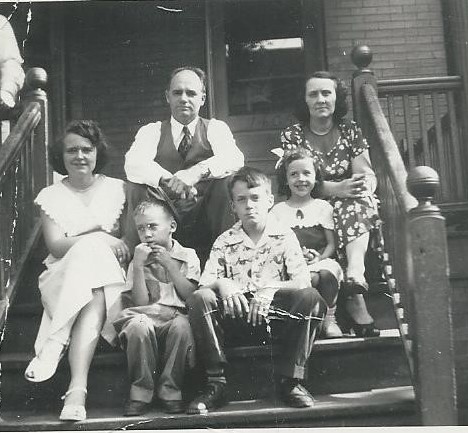
On especially sweltering summer nights one by one my family evacuated the stifling apartment and sat together in a little cluster on the wooden front stairs. There every summer evening without exception I fell under the spell of our little street. I watched the flight of night hawks circling high above chimneys and sweeping down like kites. My eyes settled too on the entwined strands of ivy on the trellis next door, on the blinking traffic lights and long beams of headlights spread like cream on Ridge Avenue, the yellow-glowing lamp lights in the windows of neighbors, and the demented boy who rode the street at nights with his little dog in a paper bag in the basket of his bicycle. And if our luck was good, down the street came what we were all wishing for: a breeze. Then the multitude of closely assembled leaves trembled on the trees that were tinged with moonlight.
The six of us were frugal with words on those evenings, parceling them out sparingly, as though they were precious things that needed protecting. When we spoke among ourselves it was not of topics momentous or memorable. Serious subjects were best saved for visits to our stairs of my father’s family–Welsh of course, with musical accents and exotic names, all of them worldly enough to speak on most any subject with some professed expertise. They always came bearing a vast stock of stories and bits of song and strong opinions that differed markedly from one another and were bickered over turbulently, but in a generally agreeable and forgiving manner. Sometimes too, other visitors came to sit with us.
Whenever anyone on those stairs spoke, I listened intently to the words, the silences, and the breaking of the silence, the short sentences and the longer, the soliloquies, the jokes, comments, stories, exaggerations and wild tales of utterly impossible events that there was an unspoken agreement to play along with but not for a minute believe. Sometimes I understood what was being discussed or commented on or observed, but often I did not. When I did not, my attention drifted and the words dissolved into a hum and became merely sounds.
Then I thought that perhaps when I was older and my time had come I would understand everything or most everything of which these people spoke, that meanings to which I, as a little child, was not privy, would then become clear to me, and I too would be able to speak fervently of them. At times the words the adults uttered came accompanied by a gravity or sadness that frightened me—talk of war and defeats and death and deepest sorrows. But soon someone usually said something that brought laughter all around, and I laughed with them, not knowing what brought them that flash of joy. But I shared in it, knowing that it was good and that when they were happy I was happy.
Too soon the deepest darkness arrived–imperceptibly, as if we had been inattentive and without our knowing it had descended stealthily from its source or risen from the earth to wrap itself around us. Street lights, old and sunken into the ground and standing precariously like drunken sentinels wearing metal caps, then lit and cast yellow cones all down the street. Swarms of flitting fireflies carrying their little lanterns behind them appeared and hovered like tiny intermittent airborne embers that speckled the night like the amber tips of matches. Once aloft on their nocturnal flight like winged magnets the fireflies drew their tormentors–my brother and other giddy children and me. Powerless against our quick hands, soon they were assembled like congregants in a glass jar which glowed like a church in the night.
The twilight sinks and the evening wanes and the intense heat cools and the street becomes warm and peaceful. Soon from our visitors emerge the end-of-evening yawns and “oh-my-goodness-how-time-flies,” and they pack up and leave for home. We say goodbye and they are gone. My family is alone now, all of us speaking in drowsy tones. We hear the nightly chants of the sleepless crickets from under the porch and in the hedges and see neighbors hurrying home. It is the end of this day.
My mother flutters her fingers and says, “Well, it’s getting late” with a sigh that conveys that she is weary, and my father says, “Now heed your mother children.” While still able to, I cast one last long look at the people who share this place with me. Somehow out of God’s grace and for reasons I will never fathom, they have been sent to dwell in this house for a time and to be the objects of my love forever. We children moan as pathetically as we can to be granted a few minutes more of wakefulness, but despite our protests we are ushered inside.
I lift the window shade slightly and see, overhead, a splinter of a moon and protective stars attending us. There with me in that bedroom is my brother sleeping, and there are my sisters sleeping. I am sheltered there in that sanctuary of my youth, safe in the protective hands of my parents and the Lord. My life will never be as free of complications and contradictions as then. There is no need yet to try to muddle through a life I do not fully understand.
It is now a time of resplendent picnics and sunny beaches, a blessed period of my life when pain is a stranger to me and I am immune from suffering. I lie remembering the day as I will remember it forever–a blistering journey to the cool of evening. And trying to peer forward into time and see how I will be as a man, I wonder what this life holds in store for me and if I will live mine creditably enough. I study my hand suspended in air like a gray and familiar bird. I whisper, “That is me, me,” and with that thought something stirs deeply in me that all my life will be inexpressible. And then I make a wish that things will never change, but will stay as they are forever.
I am told that my mother and father are deathless, my brother and sisters are deathless, and that I am deathless too; that there really is no death and we endure everlastingly and that time is an illusion. But I know that my life as it is now will end. I know that we in my family are seeds that will be cast on separate earths, that we will be drawn apart to live our lives there to the end. And that too soon those people I intend well toward will pass away and leave no trace but in my memory. That the day will come when I will never again sit on those stairs with my beloved family on an evening in the heat of summer.
After a while the faint sounds of spoons against coffee cups and the low drone of speech floating from the kitchen cease and my parents go to bed. Of my family I think in my child’s way–they are all of them–each of them–good people, devoid of malice, and I am blessed to be among them. Why, I wonder, have I been so favored? “Dear Lord, keep these people safe, and please treat them kindly. Spare us please from pain or so apportion it so that none of us is asked to bear more than one should be required to.”
Silently I pray, as always fast, “God bless Mom and Dad and…” and I fall to sleep beseeching God. The day ends then, and I dream, and in a moment another dawn breaks.
© 2014 David J. Rogers






 davidjrogersftw