“Writing a novel is a painful and bloody process that takes up all your free time, haunts you in the darkest hours of night, and generally culminates in a lot of weeping over an ever-growing pile of rejection letters. Every novelist will have to go through this at least once and in some cases many times before they are published, and since publication itself brings no guarantee of riches or plaudits, it’s not unreasonable to ask what sort of a person would subject himself to such a thing” (Alice Adams).
Prescriptions:
Have a strong belief in and respect and enthusiasm for writing. To many serious writers writing is the central activity of their lives: no other activity compares. It is probably true that the majority of people, young or old or in between, don’t like to write. But there is just something about the act of writing that people struck by the writing bug find irresistible. Many aspiring writers wait all day for the half hour between putting a child to bed and sleep when at last they are free to pound away at a keyboard.
Be patient because all writers who reach high excellence in their craft will have done so via a long, sustained period of learning and application. P.G. Wodehouse wrote that “Success comes to a writer, as a rule, so gradually that it is always something of a shock to him to look back and realize the heights to which he has climbed.” “If the promising writer keeps on writing—writes day after day, month after month…he will begin to catch on” (John Gardner.)
 Have a need for self-expression and self-disclosure. Good writers reveal themselves in their work. Readers want writers to reveal themselves. A novel, for example, enables authors to convey a wealth of information that expresses them. Your writing, even the way you turn a phrase and the metaphors you use (why did you use an image of a fish then instead of a train?) and your vocabulary and points of view, tell the reader what you’re like. Writers have a need to discover exactly what they are thinking by writing it out, and then to artfully communicate it to the reader who wants to know.
Be more self-disciplined in matters concerning your work than most people in other fields .Success in writing is largely a matter of discipline.
Learn to overcome boredom and fatigue, particularly through positive self-talk and physical conditioning. .
Sacrifice for the sake of your writing. Anton Chekhov said, “It is difficult to combine the desire to live with the desire to write.” In A Moveable Feast Hemingway wrote, “On Thursday I was…feeling virtuous because I had worked well and hard on a day when I wanted to go to the races very badly.” For some writers writing is more important than their family. The family goes to the zoo; they stay home and write. “Generally (Eugene) O’Neill elected to lead an existence completely removed from what the great majority of people would call life, It was centered on, was focused on, organized around work” (Malcolm Cowley). Toni Morrison didn’t do anything but write, to the exclusion of everything else.
Take pride in your extraordinary writer’s memory nature has equipped you with. Your writer’s imagination depends so much on remembering what you’ve heard about, read about, or seen. Whatever happens to writers they never forget it, but store it for future use. Katherine Anne Porter said, “We spend our lives making sense of the memories of the past.” Writers must have a gift to remember sensations and images that were experienced at times many years earlier and to relive them in their original freshness and vividness. Not just memories, but detailed memories: “Thus the greatest poets are those with memories so great that they extend beyond their strongest experiences to their minutest observations of people and things” (English poet Stephen Spender). A writer may not be able to remember a telephone number or to pick up a dozen eggs at the store, but will never all his life forget the expression on his mother’s face as she came in the door that particular day. He has a perfect memory for that. Memory is a writer’s workshop.
 Possess extraordinary energy. No outstanding writing achievement has ever been produced without hard work. One of Joyce Carol Oates’ novels had 5,000 pages of notes. When writers are functioning at their best they work at white heat for an hour, a month, or years. Creative people don’t run out of steam. Their enthusiasm doesn’t wane very long.
Don’t spend your time working on easy problems. Good serious writers work on problems that are hard for them because they’re stimulated by things that are difficult. They not only solve problems, they create them because when they solve those they make progress and become better writers. That’s how they create work that no one has seen the likes of before and expands their abilities at the same time. A major intuitive skill effective problem-solving writers have developed is being able to identify the specific point to approach the crux of the problem.
Be resilient and able to overcome obstacles and to persevere. Many writers persist however difficult the physical and mental effort of pursuing their goal might be. “Creative people are those who are more willing to redefine the ways in which they look at problems, to take risks, to seek to overcome daunting obstacles, and to tolerate ambiguity even when its existence becomes psychologically painful.” (Scott Barry Kaufman and James Kaufman)
Enjoy writing’s sweat factor and be able to produce tremendous amounts of work. Writers–creatives–love to work. Production is the writer’s main goal. Usually the greatest writers are also the most prolific. Cynthia Ozick said, “There is a definite relationship between being major and having a profusion of work to show. You could write one exquisite thing, but you would never be considered more than a minor writer.” Thomas Wolfe sometimes wrote 5,000 words in a night. Georges Simenon who was capable of writing 60 to 80 pages per day, produced 200 novels, 150 novellas, autobiographical works, numerous articles and scores of pulp novels under two dozen pseudonyms. Ray Bradbury took two hours to write a poem, half a day to finish a short story, and nine days to write a novel.
Strive for the fullest development of your skills. Developing skills leads to competence, then to expertise, then excellence, then greatness. If you feel you have the skills, you’re less likely to be haunted by self-doubt and your writing will flow more freely.
 Have a strong concern for your technique and style. The reader isn’t meant to notice a writer’s technique, but other writers are aware of it immediately. The first thing you notice about writers is their style. Toni Morrison said that “getting a style is about all there is to writing fiction.” An appealing style is so important to a writer that writers joke about it:, ”If you are getting the worst of it in an argument with a literary man, always attack his style. That’ll touch him if nothing else will” (J.A. Spender).
Maintain an artistic vision and heightened perception. To writers the world is inexhaustibly rich with aesthetic potential. There are dimensions of reality they are sensitive to that other people overlook, perceptions of what might be called “hidden reality.” It’s the business of the writer, who has the creator’s faith that they are seeing a true reality, to find, collect, and communicate that reality in their work. Eugene O’Neill: “I am a dramatist…What I see everywhere in life is drama.”
Have a capacity for self-criticism and objectivity about your work and your abilities. Writers must learn to lay their egos aside as they would any other impediment.
Be sensitive to life and open to experience. Insatiably curious, writers plumb what is outside them in the world and their own thoughts, sensations, and emotions. They are not afraid of what ogres they might discover in the world they write about or in themselves.
Be what you are: more self-confident, rebellious than the vast majority of people. Writers who lose their youthful rebelliousness are in danger of losing their talent as well.
Have a large tolerance for ambiguity–larger than the great majority of people. That’s one reason writers are generally such effective problem-solvers.
Be restless because you can’t help but be. Writers often move on to other projects just when what they’ve accomplished becomes clear. (Months may pass, years may pass, but be sure to get back to your project and finish it.) The first stanza of a poem by Wordsworth may have been written 28 years before the last stanza was written.
Strive for competence and constant improvement. Writers are never content very long. They are guided by a persistent willingness to write with more expressive power.
Value independence. Writers must be allowed to move unrestrained in their own direction under their own power. No voice should be more persuasive than the writer’s internal voice saying “X is the truth I must pursue.”
Spend a lot of your time alone. Most successful writers would agree with historian Arthur M. Schlesinger that “everything that matters in our intellectual and moral life begins with an individual confronting his own mind and conscience in a room by himself.” Writers often prefer solitude over socializing.
Have the ability to focus. Creative people often learn at an early age that they will achieve more if they focus their efforts on one area rather than dividing them among a variety of pursuits. Writers are capable of intense concentration, losing all sense of time and place, conscious only of the work before them. They will let nothing divert them from accomplishing it. Gustave Flaubert said that only writing mattered to him, and that he kept all his other passions locked up in a cage, visiting them now and then for diversion. Focusing is intense. Emily Dickinson said that if she felt physically as if the top of her head was taken off, she knew that was poetry.
Be playful and value the simple and the unaffected. Writers are in love with simplicity and bring to mind a Chinese proverb: “A truly great man never puts away the simplicity of a child.”
 Be able to muster an abundance of physical strength and stamina. Often it’s the end of writers’ endurance that stops their working day. Novelist Thomas Wolfe would turn in manuscripts a million words long . He claimed that the physical demands on the writer made the writer’s life seem to him to be the hardest life man has ever known.
Adapt and make adjustments. An experienced writer has learned when to stop and begin again when something isn’t working.
Be studious in the sense of studying to develop your craft. All writers study and all are self-taught to a greater or lesser degree. Composers and fine artists are likely to have been taught by masters; writers are likely to have taught themselves.
Establish rapport with readers. Your writing is always for someone–yourself certainly. But also the audience, the reader. Skilled writers are aware of whom they are writing for and establish rapport with them within the first few sentences of the work.
Take luck, the breaks, and good or bad fortune into account. Good luck often follows persistence. A failure or wrong direction or bad luck may lead to something fruitful later on. A “wrong” word in a sentence may prove to be the perfect word.
 Have or develop a business sense. You have a career to manage and responsibilities and expenses. Study marketing and salesmanship–read. Take business classes.
Feel deeply; be emotionally rich. Writing, like music, must convey emotion–from sorrow to joy and everything between. Writers have strong feelings. For example, they often have fiery tempers.
If I asked you what you think are the qualities that it’s most important for writers to possess, how would you answer?
I, myself, would begin with “hard worker.”
© 2021 David J. Rogers
For my interview from the international teleconference with Ben Dean about Fighting to Win, click the following link:
Order Fighting to Win: Samurai Techniques for Your Work and Life eBook by David J. Rogers
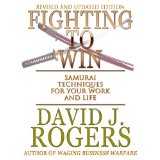
Click on book image to order from Amazon.com
or
Order Waging Business Warfare: Lessons From the Military Masters in Achieving Competitive Superiority
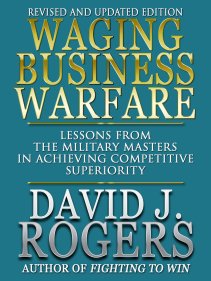
Click on book image to order from Amazon.com
or
 and he suddenly was rich. On the other hand, when Ernest Hemingway was young and poor in Paris and unable to support his family with his stories he would catch pigeons in the Luxembourg Gardens when the gendarme on duty went into a café during his break, and then take them home and cook them. Some writers, like painters such as Pablo Picasso, love being rich. Picasso said he wanted to work without material worries “like a pauper,” “but with a lot of money.”
 What do geniuses talk about?
  One of the problems superb writers face is that they–and no one else–are the best judge of their work and yet they must endure sometimes ignorant, amateurish editors and critics. Henry Miller found himself being abused by editor after editor he submitted work to. He snarled, “Who are these shits? Where do they get off saying such things to me?”
 Sherwood Anderson died after swallowing a toothpick with a hors d’ oeuvre at a cocktail party. Katherine Mansfield married a singing teacher eleven years older than herself and abandoned him the morning after their wedding night. George Bernard Shaw said, “Experience is the name everyone gives to his mistakes.”
 ready to start writing. Ernest Hemingway had to first sharpen all the pencils he anticipated using that day. Edgar Alan Poe petted his cat before he started.
  Jonathan Swift, author of Gulliver’s Travels, went a year without talking to anyone. Truman Capote’s advice to young writers was to socialize and not “go up to a pine cabin all alone,” because “You reach that stage soon enough.” Voltaire preferred the company of his mistress. He wrote in bed using her back as a desk.
 Maurice Valency thought that failure is very difficult for a writer to bear, “but very few can manage the shock of early success.” P.G. Wodehouse said that success comes to a writer rather gradually, and that it is something of a shock to him or her to realize the heights to which they have risen.
 Playwright Lillian Hellman said writers are “fancy talkers about themselves.” She said that if she had to give advice to young writers she would say, “Don’t listen to writers talk about writing or themselves.”


 davidjrogersftw