DELIA POEMS
She and I (In the Manner of Catullus 84-54 B.C.)
If ever there was a young woman who is self-sufficient and
Requires nothing beyond herself
And has a heart that like stone will never break
It is Delia. While she likes me and I like her and we are content together,
It is apparent that she doesn’t need me any more than I need her.
She calls her other affairs “flings” and when they
End they end. They are brief, none intense.
She says she feels more deeply about me than she is
Capable of feeling about anyone else, yet
For her and for me love is as elusive as a bumble bee.

The Difficulty of Recalling a Past Romance`
Why when we gave ourselves to them
So passionately, tenderly, proudly
And for that period with them
Thought only of them and they committed
Themselves to us can we not now recall
Through memory’s thick gray mist what
They were like?
An Affair Begins and Ends
Unfathomable,
Troubled,
Delia entered
My life so
Suddenly
And I hers
Neither was prepared.
Three unexpected
Years together
Seemed a moment
Yet ended
Abruptly
With her flowing tears.
Goodbye
But that last night I was firm and told Delia
That I must be leaving forever
In a few minutes.
She was surprised and did not
Understand what had happened
Between Friday and Monday
That from now on the woman
On my mind would be someone else,
And that shortly I would be gone entirely
From her life.
Meeting Diana
I saw her across the college cafeteria
And put down my book and went to meet her.
Her name, my name.
Black hair. Green eyes.
Elegant. Exquisite. Young.
The most beautiful woman on earth.
GOING HOME AND OTHER POEMS
Going Home
I will go back where I grew up and visit
The people I miss the most–
My sister Sharon, my parents,
A few friends, all gone now.
 I will arrive in the evening as the sun
Begins to set at the end of the street
Above the church where my father sang.
I will smell three hundred six o’clock dinners and
Watch the night hawks circle our chimney,
Neighbors coming home from work,
Children putting their bikes away.
I will watch my younger self run a race
To the corner and back.
Then I will sit on the stairs listening
To crickets in the hedge chirping
Their praise of summer nights.
Awaiting the Arrival of Dawn
I relish waking early
And feeling that tingle in my waking body,
The chilly air lying so comfortably on my skin,
The enchantment that only a five in the
Morning holds for me.
I feel the growing anticipation
Of a remarkable day waiting ahead, of a
Remarkable life thronging with possibilities.
The knowledge doesn’t frighten me that
We are all marionettes dangling
Between the vast and sacred past and the vast
And sacred future.
I delight in darkness and know that a bond
Intertwines me with everyone who exists
Or ever has or will; and know too that some
Yet unknown purpose to my life beckons fondly
And that one day I will discover it.
So I dream of splendid things through
The seasons as they measure out my life.
I welcome the luminous skies and the
Magnificence of morning–
And I will all my life
While awaiting the arrival of dawn.
The Printers
The one skill they all shared
Was that they were masters
Of the big presses–
Rough good-hearted men
Who lived like vagabonds
Leading solitary lives in Chicago
Boarding houses with broken
Chairs and tables and nine or ten
Paperbacks with crimped pages.
The soft-spoken one named Aaron
Had made and lost fortunes
In investments many times
And currently was penniless.
He worked in monogrammed
Pink, blue, or gray shirts with stiff collars
And French cuffs and
Never spilled a drop of ink on them.
A President’s Death
Poor Professor Johnson,
I pitied him–his deep feelings.
A dignified man, a scholar,
Teacher of eighteenth
Century British poetry,
Couldn’t speak but to
Say go home, there would
Be no class today.
On the subway someone
Had a portable radio.
No passenger speaking,
Everyone listening in shock,
The tinny, crackling
Radio voice telling us over
And over as though we
Wouldn’t believe him, that
The President I felt I knew
Though he was rich and I
A student struggling with
Illness and poverty,
Had been shot. Professor
Johnson went home and read
Alexander Pope’s masterful
Couplets through tears.
Her Yellow Bathing Suit
With rapturous eyes and golden tan
She was the loveliest girl
In the neighborhood.
She had freckles, was Irish,
Had an Irish name–McGuire.
She liked me. At her door
She took my hand.
As we walked to the beach–
Her hand so soft–
We sang of happy things.
Her hair was parted
And drawn back with
Thin red ribbons
Except when she swam and let her
Long hair free to float as it wished.
I can’t forget her face
Which made everyone stare as she approached and
Still after she had passed, and that
Rendered plain every other girl who,
Jubilant, dove headlong into the frothing waves.
When she turned her head
She did so gracefully, like a
Bashful doe hiding in a thicket. That day
She was wearing a
Gold necklace with tiny links.
Everything she did; everything she said,
Her every feature, enchants my memory,
Particularly the yellow, yellow,
Yellow of her yellow bathing suit,
The only yellow on the crowded beach.
A Writer’s Epiphany: The Object in the White Light
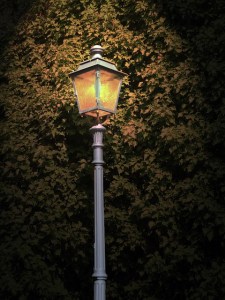 Working so hard on abstract
Problems–being so sick of them that
My brain ached. Troubled, anxious,
Confused, sleepless, I went out for a walk
Hoping that the cool late night air
Might be therapeutic and might clear
My thinking so that I could decide
Calmly if such a life would provide happiness
Or if I should choose a style of life
More conducive to peace of mind.
The dim streets empty, restful, a light rain,
The whistle of a distant train,
The bell on a boat ringing,
A woman on the boat singing.
Near the beds of flowers, on the pavement–showered
In the white light of a street lamp–a single object:
A book.
Perhaps this book I had found, which a scholar may have lost
Or angrily thrown to the ground,
Had been purposefully intended for me
By the ineffable wisdom of the stars, by good fortune,
As a sign, a portent, a clue, a key.
And that what this epiphany of the book
In the pure white light in the rain
And the shrill whistle of the far-off train
Meant was that I could not escape my pre-
Ordained destiny that suited the architecture of my genes,
The juncture of talents, gifts, desires, qualities–
Not striving to become any of the thousand entities
Others are suited to be, but that are alien to me,
Becoming thereafter one thing alone:
A being gluttonous of words, a fish content and
Self-possessed, free of anguish,
Swimming in seas of language.
The Fathers in My Youth
After dinner, when the weather was good, the fathers–
Some in gaudy suspenders, to a man seeking peace–
Went alone outside in the yard to smoke.
They stood stationary and solitary in the middle of the yard,
Gazing up at the dazzling field of glinting stars,
Being reminded of their own inadequacy, their own insignificance,
Feeling in themselves the overwhelming rapture and wonderment
Of being alive on this earth on this night.
Long Day
I’m still at work though it’s getting late.
I’m using an orange as a paper weight.
The Memory of Pain After a Long Illness
There is no memory
Like that of pain–
Impossible to share
And futile to compare.
There is no memory
Comparable to that of pain.
SIX MONTHS RIDING FREIGHT TRAINS ACROSS AMERICA WITH A FRIEND
Overview
We zigzagged back and forth across the country.
We heard the cries of hawks echoing through canyons and watched
Eagles circling like feathery kites above the great, austere
Shapes of mountain peaks. And always in the background
We heard the unceasing clackety-clack of the swaying trains.
We prowled train yards and for many hours
We sat on box cars, our legs dangling,
Gleaming railroad tracks under us.
And we felt deeply the fearful stillness of big cities
In darkness–their gloomy late nights. We saw
Women selling stuffed armadillos, a beautiful woman
Eating apricots at a picnic table, and evening after evening
Saw the sunlight fade.
A Place to Sleep
We slept on box cars and flat cars,
On benches in parks and playgrounds,
And in laundromats and on motel lawns,
 The gaudy, intermittently-flashing lights of the vacancy
Signs keeping us awake. We slept without bedding
On creaking bed springs that cut your back torturously
Like knives in foul-smelling small-town two-bit jails that
Put us up for the night and fed us along with the prisoners.
Crossing a River in a Boxcar on a Rainy Night
A downpour had struck up suddenly and surprisingly
As our freight train was pulling in. Waves of cold rain rushed
In one side of the boxcar and out the other sheet after
Sheet. Flashes of lightning illuminated the entire sky
And cracked like gun shots in a shooting gallery.
Then the rain stopped just as
Suddenly, the lightning ceased, and the wind died. The
Sky had already cleared then and was tinged with a mellow
Violet at its edges. A wind, warm and refreshing in the cool
Night had come up from the south. We had
Crossed the Mighty Mississippi on a
Shaking railroad bridge that early September night.
Thoughts of Home
Often toward evening under skies appearing low enough to touch,
I thought of Chicago: the beaches, Sheridan Road, night falling, city
Lights starting to glitter, the people I loved.
A BOY’S ADOLESCENCE
Grocery Store Clerk/Delivery Boy
How I loved being twelve and
Out on a grocery delivery to an old
Neighborhood widow on streets whose every bump,
Hill, and crack my wagon was friends with–
No one with me to boss me, no problems to concern me,
And there feeling I was in a garden
Delighting in the air, golden
Sunlight, and glorious shades and shapes of
That tiny patch of the earth that fortune
Had so generously allocated to me for my pleasure,
And sounds beyond number that sang in my young ears.
Lyric for Angela
At seventy-five cents per hour
I am a twelve year old
Professional bagger of cans
Of pineapples and tomatoes,
Weigher of potatoes,
Stocker of shelves
So the labels artfully frame
For the customers’ eyes
The Gerber baby,
The Scott tissues,
The orange carrots,
The vivid green peas.
When I am near Angela,
The dark-eyed store owner
Who favors me
My heart beats faster.
I cannot breathe
When I am near Angela.
As she works she sings.
Her spirit enfolds and singes me
As with hot tongs.
She smiles with
Such sweetness, gentleness,
And goodness she breaks my heart.
Her hair, her voice, her hands, her
Presence bring
A quality into my life
Which I know to be love.
My youth is purer,
My memories more
Lasting because of her.
Angela’s husband is awful
To her and treats
Her cruelly.
I vow that one day I will
Whisper to Angela,
“Why don’t you run away?”
But I fear she will not
And that after I have gone
To high school and college
And am grown up
She will still be heard
Singing in the aisles
Of this little store
Like a bird in its cage.
© 2024 David J. Rogers
For my interview from the international teleconference with Ben Dean about Fighting to Win, click the following link:
Order Fighting to Win: Samurai Techniques for Your Work and Life eBook by David J. Rogers

Click on book image to order from Amazon.com
or
Order Waging Business Warfare: Lessons From the Military Masters in Achieving Competitive Superiority

Click on book image to order from Amazon.com
or


 davidjrogersftw