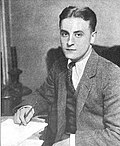
 F. Scott Fitzgerald’s (1896-1940) writing was the major interest in his life. From grade school to his death nothing was quite true to him unless he had written about it. He was a fine writer, and his writing was always about himself or people he was intimate with. As a result his life was inextricably bound up with his work and his life with his kooky and attractive wife Zelda was an interest in itself. He lived a colorful life and a disastrous one with Zelda. They lived like fairy-story hero and heroine, filling newspapers with reports of their wild life-style. Much of the disaster of their lives were of their own making. Fitzgerald is called the creator of the Jazz Age which began with his writing best seller This Side of Paradise at the age of twenty-four, making him rich, his goal for writing it. The book became the voice of the younger hedonistic, thrill-loving, post-World War I generation.
Fitzgerald felt that a person such as himself was happiest if they were rich and had acquired the trappings of wealth and were living “the good life.” In his earlier adult life Fitzgerald saw the “improbable, often the impossible come true. Life was something you dominated if you were any good. Life yielded easily to intelligence and effort. It seemed a romantic business to be a successful literary man.” (Arthur Mizener.)
Fitzgerald felt he could not have chosen any other profession although in the writing trade “you were forever unsatisfied.” In the nineteen twenties the big problems of his life seemed to solve themselves, and if the problems were too tough he ignored them. He strove to make a lot of money from his writing novels and dozens of short stories that were immensely popular, as he did in the early and middle parts of his career. Fitzgerald always lived well beyond his income, troubling his editor Maxwell Perkins for many advances on earnings. He was often confused between writing just for the money and writing high quality literary work. He had a keen understanding of public literary tastes and could profitably write both.
The Crack-Up
Fitzgerald wrote three magazine articles frankly describing his crack-up. His friend Ernest Hemingway advised him against writing them because, he said, they would make Fitzgerald appear weak. The fear of appearing weak was a concern of macho Hemingway, but not of Fitzgerald. Rare is writing so honest about one’s psychological and spiritual problems as Fitzgerald’s revelations in those articles.
For seventeen years things went on marvelously well, and then at thirty-nine Fitzgerald suddenly realized that he had cracked up. He said you can crack up in the mind and can crack up in the body and the nerves. His crack-up was in the nerves where he said there was “too much anger and too many tears.” He said that he had been living a long time “not caring much, not thinking about what was left undone, or of his responsibilities.” He had a sudden instinct that he must go somewhere and be alone for a while. He wrote, “I didn’t want to see people at all. I had seen so many people all my life.” He was seeking “a certain insulation from ordinary cares. I went away and there were fewer people…I felt tired and slept dozens of hours or twenty -four hours at a day.” Sick, he made lists, “hundreds of lists of happy times, baseball plays, popular songs, of pairs of shoes, of women he liked, “and then suddenly, surprising, he said, “I got better.”
In reflection he began to realize “that for two years of my life I had been drawing on resources that I did not possess, that I had been mortgaging myself physically and spiritually up to the hilt. I realized that in those two years…I had weaned myself from all the things I used to love.” He saw that for a long time he had not liked people. He felt that even his love for those closest to him was only an attempt to love them, but was not love. He became bitter about everything he encountered or thought about day and night.
In the article “Putting it Together” Fitzgerald said, “In a real dark night of the soul it is always three ‘o clock in the morning day after day. At that hour the tendency is to refuse to face things as long as possible by retiring to an infantile dream– but one is continually startled out of this by various contacts with the world. One meets these occasions as quickly and carelessly as possible and retires once more back into the dream, hoping that things would adjust themselves by some great material or spiritual bonanza…But as the withdrawal persists one witnesses the disintegration of one’s own personality.”
Fitzgerald said “It was strange to have no self–to be like a little boy left alone in a big house who found he could do anything he wanted, “but found there was nothing he wanted to do.” In a final reflection on his ordeal, his crack-up, Fitzgerald wrote, “A man does not recover from such a jolt–he becomes a different person and eventually the new person finds new things to care about.”
Fitzgerald’s Death
In 1937 Fitzgerald was sick and unable to write and no longer earning royalties. He turned to Hollywood’s film industry. He died at forty-four a modestly paid Hollywood screen writer of mediocre movies. Many critics consider his The Great Gatsby the great American novel many writers have striven to write. The Great Gatsby surprised the literary world by being more substantial than anything Fitzgerald had written before.
© 2025 David J. Rogers
For my interview from the international teleconference with Ben Dean about Fighting to Win, click the following link:
Order Fighting to Win: Samurai Techniques for Your Work and Life eBook by David J. Rogers
Click on book image to order from Amazon.com
or
Order Waging Business Warfare: Lessons From the Military Masters in Achieving Competitive Superiority
Click on book image to order from Amazon.com
or
 All writers are equipped with a good memories, but Thomas Wolfe’s memory was astonishing. Because of it he was able with ease to recall events, people, and places in stunning detail. That was his strength. His weakness was an inability to restrain the deluge of words that poured out of him from evening to dawn as he wrote, or when he spoke, and he simply, despite himself, had no ability to stay within the requirements of writing a saleable novel. He had no concept of how to write such a book and needed the help of his editor, the legendary Maxwell Perkins of Scribner’s, who at the same time was the editor of Ernest Hemingway and F. Scott Fitzgerald, two other difficult clients.
 No writer in the nineteen thirties–or even now–could write with the beauty of Thomas Wolfe’s prose. His reputation after his death suffered because of the perceived formlessness and verbiage of his writing in an age when critics preferred tight structure and economy of language–short sentences and short episodes, and highly-focused scenes rather than the volume and torrents of Wolfe’s language. Once considered by Nobel Prize winners William Faulkner and Sinclair Lewis to be America’s finest writer, and in the past extremely popular with readers and critics, Wolfe is now almost never read–unfortunately in my opinion, if one is interested in being inspired by the brilliance of written expression. Hard as you look, you will not find Thomas Wolfe–once thought a towering genius–in current anthologies of American literature.
 davidjrogersftw