Many poets write poems that contain symbols, allusions, and references that carry the reader outside the poem itself to other information. To understand the poem fully you must analyze and interpret it and perhaps conduct research. Whole long essays are written on someone’s interpretation of what a single poem really means.
My poem in this blog–“Hobos in a Clearing”–is an imagist poem. I am in love with imagery in the arts. My post of that title and a related post have proven to be popular. “Hobos in a Clearing” is constructed of twenty images.
Imagist poems are different from other poems. They require no analysis to understand them, no interpretation, and no research. To find their meaning, all that is necessary is to read the poem. They are like haiku in that way, what in Zen is “a direct pointing at reality.” A tree is a tree in an imagist poem, a mountain is a mountain, and a lovely woman is a lovely woman. The tree, mountain, and the woman do not stand for or represent something else. Imagist poems appeal to the painters and other visual artists who read my blog because imagist poems paint visual pictures in words. The sense they rely on generally is the sense of sight.
Poems cluttered with numerous references, symbols, and allusions seem obscure and difficult to many readers while the imagist poem like “Hobos in a Clearing” is clear and vivid.
The Trip
In the summer of my seventeenth year my friend and I, being romantics and seeking adventure, left our homes on the north side of Chicago and hitchhiked and rode freight trains across America to many cities, towns, and villages from coast to coast, crossing bridges and prairies and lakes, ascending mountains, and acquiring experiences that I would in the future turn into short stories, essays, and poems.
Our First Hobo Camp
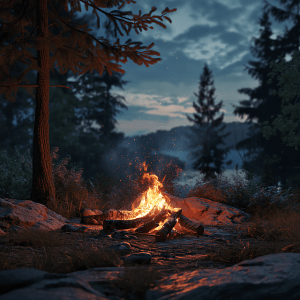 My poem describes the first hobo camp of about three hundred men we came upon, a camp looking like “the camps of infantry.” We went down the hill to meet the men, slept there a few days, ate fried beans, and listened to and took notes about the stories the forgotten men enjoyed telling.
Hobos in a Clearing
We reached the crest of the hill at dusk.
Below us, like the camps of infantry,
Burned the scattered fires of forgotten men,
Each a separate picture.
They lived in the open or in
The opulence of tarpaper
Lean-tos against a tree, and
Migrated as punctually as geese.
They wore black–perhaps it was
The soot of trains–
And squatted on their haunches like crickets
Beside the snapping flames.
Streams of smoke trailed off
High into the trees
And embers flickered and faded,
Flickered and faded
In the harsh bite and sparkle
Of the wind, and glowed bronze
On the men’s untroubled faces
Late into the night.
© 2025 David J. Rogers
For my interview from the international teleconference with Ben Dean about Fighting to Win, click the following link:
Order Fighting to Win: Samurai Techniques for Your Work and Life eBook by David J. Rogers
 Click on book image to order from Amazon.com
or
Order Waging Business Warfare: Lessons From the Military Masters in Achieving Competitive Superiority
 Click on book image to order from Amazon.com
or


 davidjrogersftw