Mining Material in One Segment of Your Experience Is A Key to Success in Writing and Art.
Scott Fitzgerald felt that successful writers have a few events in their lives that steal their mind and 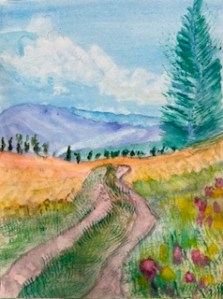 heart and they write about in one form or another time and again. What had occurred in the writer’s life before age twenty-one is the period of their life where most good writers find their richest material. Writer after writer reports that. Exceptional writers have exceptional memories. Their talent to evoke from their memories in exact detail written images of the places, people, and events they recall is remarkable. Artists too may have extraordinary memories and paint visual images of them.
When we were seventeen for adventure and to acquire material for hopefully future careers in creative writing my friend Nick and I crisscrossed the country on freight trains illegally for six months, living the life of wandering hobos before we started college. We were shot at with bullets buzzing past our heads, and chased by police with growling German shepherds snapping at our heels, four dollars to my name. Few people have that experience. It meets the writer’s critical need for originality. You can’t forget the details of an adventure like that. They provided me with material to write a unique book of poetry I titled The Poetry of Riding Freight Trains Across America. and since then other poems and blogs about freight train travel by the two of us. An editor said: “I was hooked from the first poem about that extraordinary world of lost men.”
Hobos in a Clearing
We reach the crest of the hill at dusk.
Below us, like the camps of infantry,
Burn the scattered fires of forgotten men,
Each a separate picture.
They live in the open or in
The opulence of tarpaper lean-tos against a tree,
And migrate as punctually as geese.
They wear black–perhaps it is the soot of freight trains–
And squat on their haunches like crickets
Beside the snapping flames.
Streams of smoke trail off high into the trees
And embers flicker and fade, flicker and fade
In the harsh bite and sparkle of the wind,
And glow bronze on the men’s untroubled faces
Late into the night.
Painter Julian Levi said, “It seems to me that almost every artist finds some subdivision of nature or experience more congenial to his temperament than any other. To me, it had been the sea…In painting the sea coast I have tried to acquire as much objective knowledge of the subject as I possibly could.” Levi studied the fishermen, fishing gear, their boats and assorted paraphernalia. T.S Eliot said, “We all have to choose whatever subject matter allows us the most powerful and most secret release; and that is a personal affair.”
Literary critic Gilbert Murray wrote, “It seems to me that the writers who have the power of revelation are just those who, in some particular part of life, have seen or felt considerably more than the average run of intelligent beings. I think that the great difference intellectually between one painter or writer or one actor or director and another is simply the number of things they can see in a square yard of their specific world of creation.”
Most–not all–artists and writers strive to have an original voice. Writers ask themselves, “What do I have to say or paint that people will find interesting enough to pay X dollars to put in their bookcase or on their wall?”I always ask myself, “Did the book buyer get their money’s worth?”
To find your best creative niche you must ask yourself: “What area of my life do I know better than other artists and writers do, am fascinated by, and wish to write about or paint frequently during my life?” Claude Monet painted his beautiful garden innumerable times. Paul Cezanne painted the rolling hill he could see from his window many times. Edgar Degas painted ballerinas.
Artists I know specialize in painting clouds and others paint skies exclusively. Many artists paint landscapes and birds and flowers. They then work with that specific material, possibly for their entire lives. It is their most creative world, their signature, what we know them by.
It is not a random choice, but a discriminating, highly selective instinct, a particular order of things that has an outstanding appeal to the person. American writers Ernest Hemingway and before him Stephen Crane were drawn to men under extreme pressure where the best way out of danger was through having courage.
Strive For Freedom As Though Only You Exist
William Faulkner became great as soon as he decided that the only person whose opinion he cared about was his own.
Unless they please themselves, artists and writers will please nobody. They function best when while at work they are thinking of nobody’s liking but their own: “I alone here, on my inch of earth, paint this thing for my own sole joy, and according to my own sole mind. So I should paint it, if no other human being existed but myself…Thus I must do it, for thus I see it, and thus I like it.” (John Ruskin.)
© 2026 David J. Rogers
For my interview from the international teleconference with Ben Dean about Fighting to Win, click the following link:
Order Fighting to Win: Samurai Techniques for Your Work and Life eBook by David J. Rogers
Click on book image to order from Amazon.com
or
Order Waging Business Warfare: Lessons From the Military Masters in Achieving Competitive Superiority

Click on book image to order from Amazon.com
or
 My poem describes the first hobo camp of about three hundred men we came upon, a camp looking like “the camps of infantry.” We went down the hill to meet the men, slept there a few days, ate fried beans, and listened to and took notes about the stories the forgotten men enjoyed telling.


 davidjrogersftw